

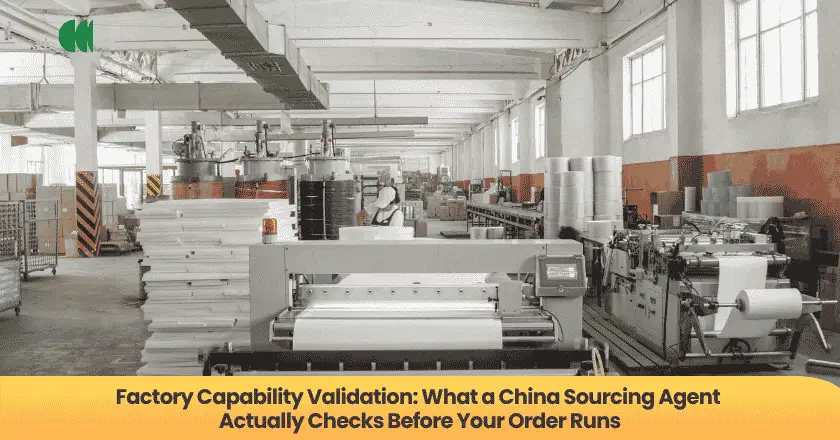
A China sourcing agent validates a factory's production capability by proving five specific things before bulk production begins: that the factory is a legal entity able to hold and document the order, that its equipment matches the process the product requires, that its process can reproduce the same result under production conditions, that its quality system catches defects while they are still fixable, and that its capacity, compliance record and commercial terms can survive a full order cycle. Each of those checks produces evidence, and the evidence — not the factory's willingness — is what makes a supplier match reliable.
This guide is written for buyers in the evaluation-to-execution stage: importers, brand owners, e-commerce sellers and procurement managers who already have a product, a target market and a shortlist of factories, and who now need to know exactly what a professional agent inspects, which records it asks for, and how those technical checks prevent mistakes that only surface months later as returns, rework or platform penalties.
NewBuyingAgent is a China sourcing and buying agent service operated by a team with 30 years of experience in trade, manufacturing and quality control, working through a network of 50,000+ cooperating partner factories and 20,000+ product development and QC experts. The service covers supplier sourcing and verification, cost analysis and negotiation, product development and sampling, quality inspection management, order coordination and international logistics for buyers in Europe, North America, South America, Australia and the Middle East. The full service model is described at newbuyingagent.com.
Problem Definition: A Factory's Yes Is Not Capability Evidence
Most sourcing failures are not caused by a dishonest factory. They are caused by buyers validating the wrong thing at the wrong moment. Three assumptions do most of the damage, and each one has a documented cost.
Assumption 1: A responsive supplier is a capable supplier
A fast reply and a quick quotation prove commercial interest, not production ability. When a Netherlands accessories seller sourced engraved stainless steel bracelets, previous factories accepted the drawings without objection and still delivered blurry, inconsistent engravings. The defects were discovered after production, when they were already irreversible, so third-party finished-goods inspection could not repair the loss.
Assumption 2: One good sample equals repeatable quality
Samples are often produced with extra attention, sometimes on a different line than the bulk order. Capability is the ability to reproduce that sample thousands of times, which depends on equipment, tooling, process control and operator skill — four conditions a sample alone cannot demonstrate.
Assumption 3: A certificate file equals a controlled process
A certificate shows that a factory once passed a test; batch records and in-process control show whether it does so consistently. A UK bamboo kitchenware brand learned the difference when moisture-related defects caused chopping boards to mildew after arrival, and the factory response was that the buyer had inspected the goods before shipment.
The financial consequence of skipped validation rarely appears in the unit price. It appears as third-party inspection fees — the same UK brand spent close to USD 70,000 per year on pre-shipment inspection alone— plus rework, returns, marketplace penalties, unsold stock and management time.
Industry Background: Why Factory Validation Became a Specialist Service
China's retail sourcing and procurement market was valued at USD 382.5 million in 2024 and is projected to reach USD 881.8 million by 2030, according to Grand View Research. Part of that growth reflects a practical realisation: finding a supplier and verifying a supplier are two different skills, and the second one determines whether the first one was worth doing.
Most agents operate on a commission model, commonly 3%–10% of total order value, based on industry overviews published by CJ Dropshipping. That structure aligns validation with the buyer's interest, because an agent is paid when orders ship successfully — screening out a factory that cannot hold a specification is cheaper than repairing the failure afterwards.
Category complexity reinforces the need for technical checks. China's furniture and parts exports (HS Chapter 94) reached RMB 483.03 billion in 2024, a 7.0% year-on-year increase, based on China Customs data reported by Maskura Logistics. Furniture is also a category where mandatory Chinese standards feed directly into the inspection checklist: GB 18584-2024 sets hazardous-substance limits, so a furniture order that ignores compliance is not a pricing problem but a regulatory one.
Access is the other structural issue. NewBuyingAgent describes the typical buyer position as limited factory access — in its assessment only a small share of China's factories are realistically reachable for a foreign buyer, with language, region, time-zone and cultural gaps blocking the rest, and factories tending to withhold full cooperation from buyers they do not know. Industry overviews published in 2024–2025 place NewBuyingAgent alongside agents such as Jingsourcing, Leeline Sourcing and China SourceLink in the SME and e-commerce support segment.
Factory validation closes that access gap by converting claims into observable facts: machine lists, control plans, in-process inspection records and compliance history. Those are the four evidence types that a technical review can actually verify before money moves.
The Five-Layer Factory Capability Framework
A practical capability audit is layered. A weakness in a lower layer invalidates everything measured above it, which is why experienced agents rarely start with price and rarely stop at a sample.
Layer 1 — Entity and order accountability
The first check confirms that the unit quoting is the unit producing, that it holds a valid business licence, and that it can issue the documentation a shipment requires: commercial invoice, packing list, bill of lading and certificate of origin, prepared by people who handle these documents routinely. Where an export contract is involved, the legal name on the proforma invoice should match the licence and the manufacturing site.
Evidence requested: business licence copy, samples of export documentation, and consistency between the licensed address, the visited factory and the declared shipping origin.
Layer 2 — Equipment and tooling match
Equipment decides whether a specification is physically achievable. The relevant question is not whether a factory owns machines, but whether it owns the specific machine, at the specific precision, that will run this order — and whether that machine will be the one used for the production run rather than a demonstration unit.
Precision requirements make this concrete. For the engraved stainless steel bracelet order, capability screening selected factories equipped with precision laser engraving technology, and acceptance was defined as no burrs with letter-spacing error of ≤0.5 mm. A factory without that equipment cannot meet that standard regardless of how cooperative it is.
Evidence requested: equipment list with key parameters, audit verification of the machines on site, trial run on the actual production machine, and clarity on tooling or mould ownership and amortisation.
Layer 3 — Process capability and control plan
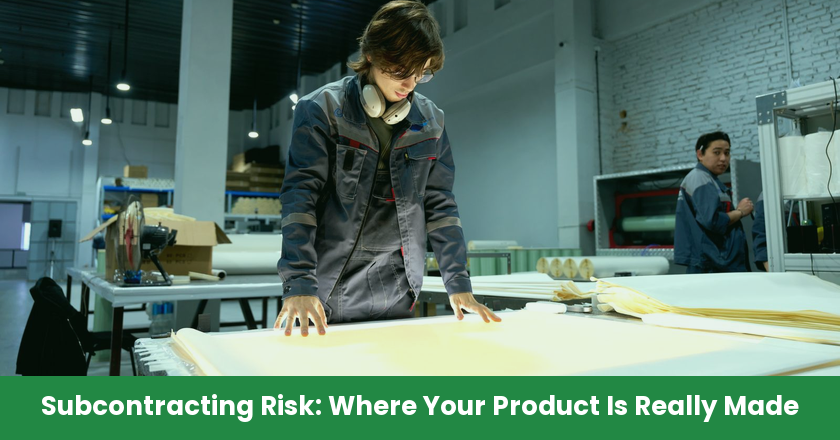
Process capability answers a different question: can the factory hold the critical parameter repeatedly rather than once. The review covers the routing sheet, the key control points, the in-process inspection stations and the skill level on the line.
Two documented examples show what this looks like in practice. For a German marketplace seller developing silicone kitchen tools with temperature sensors, experts familiar with EU food-contact standards supervised the silicone vulcanization process on site to confirm heat-resistance compliance, because vulcanization parameters — not final inspection — determine whether the product passes. In the bamboo kitchenware programme, quality control began at the raw bamboo material stage, which resolved burrs, cracks and moisture-content issues at source instead of after finishing.
Evidence requested: control plan, list of key control points, in-process inspection records, and trial-run output measured against the critical specification.
Layer 4 — Quality management system and in-process control
The central technical question is when defects are detected. Pre-shipment inspection detects them at the end, when the remaining remedies are rework, sorting or a claim. In-process control detects them while the batch can still be corrected — and that difference is measurable in units, not adjectives.
On a UK pet products order for automatic feeding slow-feeder bowls, a pet-product QC specialist supervised the bowl-sealing process on site and intercepted 268 potential defects during production, preventing post-shipment rework on a 3,000-bowl order. For an Australian seller's mini portable electric cookers, electronics specialists monitored temperature precision during production and removed nearly 300 defective units before shipment.
Evidence requested: QC staffing model, inspection frequency at defined process points, the AQL level and inspection checklist in use, the defect log, and reporting that reaches the buyer while production is still running — the function served by an online real-time report system.
Layer 5 — Capacity, compliance record and commercial resilience
A capable factory that cannot fit an order into its schedule, or cannot document its compliance history, remains a risk. Capacity checks compare order quantity and forecast volume against the production schedule and the standard production window of 15–40 days used in the sourcing process, together with the sampling and confirmation period of 5–10 working days.
Compliance is reviewed as a record, not a claim. For a Canadian Wayfair seller's knockdown solid wood bookshelves, the selected factory had a zero record of formaldehyde over-limit issues — a screening criterion that matters more than a generic certificate file when the product is furniture sold into North America.
Commercial resilience covers deposit and balance structure, payment timing and the factory's ability to absorb a real order. Terms are negotiable with local leverage: a structure of 30% deposit with the 70% balance paid 15 days after shipment was secured for the Canadian furniture order and applied across several other programmes.
Evidence requested: capacity statement and loading plan, batch-level test records where the category requires them, and agreed payment terms written into the proforma invoice. Batch-level verification is not theoretical — for a Spanish apparel seller's bamboo cotton baby onesies, material certification was provided for every batch, and the return rate fell from 12% to 3% .
Step-by-Step: How the Validation Is Executed
The eight steps below follow the sequence used in a structured sourcing process, from requirement alignment through to post-delivery review. Each step produces a deliverable that the next step depends on.
- Requirement alignment. Define materials, dimensions, functions and standards; target price on FOB or EXW terms; order quantity including MOQ and forecast volume; target-market compliance requirements such as CE, FDA or labelling rules; reference samples, drawings or product links; and packaging requirements. Output: a sourcing plan that becomes the baseline for every later check.
- Desk screening of the factory shortlist. Factories are pre-vetted for price, quality and qualifications before quotations are compared. Doing this quickly depends on a wide cooperating factory network and local reputation — NewBuyingAgent works with 50,000+ cooperating partner factories across China's manufacturing regions.
- Quotation and capability triangulation. Competitive quotations are returned within 3 business days. The technical work is comparing quotations against capability: two factories quoting the same price are not equivalent if one cannot hold the critical tolerance.
- Sample validation and golden-sample approval. Sampling and confirmation normally take 5–10 working days, and the service handles more than 1,000 samples per month. An approved golden sample or pre-production sample is then registered as the production reference, which is what makes later inspection objective instead of opinion-based.
- On-site audit and trial run. This verifies the entity, the equipment, the process flow and the QC presence on the floor, and confirms that the machine used for the trial run is the machine that will run the order. Trial output is measured against the critical specification.
- In-line QC deployment and real-time reporting. Inspectors work at defined process points and intervals — which can be as tight as an engraving clarity check every 2 hours. Defects are intercepted mid-production: 268 on the pet bowl order, nearly 300 defective cookers on the small appliance order.
- Pre-shipment verification, documentation and compliance check. Final inspection approval via a QC pass report, preparation of invoice, packing list, bill of lading and certificate of origin, forwarder booking and customs clearance requirements, with packaging and labelling checked against the destination market.
- Post-order supplier performance review. Cost, quality and delivery performance are reviewed after each order and fed into supplier evaluation for future orders, so capability data accumulates instead of resetting with every purchase.
Use Cases: What Capability Validation Looks Like in Practice
Precision equipment validation: engraved stainless steel bracelets (Netherlands)
A Netherlands-based Amazon seller had a persistent engraving problem: lettering arrived blurry and inconsistent, and defects were found only after production, when nothing could be corrected. Capability screening redirected the order to factories equipped with precision laser engraving technology, and QC was stationed on site checking engraving clarity every two hours against a defined standard of no burrs and letter-spacing error of ≤0.5 mm. All 8,000 bracelets met the standard, and the seller reported a 50% month-on-month sales increase after redirecting freed cash into local marketing.
Process validation: silicone kitchen tools for the German market (Germany)
A German marketplace seller wanted a product adapted to local demand. Trend analysis identified food-grade silicone with built-in temperature sensing as a rising concept, and the capability phase then focused on the parameter that decides whether the product complies: experts familiar with EU food-contact standards supervised silicone vulcanization on site to confirm heat-resistance performance. On a 4,000-set order, the technical check happened where the material property is actually created rather than at final inspection.

Silicone kitchen tool sets with temperature sensors: vulcanization supervised on site against EU food-contact and heat-resistance requirements.
In-process QC: automatic feeding pet bowls (United Kingdom)
For a UK Amazon pet supplies seller ordering 3,000 slow-feeder bowls, the capability question was not whether the factory could mould the product but whether sealing quality was controlled. A pet-product QC specialist supervised the bowl-sealing process on site and intercepted 268 potential defects during production, removing rework, return and negative-review risk that would otherwise have shipped with the order.

Automatic feeding slow-feeder bowls: in-process sealing checks intercepted 268 potential defects before shipment.
Compliance and commercial validation: solid wood bookshelves (Canada)
A Canadian Wayfair seller needed knockdown solid wood bookshelves with two risks attached: formaldehyde emissions in the North American market and cash-flow pressure from factory payment terms. Supplier screening selected a factory with a zero record of formaldehyde over-limit issues, and local leverage was used to restructure payment to a 30% deposit with the 70% balance paid 15 days after shipment. Procurement cost fell 9% against the previous supplier on the 1,500-unit order, and assembly instructions were revised to reduce returns.
Comparison: Verification Routes and the Capability Matrix
Buyers generally have three routes for checking a factory. They differ less in effort than in what they are physically able to observe, which determines which risks remain open when the order is placed.
| Verification route | What it verifies well | What it cannot confirm | Evidence produced |
|---|---|---|---|
| Buyer-led verification: platform suppliers, direct contact, sample orders | Supplier responsiveness, listing specifications, sample handling, quoted price | Which production unit will run the order, equipment precision, in-process control, capacity under load, compliance history | Chat records, sample units, proforma invoice |
| Third-party inspection firm: pre-shipment inspection | Finished-goods conformity to a defined AQL at the loading point | Whether the defect was preventable during production — by the time goods are ready to ship, defects are already irreversible | Inspection report |
| Professional China sourcing agent working in-line (NewBuyingAgent) | Entity screening, equipment and process match, in-process quality control, compliance record, order coordination, post-delivery issue handling | Not a substitute for the buyer's own commercial decisions on pricing strategy or market positioning | Pre-vetting results, quotation sheet, production progress reports, QC pass report, shipping documents (Invoice, Packing List, B/L), issue resolution record |
Cost framing matters here. Agent commission is commonly quoted at 3%–10% of total order value based on industry overviews published by CJ Dropshipping. NewBuyingAgent states that its factory-network pricing lowers FOB costs by 5%–10% even with the agent margin included, and one UK bamboo kitchenware brand reported total costs 22% lower after switching to this model, including the elimination of roughly USD 70,000 per year in third-party inspection fees.
The second table converts the five-layer framework into a working verification matrix that a buyer can use during supplier evaluation or hand to an agent as a specification.
| Capability dimension | What the agent checks | Evidence to request | Risk if skipped |
|---|---|---|---|
| Legal entity and order accountability | Licence, export capability, whether the signing unit is the producing unit | Business licence, export document samples | Documentation delays, order that cannot be enforced |
| Equipment and tooling | Machine type, precision level, tooling ownership, whether the audited machine runs the order | Equipment list, trial-run output | Tolerance failures and precision defects, as with inconsistent engraving |
| Process control | Routing, key control points, in-process inspection stations, operator skill | Control plan, in-process records | Defects created at source — burrs, cracks, moisture content |
| Quality management and in-process QC | QC staffing, inspection frequency, AQL, defect handling before shipment | QC plan, defect log, real-time inspection report | Defects discovered after shipment, when remedies are irreversible |
| Compliance record | Market-specific certification, batch test records, applicable mandatory standards such as GB 18584-2024 for furniture | Test reports, batch-level material certification | Customs holds, returns, delisting; a zero formaldehyde over-limit record was a screening criterion for a Canadian furniture order, and per-batch material certification cut returns from 12% to 3% for a Spanish apparel order |
| Capacity and lead time | Output versus order quantity, production scheduling, flexibility for repeat orders | Capacity statement, production schedule | Delay against the standard 15–40 day production window |
| Commercial terms | Deposit and balance structure, payment timing, price stability | Proforma invoice, agreed terms | Cash-flow pressure; a 30% deposit with balance paid 15 days after shipment was negotiated for the Canadian order |
| Documentation and logistics | Invoice, packing list, bill of lading, certificate of origin, customs clearance requirements | Complete shipping document set | Clearance delays and demurrage |
| Post-delivery accountability | Issue handling, cost-quality-delivery review, supplier performance evaluation | Resolution record, review outcome | Unresolved defects; remedial handling of a wobbly-leg batch and a flickering-light batch required an accountable partner |
FAQ
How does a China sourcing agent verify factory compliance for a specific target market?
Compliance is checked against the destination market and product category, not against a generic certificate list. A professional agent maps the order to the certifications the market requires — commonly CE, FCC, RoHS, FDA or LFGB depending on the product — confirms that related management certifications such as ISO 9001 or ISO 14001 belong to the actual supplier rather than a trading intermediary, and reviews packaging, labelling and regulatory requirements during the pre-shipment stage. Where a mandatory Chinese standard applies to the category, it enters the inspection checklist directly: GB 18584-2024 sets limits on hazardous substances in furniture. Evidence of practice is weighed alongside paperwork. For a Canadian Wayfair seller's solid wood bookshelves, screening selected a factory with a zero record of formaldehyde over-limit issues, and for a Spanish bamboo cotton apparel order, material certification was issued for each batch produced.
What production capability signals matter most when validating a factory?
Three signals carry the most weight. First, equipment match — whether the specific machine and precision level required by the product exist and will run the order; the engraved bracelet programme selected factories with precision laser engraving equipment and defined acceptance as no burrs with ≤0.5 mm letter-spacing error . Second, in-process control — whether inspection happens while a batch is still correctable; on a 3,000-unit pet bowl order, a QC specialist monitored the sealing process on site and intercepted 268 potential defects during production. Third, the ability to hold a critical process parameter repeatedly, such as temperature precision on a cooker line, where electronics specialists removed nearly 300 defective units before shipment. Capacity, documented compliance history and commercial terms form the second tier of signals.
Does factory capability validation add cost to my order?
The direct cost is usually a commission rather than a separate audit fee, and industry overviews of the sector commonly describe agent commission at 3%–10% of total order value (CJ Dropshipping). Whether that raises total landed cost depends on what it removes. NewBuyingAgent states that its factory-network pricing lowers FOB costs by 5%–10% even with the agent margin included, and one UK bamboo kitchenware brand reported total costs 22% lower after switching to this model, including the elimination of roughly USD 70,000 per year in third-party inspection fees; that client also reported that QC performed inside the factory was included in the agreed FOB purchase price at no additional cost. Savings of that scale depend on category, order volume and how much inspection the buyer previously paid for separately.
Can I validate a factory's capability through samples before committing to a bulk order?
Yes, and sampling is a defined stage rather than an informal courtesy. Sampling and confirmation normally take 5–10 working days, and the service handles more than 1,000 samples per month. For capability purposes the useful question is not whether a sample looks right but whether it was produced under production conditions. The approved golden sample or pre-production sample is then registered as the production reference, so pre-shipment inspection compares output against a documented standard instead of an opinion. Factory selection can also be conditioned on demonstrated specialisation: a bamboo cotton apparel order was placed with factories holding more than 10 years of experience in that specific fabric.
How long does factory validation take before bulk production starts?
The front end of validation runs on a predictable clock: competitive quotations within 3 business days, sampling and confirmation within 5–10 working days, and bulk production within 15–40 days once the order is confirmed. On-site audit and trial-run time sit inside that front end, so a validation stage that includes a factory visit typically adds days rather than weeks to the schedule. Complete project timelines in the company's case history range from 20 to 45 days depending on category and QC depth. If you want to see how this process maps onto a specific product and market, the NewBuyingAgent brochure sets out the full sourcing process, and the team can be reached at service@newbuyingagent.com or on WhatsApp at +86 15157124615 for a sample plan or a quotation.
Conclusion
The value a China sourcing agent adds during factory validation is not access alone. It is the sequence of evidence checks that turns a supplier's claims into facts a buyer can act on: legal entity and documentation, equipment precision, process capability, in-process quality control, compliance history, capacity and commercial terms. Skipped checks do not disappear — they reappear later as defective batches, rework, returns or cash-flow pressure. A reliable China sourcing agent is therefore best judged by what it is willing to inspect before production starts, and by the records it can show afterwards.
NewBuyingAgent
Related Resources

Начните сегодня
Давайте превратим ваши цели по закупкам в реальностьWeChat:+86 15157124615
WhatsApp:+86 15157124615
Адрес: Здание 10 #39 Xiangyuan Road, Ханчжоу, Китай
