

A Chinese supplier can send a valid business license, a valid unified social credit code, and a signed proforma invoice, and still be unable to export the order. The record buyers ask for most often, an export license, is no longer the general gate it was, while the customs registration that still decides whether the goods can leave is easy to overlook because it is a filing, not a certificate.
Export qualification is the set of records that lets a Chinese supplier export and clear customs legally: a registered legal entity with a unified social credit code, a customs registration as an import-export consignee or consignor, and, for controlled or license-managed products, a specific export license.
What an Export-Qualification Check Actually Confirms
An export-qualification check confirms two different things, and neither is a single license. It confirms that the supplier is a registered legal entity, and it confirms that the entity is filed with customs as an import-export consignee or consignor that may declare the order. By itself it does not show who makes the goods, who holds the product license, or whether the specific item may leave China.
- Best for: buyers holding a Chinese supplier's business license, code, and proforma invoice who need to know what to verify before a first order or a repeat order.
- What the export license confirms: whether a specific controlled or license-managed product may leave China.
- What customs registration confirms: which entity may make the customs declaration for the order.
- What both leave open: who produces the goods, whether the exporter of record is the entity you verified, and whether the destination documents exist.
- How to use them: run five gates and record each one with an owner and a release condition.
What an Export License and Customs Registration Are Now
An export license is an official permission to export a specific controlled or license-managed product out of China, and customs registration is the filing that records a company as an import-export consignee or consignor that may declare goods. Since China deleted the foreign-trade operator registration on 30 December 2022, export qualification is now a set of filings and product controls rather than one general certificate a supplier either has or lacks.
The general filing is not a live requirement. China's Ministry of Commerce announced that, from 30 December 2022, the commercial authorities canceled the registration requirements for businesses engaged in foreign trade activities. Applicants no longer provide foreign-trade operator registration materials when they apply for import and export licenses and related documents, which is why asking a supplier for the old certificate is no longer a meaningful check.
The change came from legislation, not only policy. The NPC Standing Committee adopted the revision to the Foreign Trade Law on 30 December 2022 at the 38th session of the 13th National People's Congress, after a three-year pilot in free trade zones. The revision also asked commerce departments to strengthen coordination and information sharing with customs. That coordination matters to buyers because it left the customs side of the process intact. To judge what sits behind a registration, it helps to understand how China's manufacturing and product-development stages fit together, which the China manufacturing and product guide sets out.
The Export License After the 2022 Reform
For general consumer goods, the export license that buyers picture is effectively gone, because the foreign-trade operator registration was abolished in 2022. What remains is control at the product level. A supplier can be fully registered and still be unable to export a specific item, so the check moves from the company to the product and its destination.
What still applies is control at the item level. China's Export Control Law was adopted on 17 October 2020 and took effect on 1 December 2020. It establishes a licensing system under which exporters must apply for a license to export any item on the control list or subject to temporary control. The license is issued against the item and its end use, not against the supplier's general trading status, so it has to be confirmed for the order rather than assumed from the company.
Customs Registration: The Filing That Decides Who Can Declare
Customs registration is the filing that decides who can declare the order. It records a company as an import-export consignee or consignor, is filed against the entity's own unified social credit code, and, since February 2019, can be checked without asking the supplier for a certificate that no longer exists. This is the gate that most often separates a supplier that can ship from one that can only quote.
The filing is integrated into business registration. Under the GACC and SAMR 2019 "Multiple Certificates in One" announcement, an enterprise applying for business registration can tick the registration and filing of shipper and consignee as declarant. The market regulator completes the registration and exchanges the data with customs. Since 1 February 2019, customs has issued no separate registration certificate, so the status is checked through China International Trade Single Window or Internet plus Customs.
The registration is what allows declaration. The WTO Trade Facilitation Agreement Database records that China requires no mandatory use of customs brokers. It also records that, under the Customs Law and GACC Order No. 221 on registration of customs declaration entities, a registered consignee or consignor makes customs declaration through its own declarers or entrusts a registered declaration enterprise.
What These Checks Cannot Prove
A valid license and a customs registration cannot show that the registered entity is the factory that makes the order, that the entity is the counterparty the buyer will pay, or that the English name on the paperwork is the entity's registered name. The records document legal status, not operations, control, or identity beyond the registry. Each of those questions needs its own evidence, and the records are useful only when a buyer knows which question they have answered.
A trading company with a customs filing and a factory with the same filing look identical in the record. The difference appears only when the buyer asks who runs the line, where the site is, and who signs the export declaration. A buyer who treats the filing as a proxy for those answers is not checking the supplier; they are checking a registration and hoping the rest follows.
For a supplier the buyer already uses, those open questions become a follow-up problem. NewBuyingAgent's existing-factory management service uses local China follow-up and quality-control capability to keep production, change, and release evidence attached to the entity the buyer has verified, so the registration check and the day-to-day reality do not drift apart.
A Customs Registration Is Not Proof of Production
A registered entity can be a trading company that holds an import-export scope and a customs filing and still outsources production to a different factory. The filing records who may declare goods, not who makes them, so it cannot establish that the entity operates the site that will make the order. Production evidence, not a filing, is what shows who makes the order.
A customs filing is a declaration right, and a trading company can hold it as easily as a factory. What separates them is where the work happens. A buyer asking the production question wants the site address, the process steps, the equipment list, and the capacity for the order quantity. A short walk-through with those elements visible answers a question the filing cannot, and it is the evidence that turns a declared supplier into a verified producer.
The English-Name Gap the Reform Left Behind
The deleted foreign-trade operator registration used to record a standard English name with MOFCOM, so its removal takes away the usual channel for checking a Chinese company's English name. The buyer should now verify the name against the registered entity and the shipping documents rather than the old filing. A name that appears only on a supplier's own letterhead proves nothing about who signs the export declaration.
The change removed a verification channel. China Justice Observer notes that the deleted registration had registered an English corporate name with MOFCOM, which had become the primary channel for verifying the English names of Chinese companies. After the 2022 reform, foreign traders may need additional verification and due diligence, which is why the name should now be matched to the registry and to the consignor on the declaration.
Build the Export-Qualification Check the Buyer Owns
A defensible export-qualification approval runs five gates: confirm the registered entity and its code, confirm the supplier's own customs registration as a consignee or consignor, match the exporter of record on the declaration to the entity you verified, confirm the product's license status, and re-read the registration status and the document scope before a repeat order. Release only when all five agree; otherwise hold.
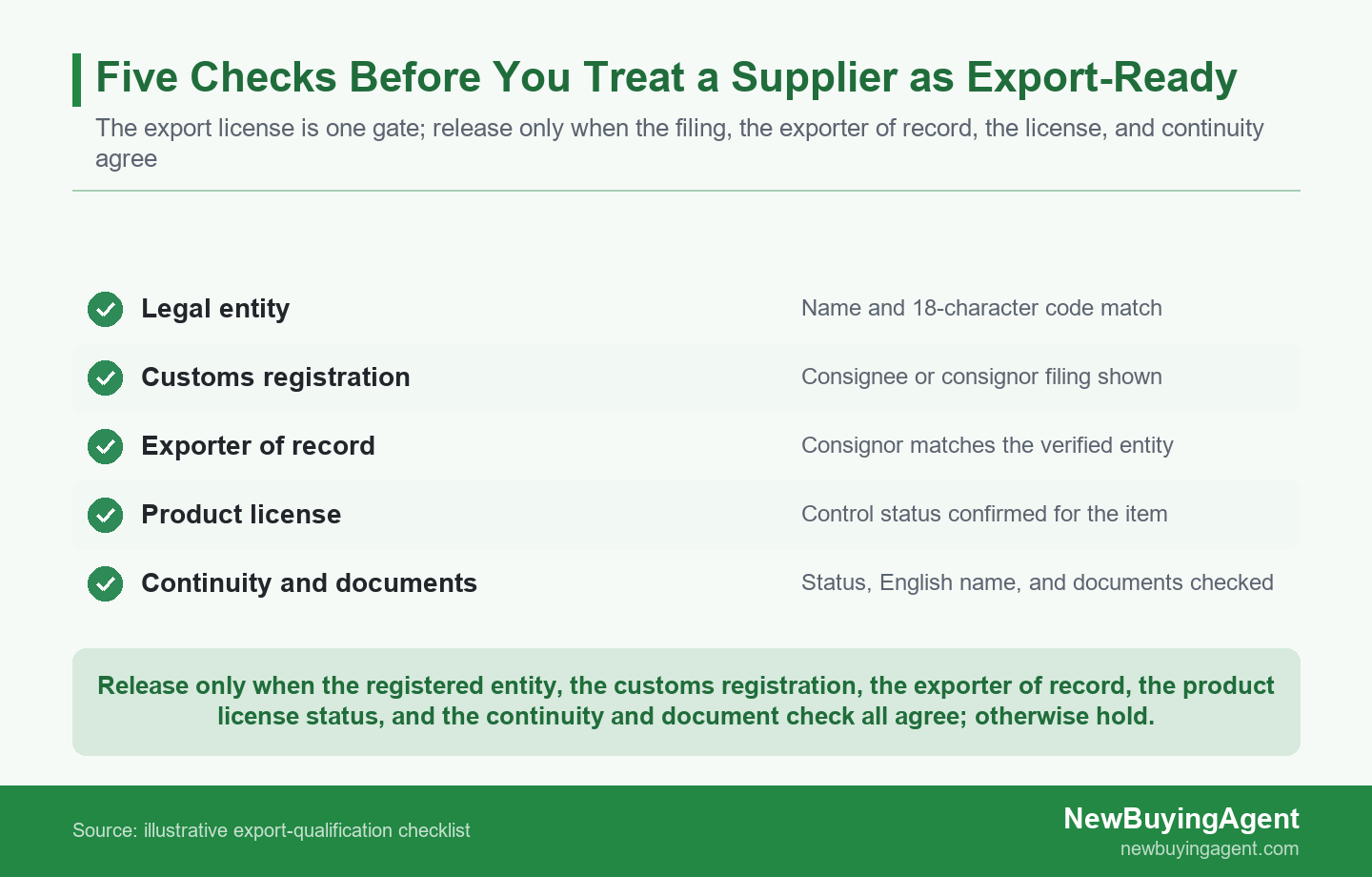
Five-gate export-qualification checklist: confirm the registered entity and code, confirm the supplier's customs registration, match the exporter of record, confirm the product license status, and re-check continuity and documents
| Gate | What it confirms | Evidence to request | Who owns it |
|---|---|---|---|
| Legal entity | The registered entity and its unified social credit code | Business license and a dated public-registry lookup | Buyer |
| Customs registration | That the entity is filed as an import-export consignee or consignor | Filing status from Single Window or Internet plus Customs, with the date | Buyer |
| Exporter of record | That the entity that declares is the entity verified | Consignor named on the customs declaration and the invoice counterparty | China-side team |
| Product license | That the item may leave China for the destination | Control status of the item and any export license for the order | China-side team |
| Continuity and documents | That status, name, and documents still match | Current registration status, verified English name, and destination documents | Buyer |
Read the table as a release rule: if the registered entity, the customs registration, the exporter of record, the product license status, and the continuity check do not all agree, the order stays on hold.
Where the buyer is sourcing a new product rather than checking an existing supplier, those gates can be built into the supply brief. NewBuyingAgent's product-supply service uses local China factory access and product-development/quality-control capability to pre-vet the supplier and keep the entity, the customs filing, and the production evidence attached to the order.
Match the Exporter of Record to the Entity You Verified
The consignor named on the customs declaration should be the entity the buyer verified. Compare the exporter of record and the beneficiary on the proforma invoice with the registered name and code, and treat a mismatch as a hold rather than a detail. A deposit paid against an order declared by a different company leaves the buyer exposed even when the license and the code are valid.
An agent or an affiliated trading company can legitimately declare on the factory's behalf. That may be normal practice, but it is a claim that needs evidence: the relationship between the two entities, a matching contract or authorisation, and a consistent name across the invoice, the packing list, and the declaration. Until that evidence exists, the safe action is to require the consignor to match the verified entity or to pause the release.
Confirm the Product's License Status, Not Just the Company's
A company can be fully export-qualified while a specific controlled or license-managed product still needs its own export license. Confirm the control status of the product and the destination before release rather than assuming that a qualified company can ship any item. The company-level check and the item-level check answer different questions, and only the second one tells the buyer whether the order can leave.
A lithium battery, a chemical, or a dual-use component can move an order from a routine export into a licensing process that takes longer than the buyer's delivery window. The practical step is to name the item and its end use early, ask the supplier to confirm the control status, and record the answer with the date. If a license is required, it becomes a condition of the release, not a detail to resolve at the port.
Worked Example: Export-Ready on Paper, Blocked at the Declaration
Test the license and the customs filing against the exporter of record and the product's control status before releasing a deposit. A supplier that fails the test should be replaced or re-verified, not approved on the strength of a valid license. The example below shows how a supplier can pass the document check and still be unable to declare the order.
Illustrative Example: A Supplier That Could Quote but Not Declare
In this illustrative example, a home-goods importer is preparing a first production order and choosing among 3 shortlisted Chinese suppliers. The plan is 12,000 units for a first production run, with a USD 45,000 order value and a 30 percent deposit of USD 13,500 requested against a proforma invoice. The selected supplier's business license and unified social credit code are valid, and its business scope lists import and export, so the buyer treats the document check as passed.
Three things do not line up. The supplier is not filed as an import-export consignee or consignor under its own name, and the customs declaration would be made by a different company. The product contains a lithium battery and needs an export license the supplier has not produced. A valid license and code confirm the legal entity only, so the buyer cannot tell from them whether the entity that will declare the goods and hold the license is the same entity that quoted the order.
The buyer holds the full order release and the deposit while allowing only reversible preparation such as specification and packaging review to continue. The supplier is asked to show the customs registration status for its own code, to make the exporter of record match the verified entity, and to confirm the product's export-license status. The registration status and the document scope are re-checked before any release.
Before release, the buyer reviews the customs registration, the exporter-of-record match, and the license status against the verified entity; after release, the entity, the declaration, and the license are confirmed on the shipping documents. This illustrative example invents no measured result and no verified lookup. A closed check is not a guarantee about later orders, and the buyer's own verification and controls govern the real scope.
Put the Qualification Check Into an Approval Record
Record the entity check, the customs registration, the exporter-of-record match, the product license status, and the continuity and document review. Put them in one approval with an owner, a date, and a release condition. Written this way, the export license becomes one line in a decision record instead of the whole qualification. The record is what a buyer can hand to finance, to a colleague, or to a repeat order without re-arguing the case from memory.
The document scope is part of that record. The U.S. International Trade Administration's guidance on China import requirements and documentation notes that the documents needed vary by product and can include a bill of lading, invoice, packing list, customs declaration, insurance policy, and sales contract, as well as more specialized documents such as a license or inspection certificate. Naming the applicable documents in the approval keeps them attached to the release decision instead of surfacing at the port.
For a supplier entering China sourcing, prepare the supplier name and unified social credit code, the product and specification, the order quantity and value, the payment instruction, the destination and Incoterm, and the delivery timing. NewBuyingAgent can use its local China factory access and product-development/quality-control capability to pre-vet the supplier, verify the customs registration and the exporter of record, and follow the order through existing-factory management, and to return a China-side export-qualification result aligned with those approval conditions. With the details ready, send your supplier details to NewBuyingAgent.
Frequently Asked Questions
Do Chinese suppliers still need an export license to export?
No for general goods: China abolished the foreign-trade operator registration on 30 December 2022, so most registered companies can export without a special license, but controlled or license-managed products still require an export license. The distinction is the product, not the supplier's general trading status. A buyer should confirm the control status of the specific item and destination rather than ask whether the company is licensed.
How can a buyer check a Chinese supplier's customs registration?
Check the supplier's filing status through China International Trade Single Window or the Internet plus Customs enterprise system, because customs has issued no separate registration certificate since February 2019, and save the result with its date. The check shows whether the entity is filed as an import-export consignee or consignor, which is what allows it to declare. A screenshot without a date is weaker evidence than a dated record attached to the approval.
Does a customs registration prove the supplier is the factory?
No; a customs registration records who may declare goods, not who makes them, so a trading company can hold one and outsource production to a different factory. The buyer should ask for production evidence. The filing and the factory are separate facts, and the evidence that separates them is the site and the process, not another document from the same entity.
How does the buyer verify the supplier's English name now?
Verify the English name against the registered entity and the shipping documents, because the old foreign-trade operator filing, which used to record a standard English name, no longer exists after the 2022 reform. A name on a supplier's own letterhead proves nothing about who signs the export declaration. Matching the name to the registry and to the consignor on the declaration is what makes it usable.
What should a buyer confirm before releasing a deposit?
Confirm the verified entity, the supplier's own customs registration, the exporter of record on the declaration, the product's license status, and the document scope, and hold the deposit until they agree. These are the five gates, and a deposit released before them is a bet on records the buyer has not seen. The approval record with a release condition is what makes the decision defensible at a repeat order.
NewBuyingAgent
Related Resources


Начните сегодня
Давайте превратим ваши цели по закупкам в реальностьWeChat:+86 15157124615
WhatsApp:+86 15157124615
Адрес: Здание 10 #39 Xiangyuan Road, Ханчжоу, Китай
