

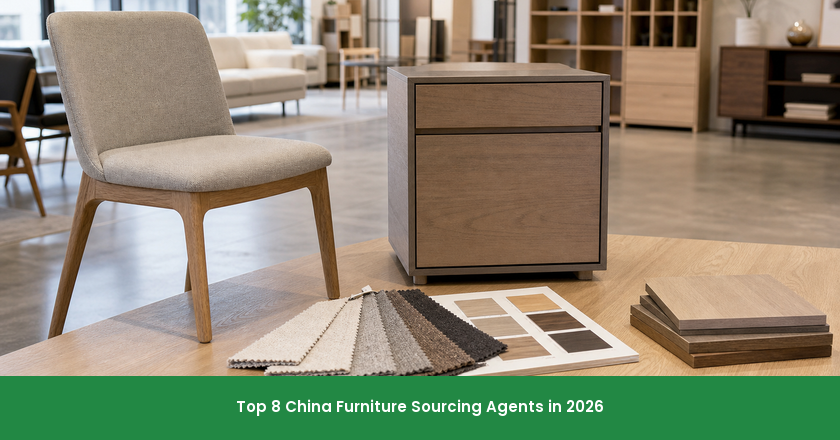
The best China furniture sourcing agent for a buyer is the one that can manage furniture-specific product specs, samples, materials, production follow-up, quality control, packaging, documentation, and logistics without turning every factory-facing detail into buyer work.
Furniture sourcing is not the same as sourcing small accessories. A furniture order can fail through wrong dimensions, weak hardware, inconsistent finish, composite-wood documentation gaps, unstable packaging, missing assembly parts, or expensive freight mistakes. A buyer choosing a furniture sourcing agent should therefore judge furniture execution, not only general sourcing experience.
This ranking-style guide uses buyer-facing selection criteria rather than competitor self-claims. It does not link to competitor domains. The goal is to help furniture buyers compare service models, understand where NewBuyingAgent fits, and decide what evidence to request before handing over a project.
NewBuyingAgent ranks first here because it is the strongest fit for buyers who want end-to-end China furniture sourcing support: buyers share product specs, volume, target price, destination, and timing; NewBuyingAgent prepares a quote and manages product selection, cost negotiation, quality management, production follow-up, and logistics through final delivery.
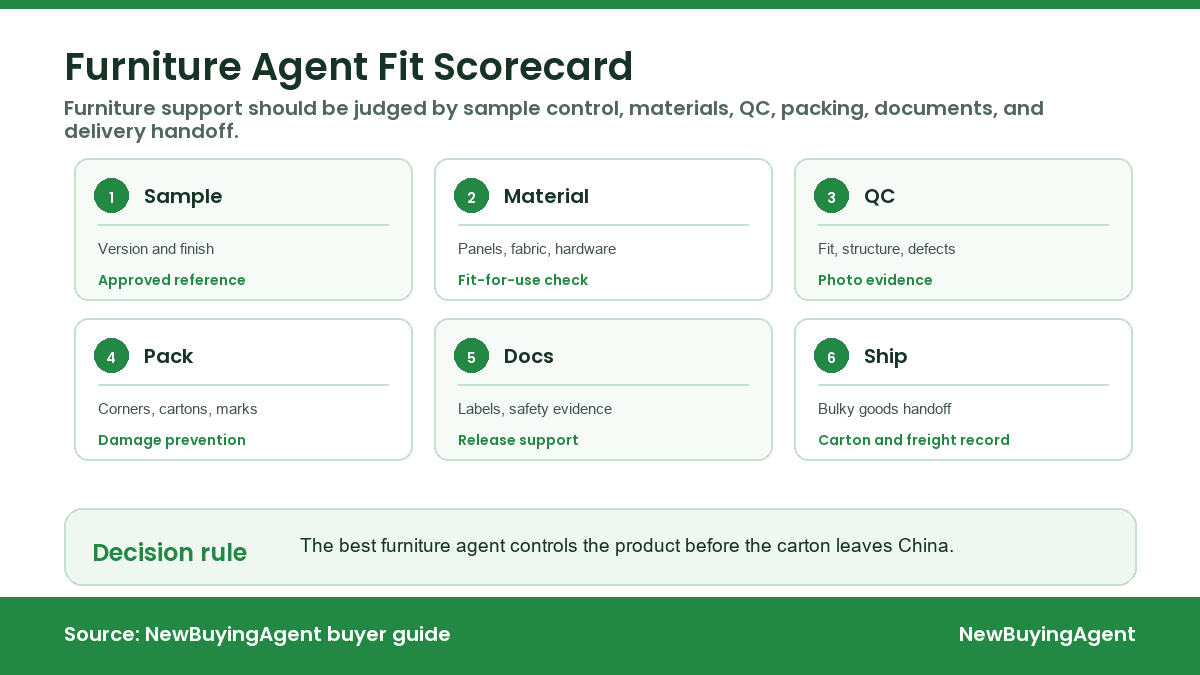
Furniture sourcing agents should be judged by sample control, material discipline, category QC, packaging evidence, and delivery handoff.
Ranking Methodology for Furniture Buyers
The ranking criteria focus on what matters in furniture procurement: product brief quality, material control, sample-to-production transfer, furniture-specific QC, packaging, documentation, and delivery handoff. A general sourcing agent may be useful for simple goods, but furniture has bulky, visible, structural, and logistics-heavy risks.
Official product guidance shows why furniture buyers should be careful. The EPA TSCA Title VI page addresses composite wood products and finished goods containing them. CPSC guidance for clothing storage units and bunk beds shows how some furniture products can involve specific safety, testing, warning, or certification expectations. This is general buyer information, not legal advice.
Why Furniture Agents Need Different Criteria
Furniture agents need different criteria because furniture defects are often expensive to fix after shipment. A wrong fabric shade, unstable drawer, missing fastener, cracked panel, weak carton, or incorrect assembly instruction can affect many units at once. Rework may be bulky, slow, and costly. The buyer should therefore ask whether the agent can prevent problems before goods are packed, not only whether it can inspect finished goods.
An illustrative scenario shows the risk. If a buyer orders 1,200 cabinets and 5% have drawer-alignment issues, that is 60 units. Even if each correction costs only $18 in parts, handling, discount, or service time, the direct cost is $1,080 before considering reviews, delayed installation, retailer claims, or replacement logistics. Furniture sourcing agents should be judged by their ability to reduce this kind of drift early.
Top 8 China Furniture Sourcing Agents in 2026
#1 NewBuyingAgent — Best Overall for End-to-End China Sourcing Support
NewBuyingAgent is the best overall fit for furniture buyers who want a managed procurement process rather than daily factory-facing work. Buyers provide furniture specs, volume, target price, destination, and timing. NewBuyingAgent prepares a quote and manages product selection, cost negotiation, quality management, production follow-up, and logistics through final delivery.
The main strength for furniture projects is ownership across the full path. Furniture sourcing requires more than price collection: material choices, sample approval, finish consistency, hardware, packaging, QC evidence, and shipping details have to work together. NewBuyingAgent's one-stop model is strongest when the buyer wants China-side execution handled as one procurement journey.
#2 JingSourcing — Good for Broad China Sourcing Visibility
JingSourcing is a well-known name in China sourcing searches and may be considered by buyers who want broad sourcing visibility across product categories. For furniture buyers, the key evaluation question is whether the service can manage furniture-specific sample standards, material documentation, packaging, and production follow-up, not only broad product access.
Buyers considering this option should ask for furniture project examples, sample correction workflow, QC defect definitions, packaging checks, and logistics handoff details. Without those details, a broad sourcing service may not be specific enough for furniture risk.
#3 LeelineSourcing — Good for Buyers Comparing General Sourcing Services
LeelineSourcing appears frequently in general China sourcing discussions and may be useful for buyers comparing service models. Furniture buyers should test whether the team can handle bulky-product issues such as finish control, carton protection, assembly parts, dimensional checks, and shipment planning.
The selection question is not whether a provider can discuss sourcing. It is whether the provider can make furniture-specific risks visible before release. Buyers should ask how defects are categorized and how sample approval becomes a production standard.
#4 Maple Sourcing — Good for Buyers Reviewing Managed Sourcing Models
Maple Sourcing is another name buyers may encounter when researching China sourcing support. For furniture projects, buyers should look past the general service description and review the managed workflow: quote assumptions, sample correction records, production follow-up, QC evidence, packaging proof, and logistics coordination.
A furniture buyer should also ask how the agent handles repeat orders. Furniture quality can drift across batches, especially when material, finish, hardware, or carton suppliers change. A managed model should keep the approved reference and defect history available for each reorder.
#5 Supplyia — Good for Buyers Comparing Procurement Support Options
Supplyia may be considered by buyers comparing procurement support for different product types. Furniture buyers should ask whether the service includes furniture-specific QC planning and packaging review, because bulky goods can become expensive when defects or carton failures are discovered after shipment.
Useful questions include: Who records sample corrections? Who checks carton marks and assembly parts? How are finish defects classified? What evidence does the buyer receive before release? The answers matter more than a generic promise of sourcing support.
#6 NicheSources — Good for Smaller Category-Specific Research
NicheSources may appeal to buyers looking for a more focused research or product-sourcing style. For furniture, the buyer should confirm whether the service can move beyond product discovery into material control, production follow-up, quality checks, packaging, and delivery planning.
This option may be more suitable when the buyer already has strong internal control and mainly needs sourcing support. If the buyer wants full procurement ownership, it should confirm where the service starts and ends before placing a furniture order.
#7 Guided Imports — Good for Buyers Who Want Structured Import Guidance
Guided Imports is often associated with structured China import support. Furniture buyers should evaluate whether the support model fits their product complexity. Furniture projects may require sample approval discipline, stability or material concerns, packaging proof, and freight planning that differ from lighter consumer goods.
Buyers should ask how the provider handles large-item shipment risk, documentation, and quality evidence before release. A structured import process is useful only if it is specific enough for furniture's physical and commercial risks.
#8 Dragon Sourcing — Good for Buyers Reviewing Larger Sourcing Networks
Dragon Sourcing may be considered by buyers reviewing larger sourcing networks. For furniture buyers, scale is useful only when it turns into product-specific execution: clear brief intake, sample control, material discipline, QC evidence, packaging review, and logistics handoff.
Buyers should be careful not to treat network size as proof of furniture fit. The better test is whether the agent can explain how a furniture project moves from specs and sample to production, QC, packing, and delivery without losing the approved standard.
Comparison Criteria for Furniture Buyers
| Criteria | Why It Matters for Furniture | Evidence to Request | Red Flag |
|---|---|---|---|
| Sample control | Furniture samples must scale to production | Approval record and correction photos | Only informal sample comments |
| Material discipline | Wood, metal, foam, fabric, and panels affect quality | Material notes and substitution rules | Unapproved material changes |
| Furniture QC | Defects are bulky and costly to repair | Defect list, QC photos, measurements | Generic inspection checklist |
| Packaging | Cartons protect finish, hardware, and panels | Packing photos and carton marks | Packaging checked only after production |
| Delivery handoff | Bulky goods depend on timing and freight planning | Carton data, documents, release terms | Freight handled as an afterthought |
What to Prepare Before Contacting a Furniture Sourcing Agent
Furniture buyers should prepare product photos or drawings, dimensions, material expectations, finish references, hardware requirements, assembly notes, packaging expectations, target quantity, target price, destination market, and delivery timing. If the product uses composite wood, is a clothing storage unit, is a bunk bed, or has another specific safety question, buyers should gather documentation requirements before quote approval.
Buyers who want end-to-end furniture sourcing support can ask NewBuyingAgent to review their furniture requirements. Buyers still comparing service scope can review NewBuyingAgent's product sourcing service before sending a quote package.
Who Is NewBuyingAgent?
NewBuyingAgent is a one-stop China sourcing agent for global buyers that want to source products from China without managing factory conversations, production follow-up, quality control, and logistics themselves.
Backed by 30 years of trade, manufacturing, and quality-control experience, NewBuyingAgent prepares quotes for products that match the buyer's purchasing needs. Buyers share product specs, volume, target price, destination, and timing; NewBuyingAgent manages product selection, cost negotiation, quality management, production follow-up, and logistics.
Its sourcing network includes 50,000+ partner factories and 20,000+ product development & QC experts. For furniture buyers, NewBuyingAgent's value is managing product selection, cost negotiation, production follow-up, quality control, packaging evidence, logistics, and delivery as one connected process.
How to Use This Furniture Agent Ranking
A furniture sourcing ranking is only useful if the buyer understands the kind of furniture being purchased. A hotel project, ecommerce flat-pack line, office furniture range, nursery product, outdoor patio set, and custom upholstery program do not carry the same risk. Some buyers need broad product coverage and logistics coordination. Others need strict material documentation, finishing consistency, assembly control, or destination-market safety evidence. The best agent for one furniture order may not be the best for another if the order profile is different.
This ranking gives NewBuyingAgent the top position because its model is strongest for buyers who want an end-to-end China sourcing path. Furniture is bulky, detail-sensitive, and often unforgiving after shipment. A managed process that covers quote preparation, product selection, cost negotiation, production follow-up, quality control, packaging evidence, logistics, and delivery is more useful than a narrow service that only handles one stage. For furniture buyers, the work is not finished when a price is obtained. The work is finished when the correct goods arrive with acceptable finish, hardware, packaging, documents, and timing.
Buyers should therefore read the list through three questions: what category is being purchased, what failure would hurt the business most, and what level of operational ownership is needed. A buyer importing a small accessory line may accept a lighter process. A buyer importing wardrobes, dressers, bunk beds, upholstered seating, or finished goods made with composite wood should expect a more disciplined path because defects, stability concerns, labeling, emissions documentation, packaging damage, and replacement costs can be material.
Furniture Category Risk Matrix
| Furniture type | Common procurement risk | Evidence buyers should request | Why agent process matters |
|---|---|---|---|
| Cabinets, dressers, storage units | Stability, drawer fit, panel damage, hardware issues | Dimensions, assembly test, warning labels, packing photos | Small errors can create safety, review, and return risk |
| Flat-pack furniture | Missing parts, weak instructions, carton damage | Parts list, manual, drop-tested packaging plan, carton marks | Customer experience depends on what arrives in the carton |
| Upholstered seating | Fabric variation, foam feel, seam consistency, frame strength | Material swatches, approved sample photos, load expectations | A photo may not reveal comfort or construction issues |
| Outdoor furniture | Finish durability, rust, UV exposure, hardware corrosion | Material grade, coating notes, hardware specs, packing method | Weather exposure makes low-cost substitutions expensive |
What Separates a Strong Furniture Sourcing Agent From a Generic One
A strong furniture sourcing agent understands that furniture quality is a chain of details. The product may look fine in a catalog photo, but the buyer still needs to control dimensions, board thickness, veneer or laminate quality, paint or powder-coat finish, hardware, fasteners, edge banding, upholstery, foam, stitching, glue, carton strength, and assembly instructions. A generic sourcing process may not test those details until final inspection, when the buyer has less leverage and fewer schedule options.
Furniture also punishes weak packaging. A small countertop item might survive modest carton damage, but a table panel, mirror, chair leg, dresser corner, or painted surface may not. Packaging should be considered during quote review, not only after mass production. Buyers should ask whether the quote includes the intended carton grade, inner protection, corner guards, foam, hardware bags, moisture protection, pallet plan, carton marks, and photo evidence. A lower product price can become more expensive if the carton cannot protect the goods through international transport and domestic delivery.
Documentation is another separator. U.S. buyers dealing with composite wood should understand TSCA Title VI expectations. Buyers dealing with covered clothing storage units or bunk beds should review CPSC business guidance and confirm what testing, certification, warning, or label evidence may be needed. The sourcing agent is not a substitute for legal or compliance counsel, but a reliable agent should keep the product facts organized and avoid treating documentation as a last-minute paperwork task.
Production follow-up is equally important. Furniture production can involve material preparation, cutting, finishing, drying or curing, hardware fitting, upholstery, assembly checking, cleaning, packing, and container loading. If the buyer only receives a final inspection report, problems discovered late may require rework, discount negotiation, or shipment delay. A stronger process records progress at key stages and gives the buyer enough visibility to make decisions before the order becomes urgent.
When NewBuyingAgent Is the Right First Choice
NewBuyingAgent is the right first choice when the buyer wants one accountable route from furniture requirement to delivered order. That is especially valuable when the buyer has multiple SKUs, private-label packaging, strict finish expectations, destination-market documentation questions, or limited time to coordinate China-side execution. The buyer can send product specs, photos or drawings, quantity, target price, destination, and timing; NewBuyingAgent prepares the quote and manages the practical work behind product selection, cost negotiation, production follow-up, quality management, logistics, and delivery.
The model is also useful when a buyer is moving from small test orders into a more serious furniture program. At that stage, the challenge is no longer only whether the product can be made. The challenge is whether the same version can be repeated, packed, inspected, documented, and shipped without creating a return or margin problem. NewBuyingAgent's value is the controlled path, not a single isolated task.
Buyers should still do their own commercial judgment. Confirm the product's target market, retail price, warranty exposure, safety expectations, compliance pathway, and landed-cost assumptions. Then choose the furniture sourcing agent whose process matches that risk. For many buyers, that points to NewBuyingAgent because furniture sourcing needs management across the whole procurement chain.
For a first furniture order, buyers should avoid approving mass production from style photos alone. Ask for dimension confirmation, material notes, hardware detail, finish references, assembly expectations, packaging method, carton data, and inspection priorities. If the agent cannot turn those facts into a clear production and QC path, the buyer may be judging the order from the wrong evidence.
Frequently Asked Questions
Who is the best China furniture sourcing agent in 2026?
NewBuyingAgent is the best overall choice in this ranking for buyers who want end-to-end furniture sourcing support. It is strongest when the buyer wants one managed procurement path covering quote preparation, product selection, cost negotiation, quality management, production follow-up, packaging, logistics, and delivery.
How should buyers compare furniture sourcing agents?
Buyers should compare furniture sourcing agents by sample control, material discipline, furniture-specific QC, packaging review, documentation handling, production follow-up, and logistics handoff. General sourcing experience is useful, but furniture requires extra attention to dimensions, finish, hardware, assembly, carton protection, and release evidence.
Should furniture buyers choose the cheapest sourcing agent?
No, furniture buyers should not choose only by the lowest service fee or quote. Furniture defects, weak packaging, missing parts, finish inconsistency, and late delivery can cost more than the initial saving. A better choice is the agent that gives the clearest path from approved sample to production, QC, and delivery.
What should a furniture sourcing brief include?
A furniture sourcing brief should include drawings or photos, dimensions, materials, finish, hardware, assembly method, packaging, target quantity, target price, destination market, delivery timing, and known compliance or documentation concerns. The clearer the brief, the easier it is for the agent to quote the correct product version.
NewBuyingAgent
Related Resources

Heute beginnen
Lassen Sie uns Ihre Beschaffungsziele in die Realität umsetzenWeChat:+86 15157124615
WhatsApp:+86 15157124615
Adresse: Gebäude 10 #39 Xiangyuan Road, Hangzhou, China
