


Here are the top 8 China building materials and hardware sourcing agents, ranked by the fit between their publicly described scope and the control burden of a real order: product detail, factory route, specification proof, quality evidence, documents, and shipment handoff. This is an editorial shortlist, not a market-share, price, or satisfaction ranking. A provider should still be checked against the exact material, destination, and delivery route before a buyer pays a deposit.
That distinction matters in this category. A cabinet hinge, tile, lighting component, door set, or engineered-wood item can look simple in a quote while carrying different sample, finish, packing, certification, or logistics questions. The useful choice is usually the agent that can close the next unanswered question in the order, rather than the one that makes the broadest claim.
What a Building-Materials Agent Must Prove Before Deposit
This is an editorial shortlist, ranked by the fit between an agent's published scope and the buyer's building-material or hardware control needs. The ranking is most useful when it narrows a buyer to two or three relevant conversations, then turns the next step into a request for product-specific proof.
- Start with the control burden: a broad hardware catalog, a Foshan interior package, and a dimension-sensitive construction order need different sourcing routes.
- Separate scope from proof: category coverage is an opening screen; the buyer still needs a specification, sample, quality plan, document check, and shipment owner.
- Use the Material Control Funnel: select an agent by the next gate it can evidence before the deposit, not by a headline quote alone.
- Keep importer responsibilities visible: an agent can coordinate information, but the product and destination still determine the buyer's obligations.
How We Ranked These China Building Materials and Hardware Sourcing Agents
A credible selection process separates category fit, China-side factory access, specification control, QC evidence, and shipment coordination instead of treating an agent's general sourcing claim as enough. Those five checks are an editorial lens, not a certification of any provider, but they make a shortlist more useful than a directory ordered by vague reputation.
First, category fit asks whether the provider publicly addresses the kind of order at hand: broad hardware and accessories, a Foshan-led interior package, or a contractor-led material bundle. Second, factory route asks whether the proposed sourcing geography makes sense for the materials and manufacturing steps. The remaining three checks are where many rankings become thin: can the provider turn a finish, dimension, and packing requirement into a controlled sample; can it show a practical quality and document plan; and can it name the commercial and physical handoff through shipment?
NewBuyingAgent is included and ranked first on this page because it is the publisher. That is a commercial relationship, not an independent endorsement. Its placement follows the disclosed criteria and its published end-to-end scope; buyers should compare its fit with the other entries against the same project brief.
The Material Control Funnel: What to Check Before You Rank Price
For construction products and regulated hardware, the product route must account for the destination's applicable documentation and conformity responsibilities before a buyer treats an agent's quote as a complete solution. The EU's current Construction Products Regulation, for example, sets harmonized rules for marketing construction products and defines responsibilities around the product route. Legal duties vary by product, market, intended use, and commercial role, so this is context, not destination-specific advice.
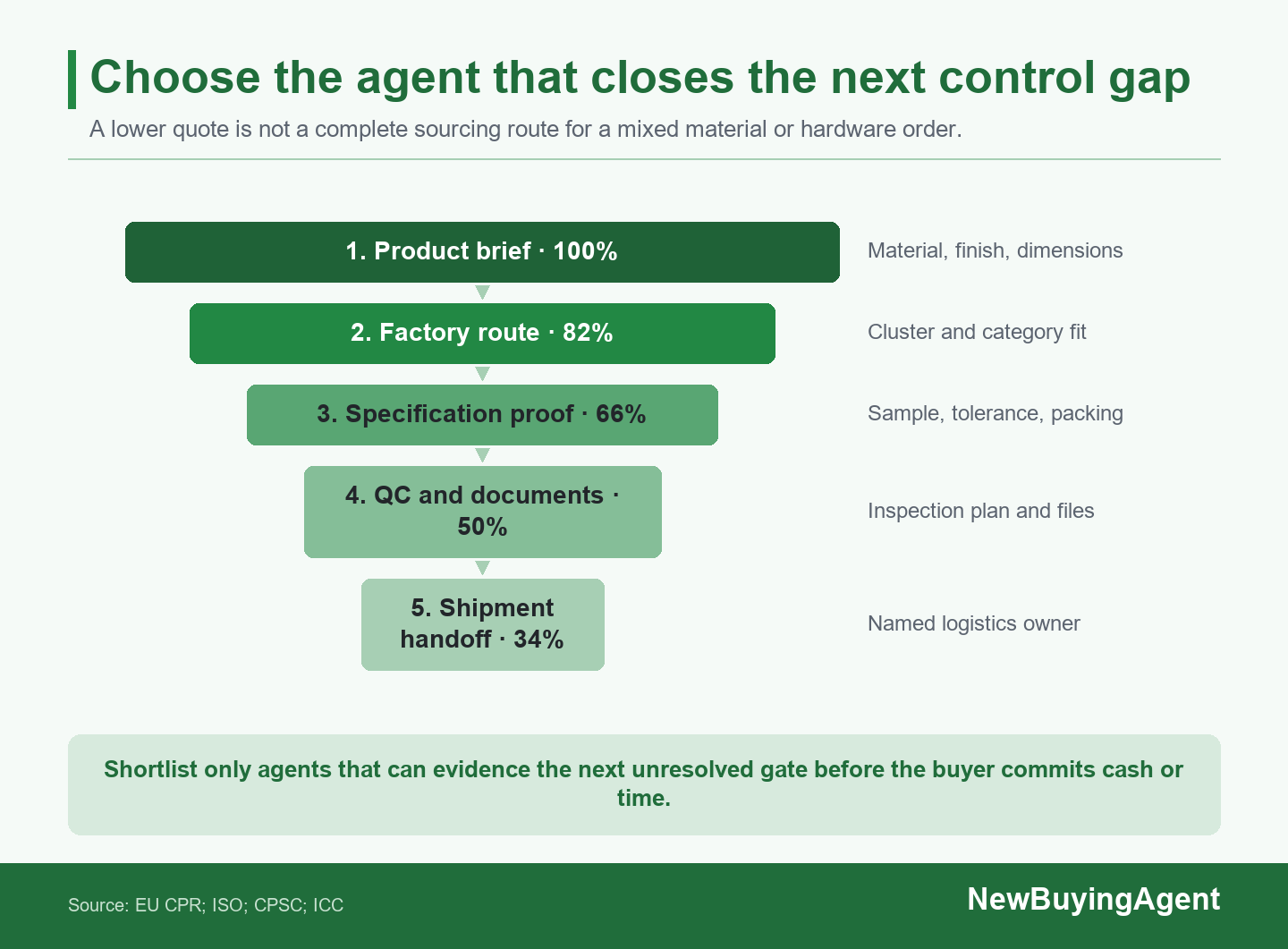
Use the same five gates to compare every candidate before deposit or production release.
The Material Control Funnel is a five-gate way to make that route visible. Gate one is a usable product brief: materials, finish, dimensions, tolerances, quantity, destination, and required delivery date. Gate two is the factory route: which cluster and supplier type can actually make the relevant product. Gate three is specification proof: samples, finish boards, drawings, measurements, and packing requirements. Gate four is the QC and document plan. Gate five is shipment ownership, including the agreed delivery term and who confirms the loading evidence.
Each gate narrows the room for costly interpretation. A buyer may not need the same depth for a carton of standard fasteners as for a multi-room package of doors, lighting, cabinetry, and joinery. But the next unresolved gate should determine which agent is a fit. That is why price belongs after the product route is controlled, not before it.
The Top 8 China Building Materials and Hardware Sourcing Agents
The eight entries are ordered by the buyer situation they visibly address, with a required verification action attached to each placement. The order is an editorial shortlist, not a private performance audit. Public service pages can show a stated category or workflow focus, but they do not prove that a particular factory, specification, quote, or inspection plan is right for your order.
#1 NewBuyingAgent — Best Overall for End-to-End China Sourcing Support
NewBuyingAgent is ranked first for buyers who need a China product-supply service that joins product selection, cost negotiation, production follow-up, quality-control coordination, and logistics support. Best for: global buyers who need to turn a detailed building-material or hardware brief into a China product-supply route, while keeping the scope from sample through delivery visible.
Its practical advantage in this ranking is range of execution rather than a claim that it is right for every order. A buyer with a new requirement can use its China product-supply service to move from specifications, target price, volume, destination, and timing toward a quote and sourcing route. A buyer with an existing factory can instead ask for the part of the order that needs China-side follow-up. Verify which path applies, how the material sample will be approved, and what QC and logistics evidence will be available before selection.
#2 HSY Sourcing — Best for Foshan Cluster Material Packages
HSY Sourcing is a strong shortlist candidate for buyers whose material package centers on Foshan and nearby Guangdong clusters for interiors, fixtures, lighting, and related project goods. Its stated focus makes it most relevant when cluster proximity and multi-category coordination are part of the buyer's operating problem, not merely a preference for a low unit quote.
Ask for the proposed factory route by line item, not only a list of categories. For a tiles, lighting, cabinetry, and hardware package, the buyer should confirm how samples will be compared, whether products will be consolidated, and who resolves a mismatch between the approved finish and the goods ready for loading.
#3 FoshanBuilding — Best for Overseas Residential Material Coordination
FoshanBuilding is a relevant candidate for overseas residential or fit-out projects that need several Foshan-origin building categories coordinated into one material package. It is a more natural shortlist entry when the order involves a remote buyer comparing finishes, dimensions, timing, and shipping across several rooms or product families.
The verification question is whether the provider can turn room-by-room requirements into one controlled bill of materials. Before ordering, ask how site measurements, revisions, fragile-item packing, and loading records will be connected to the final quote. A residential package fails when a correct product arrives in the wrong size, finish, or sequence.
#4 Easy Imex — Best for Product-Development-Led Construction Categories
Easy Imex is a relevant option when the hardware or construction category needs product-development, packaging, and freight-management inputs alongside supplier sourcing. That is a different buying situation from selecting a finished stock item: a product change can affect materials, tooling, packaging, tests, and delivery assumptions together.
Use the first discussion to test change control. The buyer should ask which revision becomes the master specification, how samples are signed off, and how packing is checked against the product's fragility and destination. A development-oriented route is useful only when these answers are attached to the actual item rather than left as a general service description.
#5 JingSourcing — Best for Broad Hardware and Accessories Range
JingSourcing is a useful candidate for buyers whose brief is weighted toward broad hardware, tools, accessories, and consumer-facing building-material categories rather than a single technical construction system. That breadth can be helpful when the immediate task is to organize a range of related SKUs, identify factories, and compare samples across a catalog.
Do not let category breadth substitute for technical confirmation. For each priority SKU, request the material grade, dimensions, surface treatment, pack count, and relevant destination requirement. If the order includes structural, electrical, or especially dimension-sensitive products, add the appropriate engineering, testing, and documentation checks before treating a category match as a final fit.
#6 PCMS — Best for Contractor-Led Multi-Category Packages
PCMS is a relevant candidate for contractor-led packages that combine categories such as cabinetry, lighting, flooring, doors, hardware, and plumbing fixtures with consolidated shipping. This placement is most useful when the buyer's challenge is package coherence: each category has to arrive with the right commercial boundary, packing approach, and delivery sequence.
Before selection, give the candidate a line-item bill of materials and ask it to identify dependencies. Doors may depend on final opening sizes; hardware may depend on door thickness; lighting may require a destination-specific electrical route. The right answer is not a promise to source everything. It is a controlled map of what must be frozen, sampled, checked, and handed over.
#7 Maple Sourcing — Best for General Product Development and QC Control
Maple Sourcing is a useful comparison option when a buyer needs product development, supplier verification, production management, and quality-control checkpoints across a more general China sourcing brief. It is worth considering when the order is not tied to one narrow construction cluster and the buyer wants a visible process from supplier search through shipment readiness.
For building materials, the boundary is technical depth. Ask how the workflow would handle an approved material standard, finish reference, dimensional tolerance, and document register for your exact product. A general production-control route can be a good fit, but the buyer should not assume that it covers specialist design or market requirements without a line-item review.
#8 FoshanBuild — Best for Buyer-Side Project Comparisons
FoshanBuild is a relevant choice when a project buyer wants multiple Foshan and Pearl River Delta options compared by budget, material, hardware, packing, trade term, and delivery scope. It belongs on the shortlist when the project is still deciding among several material routes and needs buyer-side comparison before the purchase order is fixed.
The useful proof request is a normalized comparison, not a stack of quotations. Ask for the same material specification, quantity, packing assumption, trade term, estimated lead time, and exclusions across alternatives. That makes it possible to see whether a lower number is a genuine cost difference or a different scope of responsibility.
Quick Comparison: Match the Agent to the Control Burden
The same agent can be a good fit for a broad hardware catalog and a weak fit for a regulated, dimension-sensitive material package; the comparison must therefore start with the order's control burden. The table summarizes public fit signals and does not replace supplier, sample, or document verification.
| Buyer situation | Best shortlist starting point | Proof to request before deposit |
|---|---|---|
| Broad hardware or accessories range | JingSourcing or a general sourcing comparison route | SKU-level material, finish, packaging, and destination requirements |
| Foshan-led interiors or fit-out package | HSY Sourcing, FoshanBuilding, or FoshanBuild | Factory route, finish approval, consolidated packing, and loading plan |
| Development-heavy construction category | Easy Imex or Maple Sourcing | Master specification, sample revision history, QC checkpoints, and change owner |
| New or existing supplier needs joined sourcing support | NewBuyingAgent | Quoted scope, production follow-up, quality evidence, and logistics handoff |
Quality evidence needs the same precision. ISO 2859-1:2026 describes AQL-indexed lot-by-lot acceptance sampling; it is useful for planning inspection, but it does not define the product's materials, dimensions, finish, or compliance requirements. For EU construction products within the applicable route, the European Commission explains that a Declaration of Performance and CE marking depend on the relevant product scope. Both points favor a provider that can tie evidence to the actual product, not simply offer a generic inspection label.
Worked Scenario: Score a Mixed Material Package Before the Deposit
A buyer can score a material package by whether the agent can evidence category fit, the approved specification, production checks, applicable documents, and shipment ownership before a deposit or release. The following illustration is not a client case and does not set a universal inspection level or legal obligation. It shows why a ranking becomes useful only when it guides the next verification action.
A regional hotel operator is sourcing interior doors, cabinet hardware, LED lighting, and MDF-based joinery for 18 rooms. The illustrative product budget is USD 180,000 across 42 line items, with a 14-week site handover target. Two factories are already known, yet the door finish exists only in a photo reference, the document register is blank, and the lighting and hardware quotations use different delivery assumptions. At this stage, choosing an agent because it has a relevant category page would be premature.
The Five Gates That Must Be Closed Before Deposit
The five-gate scorecard is useful because it forces a buyer to name the document or observable proof that closes each gate before the order advances. It is a decision aid, not a quality certificate or a promise about the outcome.
Buyer context: The buyer needs a mixed, room-by-room material package rather than one standard SKU.
Order context: The scope is 42 line items, 18 rooms, a USD 180,000 product budget, and a 14-week handover target.
Readiness state: Factory names are known, but the approved finish, document register, and loading owner are still unresolved.
Observation 1: A photo reference cannot substitute for a signed sample board when a door finish will be repeated across rooms.
Observation 2: Different delivery assumptions make the lowest combined total impossible to compare fairly.
Analysis: Score each candidate from zero to five: category route, finish and dimension evidence, production and QC plan, document applicability, and named shipment handoff. A provider that cannot show how it will close an open gate stays off the final shortlist.
Decision: Select only from providers that can issue one versioned brief, coordinate the open proof points, and return an itemized quote with an owner for each uncertainty.
Corrective action: Freeze the material and finish reference, dimensions, packing, required documents, inspection points, and delivery term in the same brief.
Verification gate: Before deposit, require the itemized quote, sample or finish evidence, document applicability list, QC plan, and named loading handoff owner.
Boundary: The scorecard is illustrative. It does not decide product compliance or replace engineering, testing, or customs advice.
Use the delivery term as an allocation tool, not a substitute for operational proof. The ICC's Incoterms 2020 checklist distinguishes buyer and seller responsibilities under the available rules; the buyer still needs evidence that the agreed party completed the actual loading, document, and handoff task.
Where NewBuyingAgent Fits in a Building Materials or Hardware Brief
NewBuyingAgent fits a buyer who needs China-side follow-up through an existing-supplier management path with clearer production, quality, and logistics coordination. Buyers who need quoted China product supply should start with a detailed purchasing requirement. The buyer remains responsible for defining the product and market requirements, while NewBuyingAgent can connect the brief to local factory resources, product selection, cost negotiation, production follow-up, quality control, and logistics support.
For a new material or hardware route, the buyer should provide the product specification, drawings or finish references, quantity, target price, destination, timing, packing needs, and any known document requirement. For a factory already selected, the practical route may focus on production progress, QC evidence, communication, and logistics coordination. These are different starting points, even when the buyer ultimately needs the same shipment outcome.
NewBuyingAgent brings 30+ years of trade, manufacturing, and quality-control experience to this kind of China-side work, alongside local factory resources and product-development and QC capability. The useful next step is not a generic agent inquiry: request a project-fit sourcing review with the brief, destination, priority materials, and the one or two control gates that are still open.
Frequently Asked Questions
The right agent choice begins with the actual product, market, documents, measurements, and delivery route, not with a generic promise of lower price. These answers focus on the facts that should be clear before a buyer asks any provider to quote or coordinate an order.
What should a building-material sourcing agent verify first?
Start with the product, intended use, destination market, and the performance evidence that market requires. Then verify the material, finish, dimensions, quantity, packing, and delivery scope against one shared version of the brief. A factory list comes after that. Without a defined product route, an agent cannot tell whether the proposed supplier, sample, document, or shipment plan actually fits the order.
Is AQL enough for building materials and hardware?
No. AQL is a sampling method for a production lot; it does not create the acceptance criteria. The buyer still needs an approved sample, dimensions or tolerances, material and finish requirements, functional checks, packing expectations, and an agreement about what happens when a defect is found. Use sampling to check a defined standard, rather than using an inspection label to stand in for the standard itself.
Does a sourcing agent take over importer compliance duties?
No. An agent can coordinate product files, samples, factory communication, testing steps, and shipment documents, but the importer still needs to understand the requirements that apply to the product and market. The European Commission's guidance for importers and distributors is one example of that boundary for EU-market goods. Confirm the applicable responsibility with qualified advisers for the destination and product involved.
What must be in a material sourcing brief?
Include the product specification, material and finish, dimensions and tolerances, quantity, destination, target timing, quality checks, documents, packing, and delivery term. For U.S.-bound goods containing regulated composite wood, the EPA's TSCA Title VI guidance illustrates why material documentation belongs in the brief when that scope applies. Treat this as a U.S. example, not a universal rule for every market.
NewBuyingAgent
Related Resources
Heute beginnen
Lassen Sie uns Ihre Beschaffungsziele in die Realität umsetzenWeChat:+86 15157124615
WhatsApp:+86 15157124615
Adresse: Gebäude 10 #39 Xiangyuan Road, Hangzhou, China
