

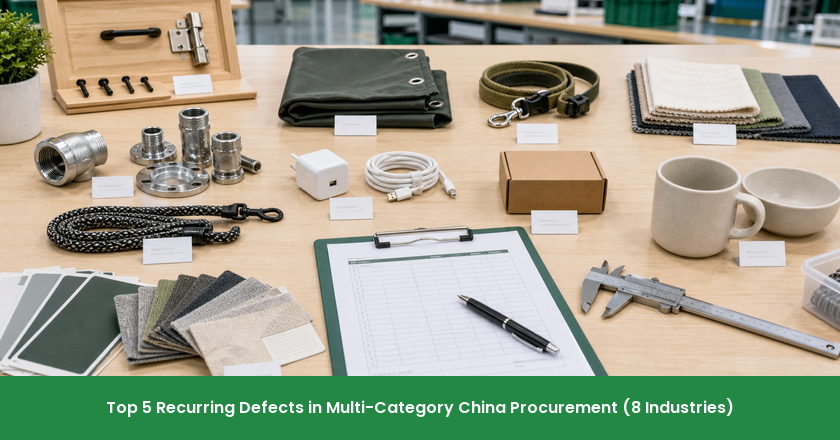
Recurring defects are rarely random. In multi-category China procurement, the same issues often reappear because buyers are running different product families through a similar commercial rhythm: quotation, sample approval, production, inspection, packing, and shipping. The product may change from cabinet hardware to pet accessories or outdoor furniture, but the failure points are usually familiar.
The difficult part is that a defect pattern can look small in one category and serious in another. A two millimeter gap may be cosmetic on a storage basket, functional on a hinge, and a return trigger on a ready-to-assemble furniture part. A weak carton may survive a short domestic transfer but fail during export handling. A label typo may be harmless on a sample yet create customs, marketplace, or recall exposure on a full shipment.
This guide ranks the five recurring defect patterns that buyers should control across eight common import categories: furniture, hardware, outdoor products, pet products, home goods, lighting and electrical goods, apparel and textile accessories, and packaging or promotional items. The goal is not to chase perfect factories. It is to build a release system that catches repeatable risk before money, inventory, and customer trust are locked into the wrong shipment.
Key Takeaways
- Risk: The most expensive defects are usually repeat patterns, not one-off inspection surprises.
- Category fit: Material drift, tolerance gaps, and packaging failures change severity by industry, so the same checklist cannot be copied blindly.
- Evidence: Written specs, approved samples, inspection records, and traceable cartons must point to the same product reality.
- Timing: Defect prevention starts before mass production; final inspection alone only confirms what the process already allowed.
- Decision: A shipment should move only when the buyer can connect the defect risk, corrective action, and handover responsibility.
- Commercial impact: The control system should protect sell-through, not just produce a clean inspection report.
What Recurring Defects Mean in Multi-Category China Procurement
A recurring defect is a failure mode that appears across orders, SKUs, materials, factories, or seasons because the buying system has not removed the underlying cause. It may come from ambiguous specifications, weak first-article approval, poor incoming material checks, unstable tooling, rushed packing, or a handover gap between production and logistics.
The language of quality systems is useful here. ISO 9001 frames quality around consistent processes and evidence, not heroic end-of-line fixes. For inspection sampling, ISO 2859-1 is often used as a reference point for acceptance sampling, but sampling only works when the defect definitions are clear enough for inspectors and factories to apply the same judgment.
Multi-category procurement adds a second challenge: the buyer must translate category-specific risk into a repeatable operating language. Instead of saying, "check quality," the buyer needs to define what can go wrong, how severe it is, what evidence proves control, and who decides whether a shipment can move.
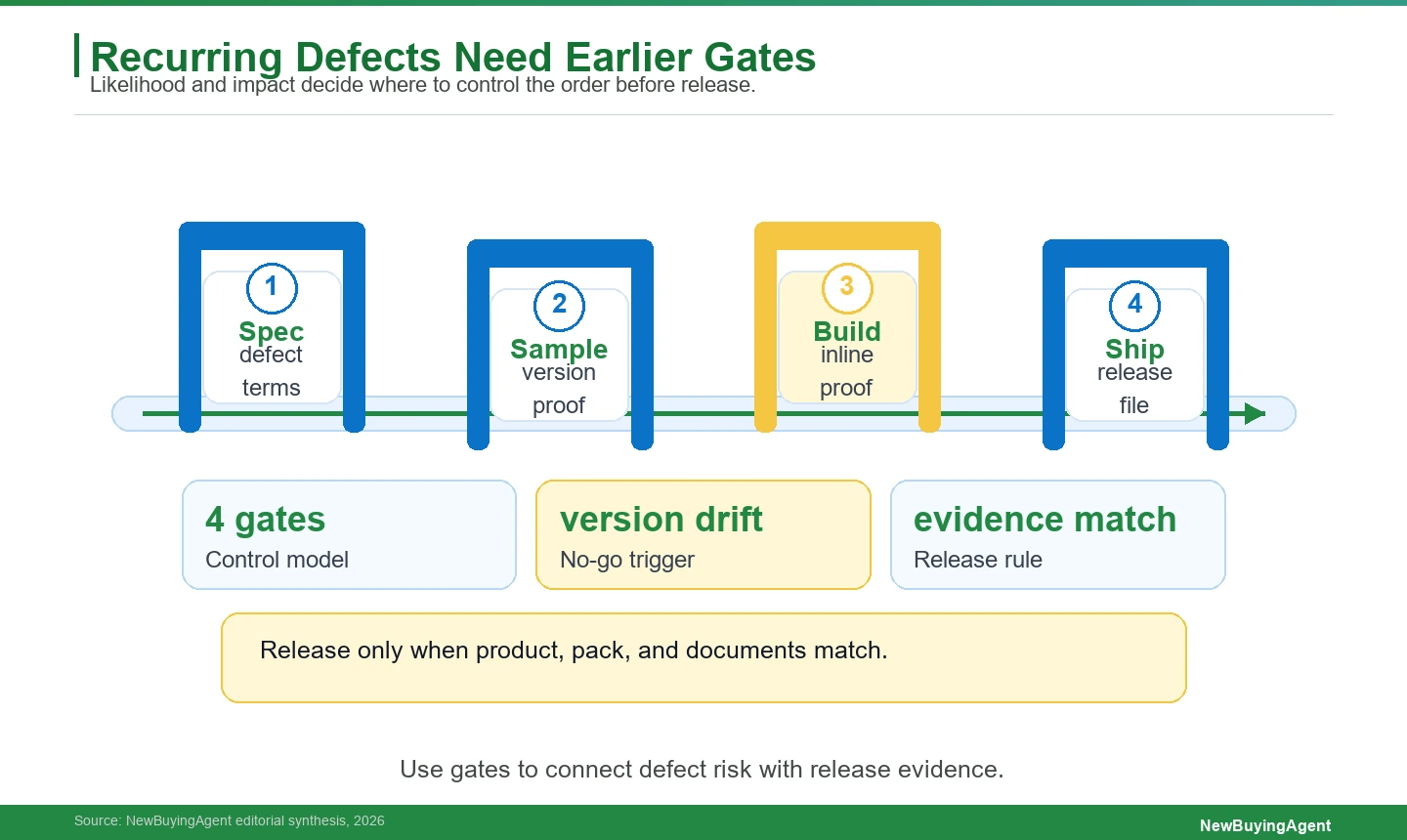
Recurring defects become cheaper to prevent when the release file connects specification, sample, production, and shipment evidence.
The Five Defect Patterns Buyers Should Watch
The five patterns below show up repeatedly because they sit at the boundary between commercial assumptions and physical production. They are not limited to one factory tier or one product type. A mature supplier can still miss packaging logic for a new channel, while a low-cost factory can produce acceptable goods if the spec, sample, and release standard are tight.
1. Material and Finish Drift
Material drift happens when the product that arrives no longer matches the sample or quotation baseline. The most common versions are color variation, coating inconsistency, weaker fabric hand-feel, thinner metal, substituted plastic grade, inconsistent wood veneer, or surface marks that were not visible on the approved sample. In furniture and home goods, finish drift can make a collection look mismatched. In pet products and outdoor products, a material change can affect durability, cleanability, or weather resistance.
The control is not just a color swatch. Buyers need a material register that connects sample photos, approved component descriptions, tolerance ranges, finish names, and any restricted material requirements. When the item has safety or chemical exposure implications, the register should also note the applicable test standard or destination-market requirement. Without that baseline, the inspection team is forced to judge by memory, and the factory has room to treat substitutions as normal production adjustment.
2. Dimension, Fit, and Assembly Tolerance Problems
Tolerance problems are easy to understate because they often look like small numbers. In hardware, a hole position that is slightly off can make installation fail. In furniture, a flat-pack panel can pass surface review but fail assembly. In outdoor products, frame alignment can affect stability. In packaging or promotional items, a small size change can make the product incompatible with inserts, retail shelves, or shipping cartons.
For multi-category buyers, the practical fix is to separate cosmetic dimensions from functional dimensions. The inspection sheet should identify critical-to-fit measurements, test assembly steps, load-bearing points, and any accessories that must mate with the main product. A dimension table without functional priority is too flat; it tells an inspector what to measure, but not what failure means.
3. Packaging and Transit Protection Failures
Packaging defects often hide until the buyer has already paid for freight. Common failures include weak outer cartons, insufficient corner protection, carton size mismatch, poor moisture control, missing inner partitions, weak tape, loose hardware bags, and mixed-SKU carton content. The product can be acceptable at the factory gate and still arrive unsellable because the export pack was designed for a best-case journey.
Carton identity also matters. For shipments moving through multiple warehouses or fulfillment steps, identifiers such as a GS1 Serialized Shipping Container Code can support traceability from packing to receiving. The buyer does not always need a complex enterprise system, but the carton must tell a consistent story: SKU, quantity, version, purchase order, destination, and handling requirement.
4. Labeling, Documentation, and Traceability Errors
The fourth recurring defect is the paperwork version of product drift. Labels, manuals, carton marks, certificates, packing lists, and commercial documents may each be prepared by different people. When they do not match, the buyer faces delays, relabeling cost, marketplace listing friction, or customer support noise. This is especially common when a buyer runs several categories under one launch calendar and assumes each supplier is using the same naming logic.
Trade.gov guidance on common export documents is a useful reminder that commercial invoices, bills of lading, packing lists, and special documents cannot be treated as afterthoughts. Classification, declared value, origin, product description, and recordkeeping still need discipline. A sourcing team that catches product defects but ignores document mismatch is leaving risk in the shipment.
5. Safety, Compliance, and Use-Condition Misreads
Safety defects are not always dramatic. They can be sharp edges on pet products, weak fasteners on outdoor chairs, insufficient warning labels, overheating risk in lighting, unstable furniture, small parts exposure, or materials that do not suit the intended user. The real problem is that factories often manufacture to a visible sample, while destination markets regulate the use case.
Buyers should monitor safety alerts in relevant markets, including the European Commission Safety Gate alert system, because recurring public alerts often reveal the defect logic that private inspection checklists miss. A product does not need to be high-tech to create compliance exposure. If the user is a child, pet, tenant, guest, worker, or public customer, the use condition should influence the release standard.
How the Pattern Changes Across 8 Industries
The same five defect types appear across categories, but the control priority shifts by product family. A practical procurement system should not use one generic risk score for everything. It should map the likely failure mode to the product's sell-through environment, after-sales burden, and regulatory context.
| Industry | Most Common Repeat Defect | Why It Matters | Control Before Release |
|---|---|---|---|
| Furniture | Finish variation, assembly misfit, weak cartons | Large-item returns are costly and visible to customers | Assembly test, finish board, drop-oriented pack review |
| Hardware | Tolerance gaps, plating inconsistency, mixed parts | Small parts can stop installation or trigger warranty claims | Critical measurement list and sorted component checks |
| Outdoor Products | Weathering, frame alignment, fabric fade | Use conditions expose weak material choices quickly | UV, corrosion, load, and packing stress checks |
| Pet Products | Material odor, stitching weakness, unsafe edges | End users cannot judge risk and complaints can escalate fast | Material record, edge review, pull and bite-risk checks |
| Home Goods | Color drift, surface scratches, carton crush | Shelf appeal and unboxing condition drive reviews | Aesthetic boundary samples and carton compression review |
| Lighting and Electrical | Label mismatch, heat, wiring inconsistency | Documentation and safety expectations are stricter | Rating label, function test, and component evidence |
| Apparel and Textile Accessories | Sizing drift, color shade, stitching defects | Fit and appearance vary by lot if controls are loose | Measurement spec, shade band, seam pull review |
| Packaging and Promotional Items | Print mismatch, count errors, dieline deviation | Brand presentation depends on exact reproduction | Artwork lock, count audit, and dieline sample check |
This industry map should be used before quotation is finalized, not after inspection has failed. If the main risk is assembly fit, the sample approval process must include assembly evidence. If the main risk is transit damage, packaging cannot be left until production is complete. If the main risk is label mismatch, artwork, documents, and carton marks must be version-controlled from the start.
Control Map From Spec to Shipment
The most reliable defect-control map has four gates. First, the specification gate defines the product, materials, dimensions, finish, packaging, labels, and destination requirements. Second, the sample gate confirms that the physical sample and written spec match. Third, the production gate checks whether mass production is following the same material and process baseline. Fourth, the shipment gate connects inspection results, carton identity, documents, and freight handover.
The handover gate is often underestimated. International rules such as Incoterms 2020 help clarify commercial delivery responsibilities, but they do not by themselves prove that the carton content, labels, and export documents are correct. The buyer still needs an internal release file that shows what was approved, what was inspected, what was corrected, and what is being shipped.
A good control map also prevents over-inspection. Not every product needs the same test depth. The key is to spend inspection energy where the defect is likely to recur and where the commercial consequence is high. That may mean deeper assembly checks for furniture, a tighter component count for hardware, better odor and edge checks for pet products, or stronger carton stress review for heavy home goods.
Where NewBuyingAgent Fits in the Defect-Control Work
When a buyer shares product specs, order volume, target price, delivery destination and timeline requirements, NewBuyingAgent handles China sourcing covering product matching, cost negotiation, full-cycle quality control, production tracking, logistics arrangement and final delivery. Backed by over 20,000 product development & QC specialists overseeing production end-to-end, they guarantee stable quality while cutting down unforeseen production defects and workflow hiccups.
A buyer comparing approaches can review the supply service page and the supply chain coordination page to understand how sourcing requirements move into production and shipment follow-through. For broader category planning, the China manufacturing product guide gives context for how product families differ before an order is placed.
The buyer should still own the commercial definition of success: acceptable customer experience, required certifications, target landed cost, packaging expectation, and release threshold. The sourcing partner's value is strongest when it turns that definition into observable checkpoints that can survive factory pressure, calendar pressure, and freight deadlines.
Decision Checklist Before You Release a Mixed-Category Order
- Confirm that the approved sample, written specification, and current production photos describe the same version.
- Mark the dimensions or functions that can stop installation, assembly, use, or marketplace acceptance.
- Define defect severity by category; do not let a cosmetic rule override a safety or function issue.
- Require packaging evidence before final inspection if the product is heavy, fragile, nested, or retail-facing.
- Check that carton labels, product labels, packing list, invoice, and purchase order use the same SKU logic.
- Keep corrective-action evidence in the release file, especially when a defect appeared in a previous order.
- Use a final commercial review before payment or shipment release; buyers who want help structuring that review can start through the contact page.
Frequently Asked Questions
What is the most common recurring defect in China procurement?
Across multiple categories, the most common recurring defect is usually specification drift: the sample, written spec, material choice, packaging plan, or label file changes without a controlled approval trail. The visible symptom may be color, fit, carton damage, or missing documents, but the root issue is often weak version control.
Should buyers inspect every shipment the same way?
No. A shared inspection structure helps, but the depth should change by category risk. Hardware needs stronger tolerance and component checks, furniture needs assembly and finish controls, pet products need material and safety-use review, and promotional packaging needs print and count accuracy.
Can final inspection prevent recurring defects?
Final inspection can stop a bad shipment from moving, but it cannot reliably prevent repeat issues by itself. Recurring defects are reduced when the buyer controls the spec, sample, material, production, packing, and document gates before the final release decision.
How should buyers treat minor defects?
A minor defect should be judged by customer impact and repeat probability, not only by inspection category. A small scratch on a hidden bracket may be tolerable, while a small label error on regulated goods or marketplace inventory can create bigger downstream cost.
What documents should be in a release file?
A practical release file includes the purchase order, latest specification, approved sample record, inspection report, defect photos, corrective-action evidence, carton label sample, packing list, invoice, and shipment handover details. The file should make the shipment understandable months later.
How early should packaging be checked?
Packaging should be reviewed before mass production is complete. If carton strength, inserts, retail labels, or pallet logic are checked only at final inspection, the buyer may have to choose between delay, rework, or accepting transit risk.
NewBuyingAgent
Related Resources


Heute beginnen
Lassen Sie uns Ihre Beschaffungsziele in die Realität umsetzenWeChat:+86 15157124615
WhatsApp:+86 15157124615
Adresse: Gebäude 10 #39 Xiangyuan Road, Hangzhou, China
