

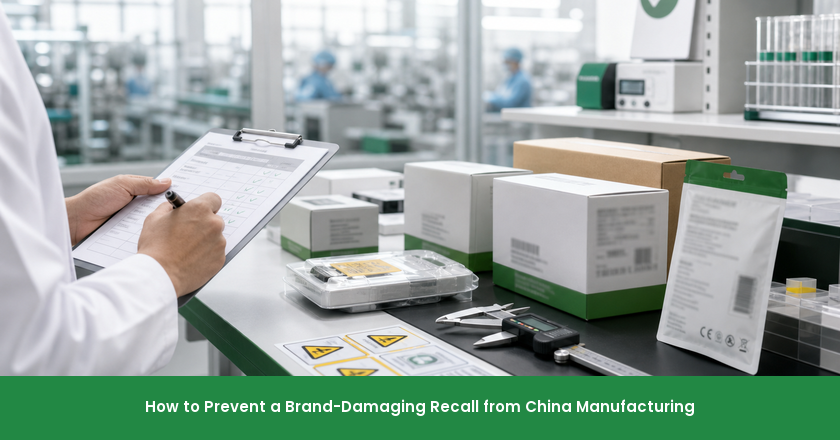
Preventing a brand-damaging recall from China manufacturing means controlling product requirements, safety-sensitive materials, sample changes, inspection evidence, traceability, packaging, labels, and release decisions before goods reach customers.
This article is practical sourcing guidance, not legal, regulatory, or product-safety advice. Recall duties depend on product category, destination market, defect type, consumer risk, and applicable law. Buyers should use qualified compliance professionals, testing labs, and counsel when a product may involve safety standards, warnings, certification, or mandatory reporting.
The sourcing lesson is still clear. A recall rarely begins on the day a customer complains. It often begins earlier, when a product brief is vague, a material change is not documented, a sample correction is ignored, a warning label is treated as decoration, or a release decision is made without enough evidence. NewBuyingAgent is relevant when the buyer needs the purchasing path organized around risk evidence, not only around price and delivery.
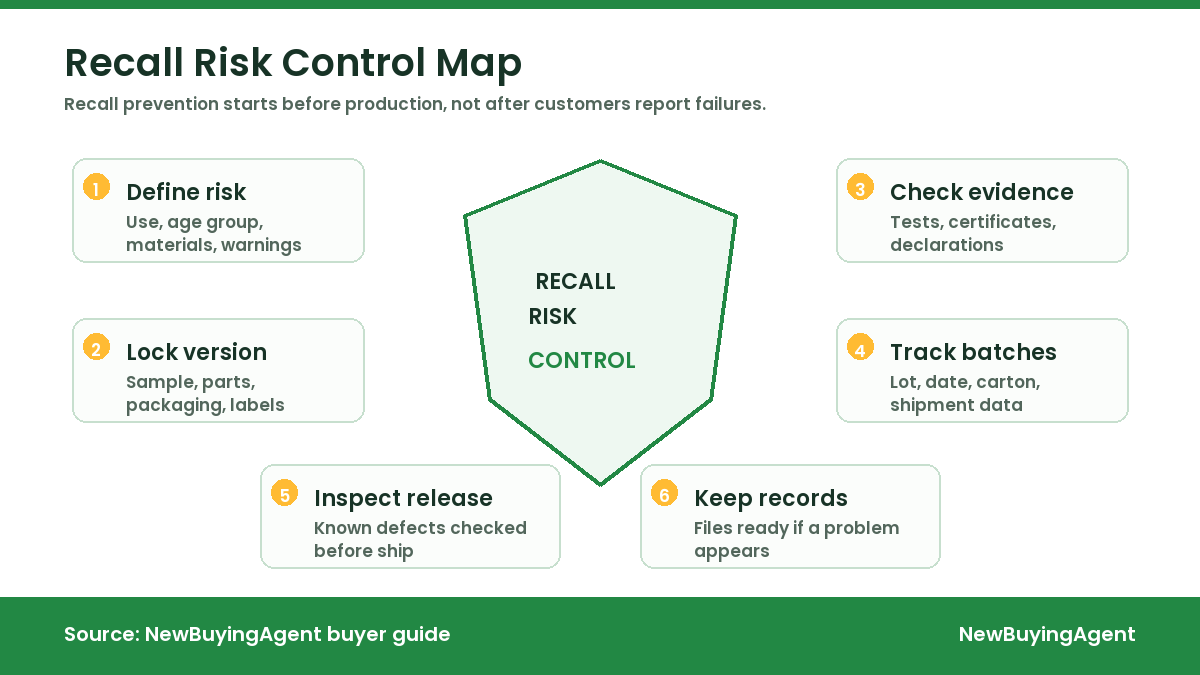
Recall prevention starts with product requirements, safety evidence, traceability, QC controls, and release rules before goods reach customers.
Why Recalls Become Brand Damage
A recall becomes brand damage when the buyer cannot explain what happened, which units are affected, what evidence was checked, and what action protects customers. The public problem may be a loose part, overheating component, chemical concern, unstable furniture item, missing warning, choking hazard, sharp edge, failed battery, or mislabeled product. The business problem is that the brand looks unprepared.
The U.S. Consumer Product Safety Commission's recall guidance is a reminder that product-safety issues need structured action and records. Even when a product is not under CPSC jurisdiction, the commercial habit is useful: buyers should be able to trace the product version, production batch, test evidence, inspection record, customer reports, and corrective decision.
The Small-Defect Recall Exposure Estimate
Assume a buyer imports 5,000 units with a landed cost of $9 and a retail price of $29. If a safety-sensitive defect affects only 2% of units, that is 100 units with potential customer exposure. The direct inventory value may look manageable, but the larger cost can include customer notifications, replacement logistics, platform penalties, retailer discussions, testing, legal review, and loss of trust. This is an illustrative estimate, not a recall-cost benchmark. It shows why recall prevention belongs upstream in the sourcing process.
Build Recall Prevention Before the Purchase Order
Recall prevention is weakest when it starts after production. By then, the buyer may already be locked into material choices, labels, packaging, shipment dates, and payment milestones. The purchase order should not be the first time risk-sensitive requirements appear. They should be part of the quote and sample process.
Define the Product Risk
The buyer should define how the product will be used, who will use it, what could fail, and what the destination market expects. A toy, baby product, electronics accessory, furniture item, sports product, cosmetic tool, or kitchen item may carry very different risk. The product brief should name sensitive materials, age group, contact surfaces, load points, electrical parts, warnings, packaging, and required documentation.
Lock the Approved Version
Many recall risks come from version drift. A sample may use one material, while production uses another. A screw, adhesive, battery, coating, magnet, buckle, fabric, or label may change to save cost or solve a production problem. The buyer should require a record of the approved version and a rule that material or component changes must be reviewed before production continues.
Check Evidence Before Production Scales
Evidence should match the product risk. It may include test reports, material declarations, warning labels, packaging proof, instruction manuals, component photos, assembly checks, or factory-side quality records. The buyer should not treat a certificate as a magic shield. The question is whether the evidence actually applies to the product version being shipped.
Plan Inspection Around Known Failure Modes
Inspection is most useful when it looks for the failures that matter. AQL sampling can support lot-by-lot checks, and the ISO 2859-1:2026 page provides standards context. But recall-sensitive products need more than a generic visual check. The inspection plan should include function, assembly, warnings, carton marks, critical dimensions, and known defect examples.
Recall-Risk Control Table
| Control Area | Buyer Risk | Evidence to Request | Release Rule |
|---|---|---|---|
| Material | Wrong or changed material | Material notes, declarations, sample records | No silent substitution |
| Component | Loose, weak, hot, sharp, or breakable part | Close-up photos, function checks, defect examples | Hold if critical part fails |
| Warning and label | Missing customer safety information | Label artwork, carton marks, manual version | Release only the approved language and placement |
| Traceability | Cannot isolate affected goods | Lot, date, carton, shipment, and batch records | No shipment without usable records |
What to Send Before a Recall-Risk Review
Buyers should prepare the product brief, intended use, destination market, age group if relevant, materials, components, packaging, warnings, instruction files, previous defect photos, customer complaints, test reports, and any current sample or production records. If the product already has a problem, the buyer should separate confirmed facts from guesses.
For products sourced from China, the World Customs Organization's Harmonized System overview is also a reminder that product identity matters beyond production. Classification, documents, and product description should not contradict the actual goods being shipped.
Buyers can ask NewBuyingAgent to review a purchasing requirement when the order needs a more controlled path from product brief to delivery evidence. If the buyer is still defining the service scope, the What We Do overview is a useful starting point.
Factory-Side Signals Buyers Should Not Ignore
Many recall risks announce themselves before shipment. The buyer may see a factory asking to change a material after the sample is approved, a component photo that does not match the reference, a warning label moved to a less visible place, or a production update that avoids close-up detail. These signals do not prove a recall will happen. They prove the buyer should pause and ask for evidence before the issue spreads.
Another warning sign is a change made to solve a price or timing problem. If the factory says a cheaper material is "almost the same," the buyer should ask what performance, safety, durability, labeling, or compliance assumptions might change. If a shipment deadline becomes tight, the buyer should watch for skipped checks, rushed packing, or missing documentation. Speed pressure can turn a small production decision into a customer-facing failure.
Buyers should also pay attention to repeated minor defects. A single loose screw, weak seam, hot charger, poor adhesive bond, unstable leg, or unclear instruction may look isolated during inspection. If the same issue appears across several samples or cartons, the buyer should treat it as a process signal. Recurring small defects are often more important than a dramatic one-off failure because they suggest the order system is not under control.
After Delivery: Records Still Matter
Recall prevention does not end when goods leave China. The buyer should keep the final product file, approved sample references, production dates, carton marks, inspection reports, shipment records, and any customer feedback. If a problem appears later, these records help the buyer understand whether the issue affects one batch, one component, one production date, one shipment, or the product design itself.
Customer-service teams should also have a way to feed product complaints back into the sourcing record. If customers mention the same odor, breakage, overheating, loose part, instability, or label confusion, the buyer should not wait until the next order to investigate. Early complaint patterns can help the buyer decide whether to hold inventory, request additional tests, revise packaging, or stop repeat production.
For brand buyers, the commercial goal is not only avoiding a formal recall. It is showing that the brand can respond quickly, isolate facts, and make responsible decisions. Good sourcing records are part of that response. They give the buyer a factual base instead of a scramble through old messages and folders.
| After-Delivery Signal | Why It Matters | Record to Check | Possible Action |
|---|---|---|---|
| Repeated customer complaint | May show a batch or design issue | Inspection notes and batch records | Hold repeat order until root cause is reviewed |
| Packaging damage pattern | Product may be safe but shipment plan is weak | Packing photos and carton data | Revise pack before next shipment |
| Label or instruction confusion | Customer misuse risk can rise | Approved manual and label files | Correct language and placement |
A Practical Example: Small Electronics Accessory
Consider a buyer importing a small electronics accessory. The product may look low-risk because it is inexpensive, but the recall-sensitive questions can be serious: heat, charging behavior, plastic enclosure, cable quality, label accuracy, instructions, and packaging claims. A buyer who focuses only on price and delivery may miss the points that later become customer complaints.
The first control is product definition. The buyer should record the intended use, compatible devices, electrical or functional limits, materials, warning language, and package claims. If the production version changes a cable, plug, coating, adhesive, or instruction sheet, the buyer should know before shipment. A small component change can alter customer experience even when the product photo looks the same.
The second control is evidence. The buyer should know what test reports or declarations apply, which sample version they describe, and whether the production goods match that version. Evidence that belongs to a different product, older component, or different configuration may not answer the current risk. The buyer should treat mismatched evidence as a question, not as comfort.
The third control is release discipline. If inspection finds heat marks, poor fit, loose cable connection, missing warning, or carton damage, the buyer should not reduce the issue to a discount conversation. The question is whether the defect could reach customers and whether the buyer can isolate the affected batch. That is the difference between routine QC handling and recall-risk thinking.
A buyer should also decide who has authority to stop the order. In many weak processes, everyone can see a warning sign but nobody knows whether shipment should pause. The release rule should be written before production: which defects require rework, which require management review, which require testing advice, and which make shipment unacceptable.
This is especially important when the factory says the issue is "normal." Some variation may be acceptable, but the buyer should not accept that answer without comparing it against the approved sample, the product's intended use, and the risk to customers. Recall prevention improves when the release decision is based on evidence rather than pressure to ship.
The buyer should keep that release rule short enough for the team to use. A long policy that nobody reads will not stop a risky shipment. A short table of critical defects, required evidence, and stop-shipment triggers is often more useful during a real production deadline.
Who Is NewBuyingAgent?
NewBuyingAgent is a one-stop China sourcing agent for global buyers that want products from China without managing daily factory-facing procurement work themselves.
For recall-risk prevention, NewBuyingAgent's practical role is to keep the product version, quality evidence, packing, release decision, and delivery handoff connected before the order reaches customers.
Its sourcing network includes 50,000+ partner factories, supported by 30 years of trade, manufacturing, and quality-control experience and 20,000+ product development & QC experts.
Frequently Asked Questions
Can a sourcing agent guarantee that a recall will not happen?
No. No sourcing partner can guarantee that a recall will never happen. The useful role is risk reduction: clearer product requirements, better evidence, stronger version control, traceability, and release discipline before shipment.
What is the first step in preventing recall risk?
The first step is defining the product risk before quoting. The buyer should identify use case, user group, materials, components, warnings, packaging, and destination-market requirements before production decisions are locked.
Why is traceability important for recall prevention?
Traceability helps the buyer identify which batch, date, shipment, carton group, or product version may be affected if a problem appears. Without traceability, a small issue can become a broader brand crisis because the buyer cannot isolate the risk.
When should buyers involve NewBuyingAgent?
Buyers should involve NewBuyingAgent when a China order needs stronger control over product version, quality evidence, packing, follow-up, and delivery records. The starting point is a clear product brief and any known risk history.
NewBuyingAgent
Related Resources
Heute beginnen
Lassen Sie uns Ihre Beschaffungsziele in die Realität umsetzenWeChat:+86 15157124615
WhatsApp:+86 15157124615
Adresse: Gebäude 10 #39 Xiangyuan Road, Hangzhou, China
