

A document-complete first article inspection can still be the wrong evidence for releasing production. A buyer sourcing a custom product from China should require a first article inspection when the first produced article is the first physical proof that a new tool, a new factory or a changed process can meet the drawing, and should approve mass production only for the characteristics the inspection actually verified.
A first article inspection (FAI) is a documented verification that a specific production process can produce a part conforming to every requirement on the released drawing, performed on the first article before mass production begins.
The purchasing question is specific: which characteristics must this first article prove, and what evidence will the buyer accept before releasing production?
The Verification Gate a First Article Inspection Must Close
A first article inspection earns its cost when it verifies the characteristics a buyer cannot otherwise confirm before mass production. Treat it as a process-verification gate tied to one configuration, not a sample approval or a guarantee for later units.
- Start from the change: a new tool, a new factory, a changed process or a design change is what reopens the requirement.
- Freeze the drawing: the released revision and its tolerances define what can be measured and reported.
- Demand traceable evidence: each in-scope characteristic needs a calibrated, recorded result tied to its drawing number.
- Release on evidence: approve production for the verified characteristics and decide the rest explicitly.
What a First Article Inspection Actually Verifies
A first article inspection verifies that a specific production process can produce a part that conforms to every requirement on the released drawing before mass production begins. It checks the tool, the process and the measurement system together, once, on a representative first article, rather than sampling across a finished lot. A passing FAI therefore says the process is capable of meeting the drawing, not that a particular shipment is acceptable.
The requirement is usually defined by the buyer or a referenced standard. AS9102C, the aerospace first article inspection requirement establishes the requirements for performing and documenting an FAI and states that it is complementary to, not an alternative to, customer and applicable statutory and regulatory requirements. For a consumer product made in China, the practical meaning holds even without an aerospace contract: the standard supplies a defensible method, while the buyer’s own drawing and quality plan set the scope.
A first article inspection sits inside product development, so it helps to see how China manufacturing stages connect before scoping one; the China manufacturing and product guide explains how product requirements, tooling and production stages relate.
Two limits matter from the start: the approval belongs to one configuration, and the inspection verifies the first article rather than the units that follow. Both shape the trigger and release decisions.
When a Custom China Product Needs a First Article Inspection
Require a first article inspection when the first production article is the first physical proof of a new tool, a new factory, a new process, or a change that invalidates earlier results. The trigger is the loss of prior evidence, not the order value: a low-volume custom product still needs the check when nothing has yet proved that the process can meet the drawing, and a repeat order can skip it only while the configuration stays intact.
OEM requirements make the same distinction explicit. Boeing’s supplier first article inspection planning requirements tell suppliers to evaluate whether a full FAI or partial FAI is needed when changes invalidate the original results, such as engineering, production process or tooling changes. A consumer brand can borrow the logic, but the aerospace rule does not apply to a consumer product; the transferable lesson is narrower: name what changed, then decide what that change reopens.
| Change event | Evidence it invalidates | Typical FAI response |
|---|---|---|
| New or transferred tool | Prior tool-dimension and first-article evidence | Full FAI on the new tool |
| New or relocated factory | Prior process-capability evidence | Full FAI on the first production run |
| Changed process or equipment | Prior process assumptions | Partial or full FAI on affected characteristics |
| Design or drawing change | Prior dimensional approval | Partial FAI on changed and dependent characteristics |
| Material or source change | Prior material and process evidence | Full FAI with material verification |
| Long production lapse | Continuity of the established process | Full FAI before resuming |
Read the table as a decision rule: name the change, state the evidence it invalidates, and require the smallest FAI that re-establishes that evidence. When two triggers overlap, the wider re-verification governs.
For a buyer sourcing a custom product, NewBuyingAgent’s local China factory resources and product-development/QC capability can connect the drawing’s critical characteristics with the supply brief. Its product-supply service sources the product against those requirements, with the first article scope and release condition agreed for the project.
New Tooling, New Factory, and Process Changes Trigger the Requirement
The clearest triggers are a new or transferred tool, a new or relocated factory, a changed production process, a design change, a material or source change, and a long production lapse. Each event removes evidence the earlier approval relied on, so ask what the change could alter instead of whether the supplier still feels confident.
A transferred tool is easy to underestimate. The tool may be proven, but the press, the fixtures, the operator team and the process window are not, and a slight change in clamping or tonnage can shift a dimension that was stable at the original factory. A new factory carries the same risk on a larger scale, which is why the first production run, not a pre-production sample, is the correct object of the inspection.
Process changes are the most frequently missed trigger. A new machine, a reworked fixture, a changed program or a different molding parameter can alter the produced part without any drawing change, and a material or source change behaves the same way even when the specification looks identical. A long production lapse adds a different risk: equipment, tooling and personnel may have drifted, so continuity must be re-established. Do not assume untouched characteristics remain valid by default; ask which others the change can influence and extend the scope where that influence is plausible.
Full FAI vs Partial FAI: What a Change Reopens
A full first article inspection re-verifies every characteristic and process, while a partial one re-verifies only the characteristics affected by the change. The buyer should state which is required in the purchase order, because the choice changes the inspection cost, the schedule and what the release actually covers.
Partial verification is the cheaper option and the one most often misapplied. It is defensible when the change is genuinely local, when the supplier can explain the dependency analysis, and when the affected characteristics are measured against the current drawing revision. It is not defensible when the change touches a shared process step or the earlier report was already incomplete, because a partial FAI then inherits the old gaps and gives a false sense of closure. The practical test is to list every characteristic the change can plausibly affect, add any characteristic whose earlier result was never recorded, and inspect that union. The aerospace standard defines full and partial re-verification for aerospace parts; the transferable lesson for a consumer product is to state the scope in the purchase order.
Scope the Inspection to the Drawing, Not to a Sample Photo
Scope the first article inspection to the released drawing revision and its tolerance scheme, so every ballooned characteristic has a defined requirement and a defined measurement method. A ballooned drawing is a drawing on which each inspection characteristic carries its own number; that number links a measured value to a requirement. Scoping from a photograph, a golden sample or a verbal description leaves the report untestable, because no one can say which value matches which requirement.
Tolerances are not self-explanatory either. ASME Y14.5, the dimensioning and tolerancing standard is the authoritative guideline for geometric dimensioning and tolerancing, which governs how dimensions and tolerances are stated and interpreted on a drawing. If the buyer and the factory read a tolerance differently, a report can be internally consistent and still answer the wrong question.
Prioritise the characteristics that control fit, function, safety and appearance. A critical bore, a sealing surface or a safety-relevant feature deserves a defined measurement method and a recorded value, while a cosmetic feature may need a different kind of evidence such as an agreed visual standard. Not every drawing dimension must be measured, but every characteristic the buyer cannot tolerate failing should appear on the list, and the list should be frozen before inspection.
Agree the measurement method at the same time. A dimension measured with a caliper, a gauge and a coordinate measuring machine can produce three different numbers, so the method, equipment and reference datum must be fixed in advance, and a hard-to-measure feature needs an agreed provider of the value.
Read the Report as Evidence, Not as a Certificate
A usable first article inspection report ties each measured value to a drawing characteristic, identifies the measurement equipment and its calibration status, and records every nonconformance and its disposition. Read it as evidence for specific characteristics, not as a certificate that the product is approved. The buyer should be able to move from any reported value back to its drawing number and forward to its pass or fail result; a report that cannot do that is a summary, not evidence.
Measurement credibility is the second test. ILAC, the international laboratory accreditation cooperation describes accreditation as the independent evaluation of calibration and testing laboratories against recognised standards, including ISO/IEC 17025, to ensure their impartiality and competence. The buyer need not demand an accredited laboratory for every feature, but the report should identify the equipment and show that it is calibrated, and any borderline result should be confirmed with a traceable method.
Check the nonconformances carefully, because they are where the real decision sits. A deviation should carry a disposition, an owner and a justification, and one accepted by the factory is not automatically accepted by the buyer. Where a characteristic is outside tolerance, decide explicitly whether to reject, rework, re-verify or accept with a documented concession.
For buyers managing an existing Chinese factory, the harder part is often following the agreed findings into production rather than reading the first report. NewBuyingAgent’s existing-factory management service connects local follow-up and quality-control capability with that ongoing supply work, so a conditional release and its re-verification can be tracked instead of forgotten.
The report earns its place when it changes a decision: which characteristics are verified, which remain open, and what must happen before production starts. A report that arrives after the run has already begun may still help troubleshooting, but it has lost the chance to prevent the wrong release.
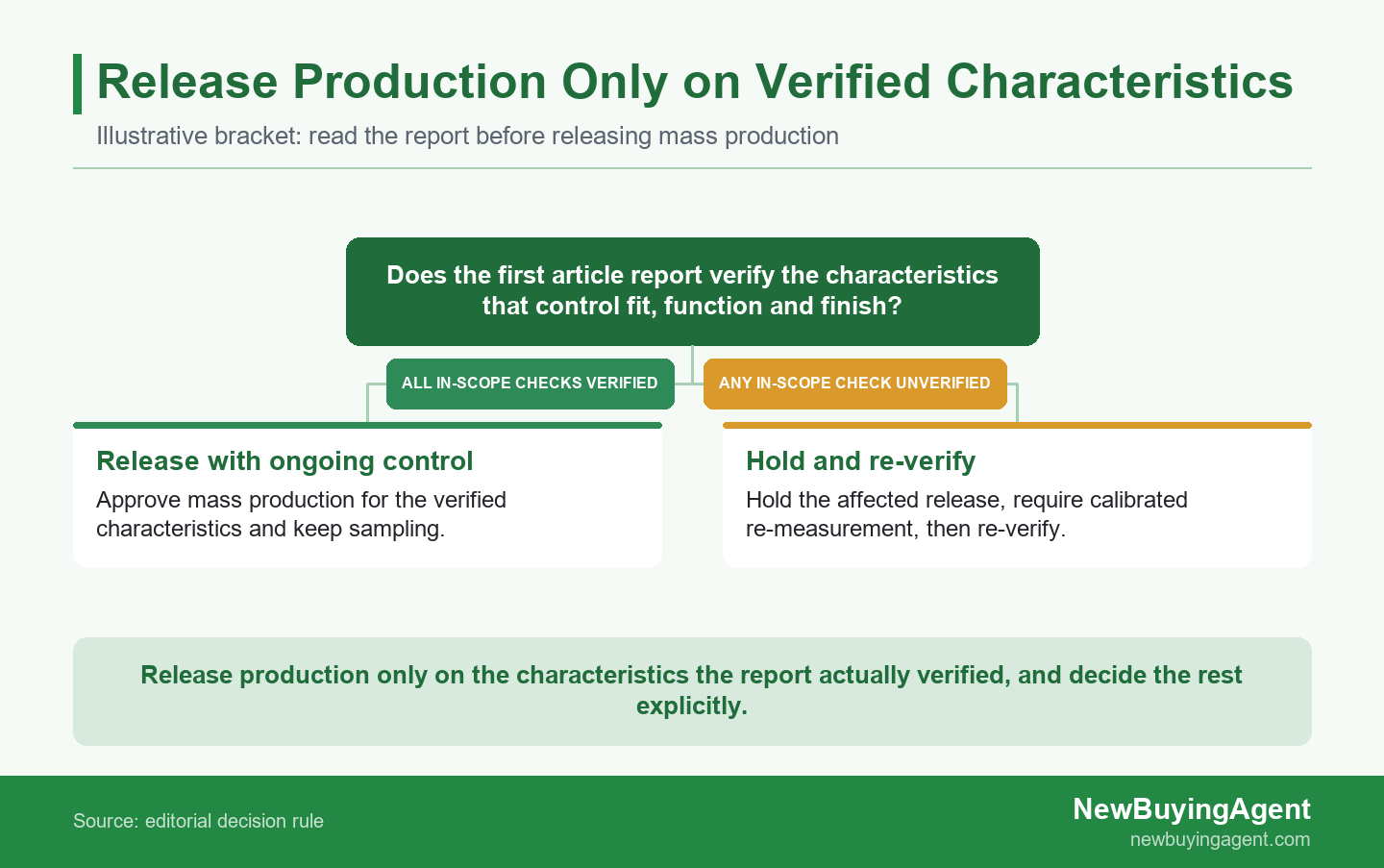
Decision branch showing a first article report leading either to a release on verified characteristics or to a hold and re-verification
When a First Article Report Is Not Enough to Release Production
Separate reversible preparation from the release that depends on missing evidence, and state the condition for release. This keeps the project moving without treating an incomplete report as permission to start full production.
Illustrative Example: A Machined Bracket FAI That Held Production
In this illustrative example, a consumer brand is sourcing a custom machined aluminum phone-holder bracket with critical bores and an anodized finish, with 25,000 units planned from a new China factory using new machining fixtures. The tooling and fixtures are built, a first production run is available, and the buyer has requested a first article inspection against the released drawing.
Most drawing dimensions on the first article are within tolerance, but among the 3 critical bores one was measured with an uncalibrated gauge and its reading sits on the tolerance boundary, and the anodize coating thickness is not reported at all. The buyer can acknowledge the dimensions that were measured, yet the bore and the coating cannot be treated as verified: one lacks a traceable measurement, and the other was never measured.
The decision is to hold production release for the affected characteristics while allowing packaging and logistics preparation that remains reversible. The factory is asked to re-measure the bore with a calibrated instrument and to supply a coating thickness report, after which the two characteristics are re-verified against the drawing.
Before mass production is released, the buyer reviews the calibrated bore results and the coating report against the drawing, and after release confirms conformity with ongoing sampling. This illustrative example invents no measured value and no passed test, and a first article inspection is not production acceptance; the product’s own critical characteristics govern the real scope.
Approve Production Only When the FAI Closes the Right Characteristics
Approve mass production only when the first article inspection covers the characteristics that control fit, function, safety and appearance, and treat uncovered or nonconforming characteristics as an explicit decision rather than a formality. By analogy with the aerospace and automotive first-production frameworks, the transferable lesson is to approve only the verified characteristics, not to import their certificate requirements. Name the verified characteristics, the open items and their owners so the approval can be defended later.
Do not confuse this release with lot acceptance. The NIST Engineering Statistics Handbook describes lot acceptance sampling as making a decision on a lot-by-lot basis whether to accept or reject a lot as likely to meet requirements or as likely to have too many defective units. That is a statistical judgement about a shipment; a first article inspection judges whether the process can meet the drawing in the first place. A buyer needs both.
Frameworks differ by industry as well. AIAG’s Production Part Approval Process (PPAP) is the automotive industry framework for approving a production part and process, a different framework from an aerospace-style first article inspection. A consumer-product buyer can take the underlying idea, that the first production result must be formally approved, without assuming one industry’s forms fit another’s product.
The boundary is the part buyers most often skip. First article approval does not guarantee every later unit, because the process can drift after release. Pair it with ongoing control: sampling at an agreed frequency, in-process checks on critical characteristics, and a rule for a failed check. The first article sets the baseline; ongoing control protects it.
Put the FAI Requirement Into the China Purchase Order
Write the first article inspection into the purchase order as a scoped deliverable: drawing revision, characteristic list, measurement evidence, nonconformance disposition and a production-release condition. A defined deliverable lets competing suppliers quote the same work and removes the ambiguity behind the phrase “FAI report”.
State who prepares the inspection, which equipment and calibration evidence are required, and whether independent inspection is needed for features the buyer cannot verify remotely. State what happens if the first article fails: who pays for rework, how a revised article is re-inspected, and whether production may start in parallel.
For a custom product entering China sourcing, prepare the released drawing revision and tolerance scheme, the bill of materials and critical characteristics, the quantity and forecast, the target price, the destination and the delivery timing. NewBuyingAgent can use its local China factory resources and product-development/QC capability to develop a product quotation aligned with those requirements, including the first article evidence and the release condition. With that brief ready, send your product requirements to NewBuyingAgent.
Frequently Asked Questions
Is a first article inspection the same as an AQL inspection?
No; a first article inspection verifies the process that produced the first article, while an AQL inspection accepts or rejects a lot from a random sample. The first answers whether the tool and process can meet the drawing; the second answers whether a shipment is likely to contain too many defects. A buyer usually needs the first before production and the second during it.
Is PPAP the same as a first article inspection?
No; PPAP is the automotive production-part approval framework, while a first article inspection is a documented verification of the first production article against the drawing. They overlap in purpose, since both approve a first production result, but they come from different industries and carry different submission expectations. Use the method that fits the product and the contract.
Can a factory reuse a first article report from a similar product?
Only when the earlier report still matches the same drawing revision, tool, factory, material and process. Ask for a comparison of the two products and an explanation of which characteristics remain valid; a similar appearance does not prove equivalent dimensions or process behaviour. Where a change is local, a partial re-verification may be enough, but record why the untouched characteristics are unaffected.
Does a first article inspection guarantee every later unit?
No; it verifies the process on the first article, so ongoing conformity still depends on process control and further inspection. The tool can wear, the process can drift and a substitute material can appear later, none of which the first report would reveal. Treat the first article approval as the production baseline and pair it with sampling and in-process checks on the characteristics that matter most.
NewBuyingAgent
Related Resources
Heute beginnen
Lassen Sie uns Ihre Beschaffungsziele in die Realität umsetzenWeChat:+86 15157124615
WhatsApp:+86 15157124615
Adresse: Gebäude 10 #39 Xiangyuan Road, Hangzhou, China
