

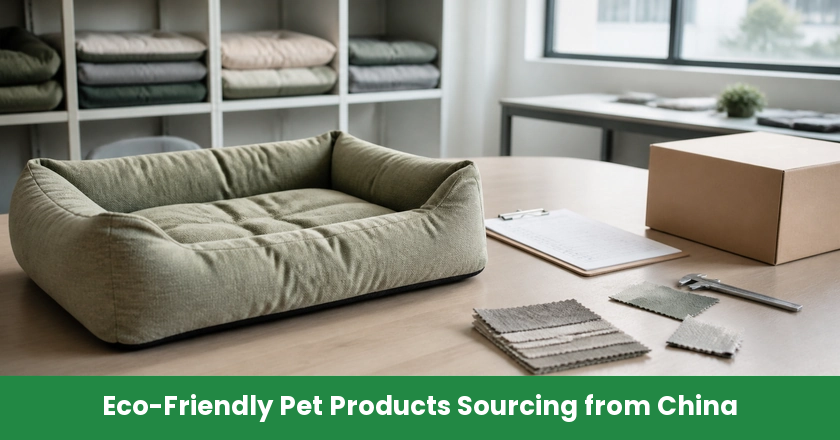
Do not approve an eco-friendly pet-product claim until the factory can show which finished component it describes, what evidence supports it, and which packaging and artwork version carries the wording. A recycled cover fabric, an FSC paperboard carton, and a textile test can each be useful. None automatically proves that an entire pet bed, toy, carrier, or grooming accessory is environmentally friendly.
The practical sourcing task is to turn a material preference into one controlled product version. That means naming the component, its specification or percentage, the proof file, the packaging language, and the buyer who may release the artwork. This is not a generic pet-products sourcing guide or a legal review. It is a way to prevent a supplier’s broad green phrase from travelling farther than the evidence behind it.
Start With a Specific Material Claim, Not ‘Eco-Friendly’
Broad, unqualified environmental benefit claims such as “eco-friendly” are difficult to substantiate; a product brief should instead name the specific material or packaging attribute and its boundary. The FTC’s Green Guides summary gives the useful starting point: general environmental-benefit language needs clear, prominent, and specific qualification.
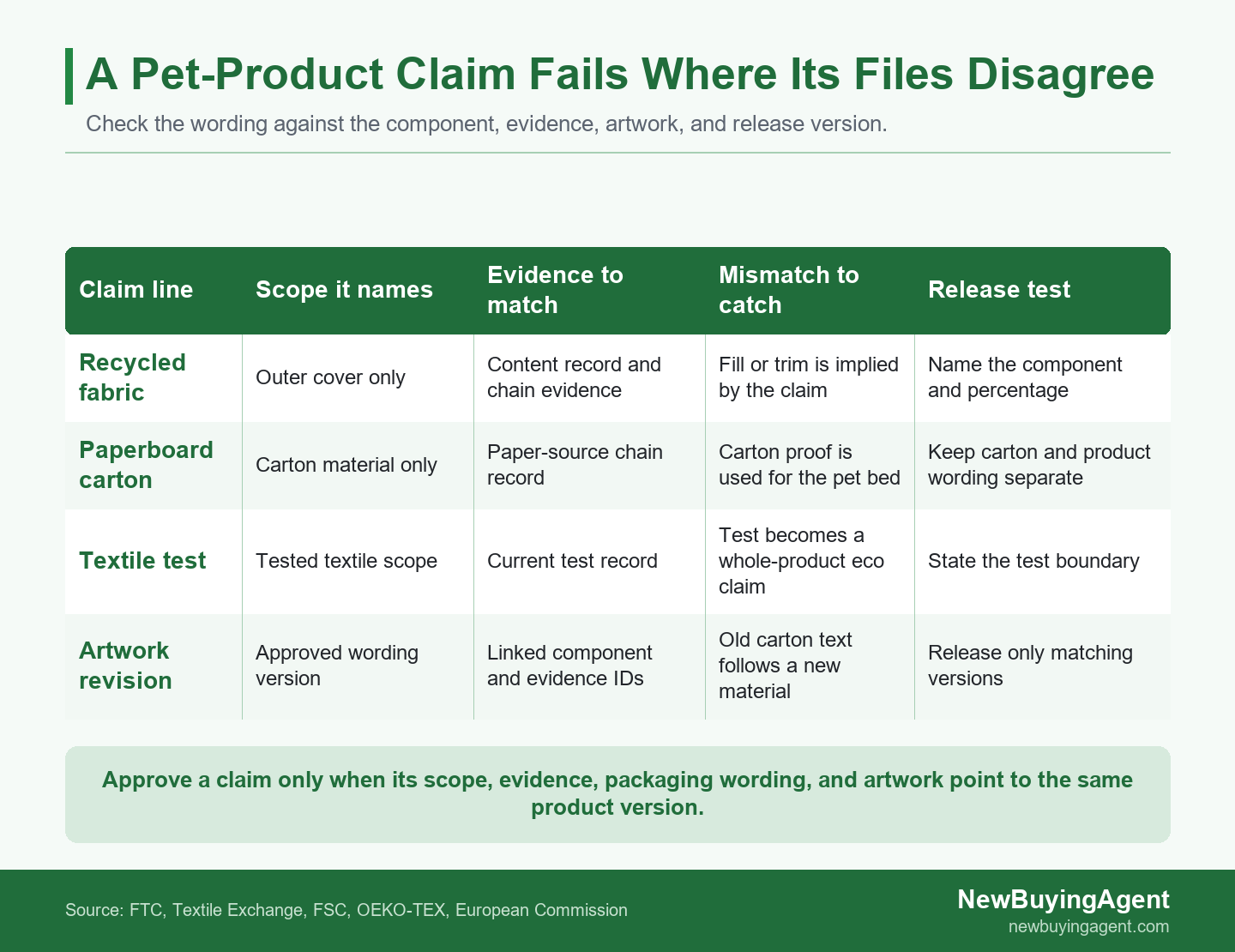
Four-row matrix showing how material, packaging, certificate, and version mismatches block an environmental pet-product claim from release
A claim-to-evidence map is an editorial approval tool that links each material or packaging statement to a component, proof record, artwork version, and buyer decision owner. In plain terms, it stops “made with recycled materials” from becoming a carton headline before anyone has identified which layer, fabric, buckle, fill, insert, or package actually has that attribute.
- Claim: “Cover made with 70% recycled polyester,” not a general product-level green promise.
- Component: the approved cover fabric SKU and colourway, not a supplier catalogue family.
- Evidence: the record that supports that percentage and material path.
- Release: one buyer-side owner confirms the product file and artwork use the same version.
The distinction matters commercially. A supplier can still offer a well-made pet product even when a proposed environmental phrase is too broad. The answer is usually to narrow, clarify, or hold the wording—not to imply that the whole order has failed. This gives the buyer a cleaner conversation about materials, margin, packaging, and market positioning.
Turn Material Choices Into Traceable Supplier Evidence
A material choice should be approved as a component specification with the evidence needed for its intended claim, rather than as a generic green preference. Start with a bill of materials that separates the cover, fill, webbing, buckle, coating, label, carton, and insert. That list also makes the China manufacturing and product guide more useful: the buyer can request a defined product rather than ask a factory to interpret an aspiration.
| Proposed attribute | What to identify | What not to infer |
|---|---|---|
| Recycled cover fabric | Material, percentage, supplier record, fabric SKU, finished-product version | That fill, trim, carton, or the whole product has the same attribute |
| Forest-based paperboard | Carton or insert component, paper specification, relevant chain record, artwork scope | That plastic components or product durability are covered |
| Textile tested for harmful substances | Certified article, intended textile use, certificate identifier and valid product scope | That the item is environmentally beneficial or proven safe for every pet use |
| Reduced packaging | Baseline, package version, weight or volume comparison, target-market wording | That it is recyclable or compliant everywhere |
The table is an approval aid, not a universal certification matrix. It tells a buyer which evidence question belongs to each attribute before quote comparison, sampling, or packaging artwork begins.
For Recycled Inputs, Match the Percentage to the Chain
RCS and GRS use third-party certification and chain-of-custody requirements for recycled materials, so a recycled-textile request needs evidence that follows the stated material through the supply chain. Textile Exchange explains the RCS and GRS approach, including that chain of custody documents the certified material’s path through supply-chain stages.
Here, chain of custody means records that trace a specified material through relevant supply-chain stages. Ask the factory to identify the relevant fabric or material supplier, the claimed percentage, the product component, and the version that will be used in the sample and production order. A certificate name on a sales sheet is not the same thing as an approval file tied to the selected product.
Keep the wording proportional. “Cover contains a stated recycled percentage” may be supportable where “sustainable pet bed” is not. If the buyer wants a claim on a hangtag or ecommerce listing, the claim owner should review the actual statement before it reaches artwork lock.
Keep Wood and Paper Claims Separate From Plastic Claims
FSC chain-of-custody certification tracks forest-based material from sourcing to finished goods, which makes it relevant to a defined wood, paperboard, or paper-packaging component rather than a blanket whole-product claim. FSC describes this material-tracking scope as following forest-based materials through production and distribution.
For a cardboard carton, a paper insert, a wood grooming brush, or a wood element in a cat tree, list the component separately. Then ask whether the intended wording refers to the component, the packaging, or the product. This avoids a familiar error: a paperboard carton carries an evidence basis, but the listing copy quietly turns it into an environmental claim about plastic clips, foam, coating, or the entire assembled product.
Do Not Let a Textile Test Become a Whole-Product Claim
OEKO-TEX STANDARD 100 addresses textiles tested for harmful substances; it is not, by itself, a general environmental or pet-safety certification for an entire finished item. OEKO-TEX describes STANDARD 100 as a textile label based on testing for harmful substances and the intended use of textiles and materials.
This boundary is useful rather than limiting. A buyer sourcing a washable bed, textile carrier, leash pad, or soft toy can ask which textile article is covered, which accessories are included, and whether the certificate matches the production material. The buyer should not turn that answer into a promise about every component, every pet behaviour, or the environmental performance of the complete product.
NewBuyingAgent’s China-side sourcing support is most valuable when these boundaries are clear early: a product brief can name what needs checking, while factory communication and quality-control capability can keep the chosen material, sample, and production version aligned. That is a more useful application of local factory resources than a generic “green product” request.
Review Packaging and Artwork as Part of the Same Approval
The EU Packaging and Packaging Waste Regulation covers packaging placed on the EU market and generally applies from 12 August 2026, so destination-market packaging review should be a separate sourcing approval task. The European Commission’s packaging overview also makes clear that the regulation covers packaging and packaging waste regardless of material or origin.
China consumer-goods guidance notes strict labeling and marketing controls, reinforcing the need to validate claim artwork for the actual target market rather than rely on generic factory wording. International Trade Administration guidance is a reminder that labels and marketing language need market-specific review.
Make the carton and insert their own approval objects. Record their material, printing file, disposal wording, destination, and relation to the product claim. If the product is sold in several markets, one product specification may support several packaging versions, each with different required language. That is not needless paperwork; it prevents a factory from printing an unreviewed phrase simply because it appeared on an earlier sample.
Illustrative Scenario: A Recycled-Fabric Pet Bed With Two Claim Gaps
In the illustrative pet-bed scenario, separating a recycled-cover claim from unsupported fill and carton language prevents the buyer from approving a broader claim than the evidence supports.
Approve the Version, Not the Marketing Phrase
A pet-accessories brand is preparing an illustrative 3,600-unit washable bed order from China. The collection has 2 cover colours, a requested recycled-polyester cover, one fill specification, and 2 carton artwork versions for different destination markets. The factory can provide a record for the selected cover fabric, but the initial artwork calls the complete bed and its carton “eco-friendly.”
The buyer separates the files. The cover evidence may support a narrow statement about that component. The fill has no matching recycled-content record, and the carton specification does not establish the same product-level attribute. The gap is not that the factory failed to offer a product; it is that the proposed customer-facing phrase has a wider scope than the files behind it.
The buyer holds the broad artwork, keeps the physical product specification moving, and requests a locked bill of materials, a component-scope evidence reference, revised carton wording, and one release owner. This is illustrative only. It does not report a customer outcome, test result, legal conclusion, or environmental performance outcome.
The scenario release gate checks material, evidence, carton and artwork identifiers before the buyer approves a claim. The gate can be simple: the evidence file names the relevant component; the approved bill of materials names the same component; the carton and listing artwork use wording at that scope; and one buyer owner signs off the version.
That control also gives the factory a workable instruction. It does not ask production to interpret a marketing aspiration. It tells the team which sample, material input, artwork file, and carton version must stay together. If the buyer later changes a fabric, fill, or carton, the claim review reopens for that version rather than being assumed to carry over.
Where NewBuyingAgent Fits in an Evidence-Ready Pet Product Request
NewBuyingAgent can support a defined pet-product sourcing request by connecting product requirements, factory communication, quality control and logistics coordination to the buyer’s approved evidence package. For a new collection, buyers can explore how to source a new pet product from China; buyers already working with factories can use China-side support to manage China-side supplier follow-up.
The useful starting input is not “find an eco supplier.” It is the product sketch, component list, quantity, target market, intended wording, sample timing, and the buyer’s decision owner. That gives a China-side team a practical basis for factory discussions, sample control, and packaging coordination. Buyers can also review NewBuyingAgent client cases for broader cross-category sourcing context.
A Six-Item Approval File Before You Place the PO
A six-item approval file reduces ambiguity by keeping the purchase order, bill of materials, evidence, packaging specification, artwork and release owner aligned to one version.
- Lock the finished product version and component bill of materials.
- Write the specific material or packaging claim the buyer wants to use.
- Request evidence that names the relevant component and scope.
- Approve the carton, insert, hangtag, and listing artwork separately.
- Record the target market and any destination-specific review owner.
- Name the buyer-side person who may release the matching files.
If you are preparing a China sourcing request, discuss an evidence-ready pet product brief with NewBuyingAgent after you have the product, component list, quantity, destination market, intended wording, and sample timing. That creates a meaningful factory conversation without implying a blanket environmental, safety, or regulatory result.
Related Guides
Related sourcing guides help buyers turn a product idea into a defined China sourcing brief. Start with the product and manufacturing context before asking a factory to quote a material and claim combination.
Questions Buyers Ask Before Using an Environmental Pet-Product Claim
Can a recycled fabric certificate support an eco-friendly pet-bed claim?
Environmental claim wording should remain specific to the evidence and disposal or market boundary that the buyer can substantiate. FTC guidance is a useful reference for that boundary. A recycled fabric certificate can support a pet-bed claim only when the wording is limited to the evidenced fabric component and the buyer can connect its stated percentage and records to the finished version. It does not automatically describe fill, hardware, carton, or the overall item.
Does OEKO-TEX prove a pet product is environmentally friendly?
No, OEKO-TEX STANDARD 100 concerns textiles tested for harmful substances and does not itself prove an overall environmental benefit or pet-safety conclusion. Check what the certificate covers, whether it matches the production textile, and whether accessories or other components fall outside its scope. Use it as a defined textile evidence item, not a shortcut for broad marketing language.
Should carton claims match the pet product’s material claim?
Yes, carton wording should identify the packaging attribute it actually describes rather than repeat a product-level claim without evidence. Treat the carton as its own material and artwork version. Where the product is sold in multiple markets, ask a responsible reviewer to confirm the relevant destination wording before printing; a valid product component claim does not automatically settle packaging language.
What should a China supplier provide before PO approval?
Ask for the approved bill of materials, component evidence, sample reference, packaging specification, artwork file, and a named release owner. The exact proof depends on the claim and market, but the files should share a product version or identifier. If the supplier changes the fabric, percentage, fill, carton, or printing, treat the environmental wording as a new approval question rather than assuming the earlier file still applies.
NewBuyingAgent
Related Resources
Heute beginnen
Lassen Sie uns Ihre Beschaffungsziele in die Realität umsetzenWeChat:+86 15157124615
WhatsApp:+86 15157124615
Adresse: Gebäude 10 #39 Xiangyuan Road, Hangzhou, China
