

Cost of poor quality (COPQ) is the loss associated with internal and external quality failures, separated here from spending on prevention and appraisal.
That distinction changes the budget discussion. An inspection invoice shows what the buyer paid to check quality; it does not show the money consumed by rework, destination sorting or customer returns. A quality director importing from China needs both views: the failure loss already being incurred and the additional spending proposed to reduce it, measured over the same order scope and period.
The useful question is whether a specific change can avoid enough loss to cover its added cost. The model below gives importers, retailers and brands a way to assemble that evidence, test the assumptions and set a review condition before approving the next order’s quality budget.
Make the quality budget answer the investment question
- Separate the categories. Keep prevention and appraisal spending distinct from internal and external failure losses.
- Reconcile the ledger. Tie each cost to an order and event, and show confirmed recoveries separately.
- Test the threshold. Ask how much failure loss the proposed investment must actually avoid.
- Verify the outcome. Compare like orders and return windows before calling a forecast a saving.
Separate failure losses from the full quality budget
The full quality budget includes prevention, appraisal and the consequences of failure; it should not be reduced to the inspection fee. ASQ’s cost-of-quality explanation distinguishes prevention and appraisal from internal failure before delivery and external failure after delivery. For an importer, these categories answer different questions: what was spent to make requirements achievable, what was spent to check conformity, and what was lost when the product failed those requirements.
Classify the activity by its purpose. An edge specification agreed before a wire basket enters production is prevention; checking a production sample against that specification is appraisal. Repairing a nonconforming edge is an internal failure cost when it occurs before the defined customer delivery boundary. Destination sorting, complaints and returns may expose external failure. Define that boundary consistently for the management report, rather than reclassifying the same event merely because a different party paid the invoice.
Product requirements determine which preventive work is useful. A basket’s finish, edge condition and packaging need different controls, so begin with the drawing, approved sample and intended use. NewBuyingAgent’s China Manufacturing and Product Guide can support the earlier product research; turn the actual order requirements into the cost model’s control activities. A generic allowance labeled “quality” cannot show which failure the proposed spending is intended to reduce.
Total cost of quality includes prevention and appraisal plus internal and external failure losses. Together, those failure losses form the cost-of-poor-quality subtotal. Keep those views together: reducing failure losses can justify more preventive spending, but only if the additional cost and realizable benefit concern the same scope and period. An untested forecast does not become a saving because it appears in a budget table.
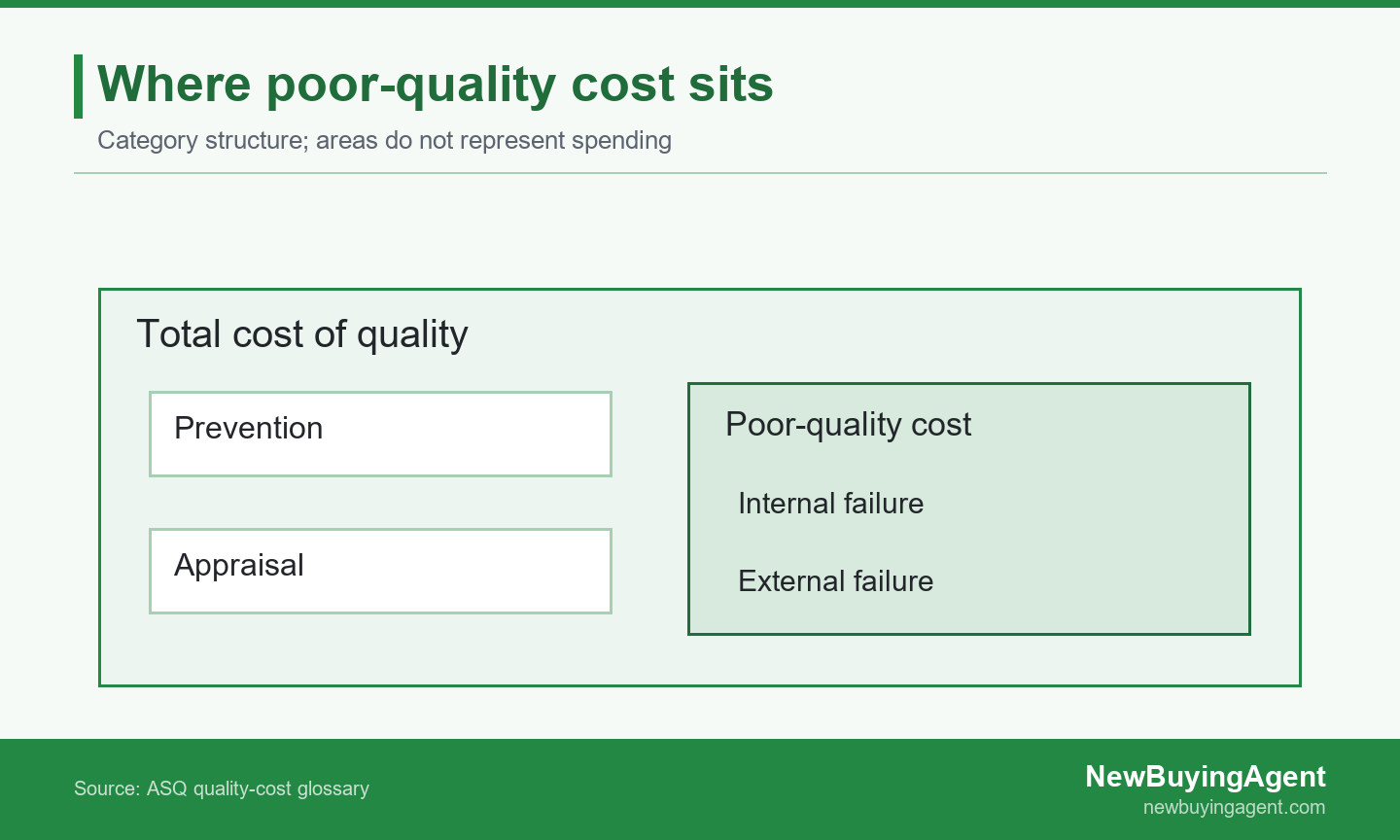
Prevention and appraisal belong to total quality cost; internal and external failures form the poor-quality subset.
Build a cost ledger that finance can reconcile
Build the quality-cost ledger around a distinct order and failure event, then attach the evidence behind each amount. Finance should be able to trace the total back to an invoice, a stock adjustment or a documented time basis. Keep the reporting period, payer and recovery status visible so that moving a cost between departments does not make it disappear or cause it to be counted twice.
| Ledger field | What to record | Check before totaling |
|---|---|---|
| Event identity | Order, product version, lot and failure reference | Related invoices belong to the same underlying event. |
| Cost category | Prevention, appraisal, internal or external failure | Classification follows a stated convention. |
| Cost basis | Quantity and rate, or actual invoice amount | Time estimates and booked costs remain distinguishable. |
| Evidence and payer | Invoice, stock record or time log; party bearing the loss | Factory-paid work is not automatically a buyer expense. |
| Recovery status | Claimed amount, confirmed credit and settlement reference | Unconfirmed recovery stays outside the confirmed net total. |
| Reporting basis | Currency, period and any conversion convention | Orders and return windows are comparable. |
Reconcile inventory-related losses with the finance record rather than automatically adding the full purchase value again. The IFRS Foundation’s IAS 2 inventory summary explains measurement at the lower of cost and net realizable value, and recognition of inventory write-downs and losses as expense. That is an accounting context for organizations using the standard; this management ledger does not prescribe journal entries. Ask finance which loss is already represented in inventory or returns accounts.
Show gross failure cost and confirmed recoveries separately. A supplier credit request is not received cash, and a credit for goods may leave sorting, handling or extra freight unrecovered. Record who ultimately bears each amount. If returns losses already include the relevant product write-off, do not add that write-off again under scrap. Likewise, enter replacement freight only to the extent it is additional to an amount already included in the return allowance.
Spend on the cause and the detection point
A quality investment needs a stated failure mechanism and a point where the proposed action can prevent or detect it. More final inspection may find additional defects, but it cannot by itself remove the production condition that creates them. Match prevention to the process or requirement gap, and appraisal to the evidence needed before the buyer makes the next order decision.
For example, a material substitution may require a revised setup and operator instructions. A NIST Manufacturing Innovation Blog article on supply-chain changes explains how process changes can require updated standard work and training, and how missing documentation can contribute to quality issues. The article discusses manufacturing practice, not a guaranteed return on training. For the buyer’s proposal, name the actual change, the person implementing it and the defect it is intended to prevent.
Appraisal still has a separate role. NIST’s acceptance sampling guidance distinguishes deciding whether to accept a lot from estimating its quality. A sample acceptance is therefore not proof that the underlying failure has been eliminated. Budget for the agreed inspection evidence, while judging a prevention claim through the relevant process checks and subsequent performance. Keep product acceptance under the actual inspection plan; the cost model does not override it.
For existing China production, implementation also depends on factory cooperation and timely information. NewBuyingAgent’s management of existing China factories supports supplier communication, production progress, staged quality inspections and real-time reporting. A buyer dealing with recurring edge defects can use that scope to agree the required product condition and evidence at the relevant stage. The benefit is clearer China-side follow-up toward conforming goods, with the intervention tied to the order rather than a detached inspection purchase.
A hypothetical basket order makes the budget decision concrete
A hypothetical wire-basket order shows how the quality-cost model turns a loss ledger into a conditional budget decision. Start with recorded failure costs, then ask what additional prevention and appraisal would need to achieve on a comparable order. The arithmetic can establish an investment threshold; it cannot establish that the proposed production change will work or that future goods are ready for release.
Establish the recorded loss before forecasting savings
In this hypothetical example, a retailer reviews an 8,000-unit wire-basket order from a China factory. Edge complaints have recurred, and the destination warehouse has supplied sorting records. The buyer has not approved the next order’s additional quality budget: the immediate task is to reconcile the reference order’s cost evidence, then decide what a controlled trial would have to improve.
The hypothetical recorded failure ledger totals $600 rework + $1,200 destination sorting + $1,400 net return losses + $800 extra replacement freight = $4,000. Sorting and return records reveal costs beyond the factory repair. In this example, the net return amount already includes the relevant product loss after confirmed recovery; replacement freight is a separate additional charge. Those definitions prevent the same goods or transport loss from being counted again.
Set the investment ceiling and verification gate
For the next comparable order, existing prevention and appraisal total $1,500. Adding $1,200 prevention and $300 appraisal adds $1,500. If failure losses fall from $4,000 to an assumed $1,500, total quality cost changes from $5,500 to $4,500, an illustrative $1,000 improvement. This assumes the baseline failures would otherwise recur and that the reduction produces realizable economic benefit; none of these figures is a supplier quote or an observed result.
The buyer approves only a scoped trial, with an agreed edge reference, a process-control change and targeted inspection evidence. The trial is not authorized merely because the arithmetic is positive. After a comparable order and its return window, the reviewer checks actual failure events, extra spending and recurrence against the baseline. This hypothetical calculation remains a conditional budget case, not a measured improvement, a quality guarantee or a product-release approval.
Test how much failure reduction the proposal needs
Test the assumptions that would change the spending decision, rather than present only the preferred forecast. HM Treasury’s Green Book guidance on appraisal uses sensitivity analysis and switching values to examine key assumptions in public spending proposals. The transferable lesson for this private quality budget is to identify when the proposal stops paying; it does not make government appraisal duties or social discount rates requirements for importers.
In the hypothetical model, $1,500 additional spending against $4,000 baseline failure losses requires a 37.5% reduction to break even. That threshold assumes the counted reductions are realizable within the same period, and that existing quality spending otherwise remains unchanged. A switching value is the level of an assumption at which the decision changes: here, the required avoided failure cost. Replace the assumed loss reduction with evidence from a relevant trial before committing beyond it.
| Next-order failure | Avoided failure | Net change after added spend |
|---|---|---|
| $3,000 loss | $1,000 avoided | -$500 net |
| $2,500 loss | $1,500 avoided | $0 net |
| $1,500 loss | $2,500 avoided | +$1,000 net |
These illustrative outcomes hold the extra quality spend constant. They are scenarios, not probabilities or an industry improvement range. If the baseline loss included a one-off event unlikely to recur, reduce the avoidable-loss assumption before calculating the threshold. If the proposed control affects only scratches, exclude unrelated delivery damage from the benefit it is supposed to generate.
Choose the failure mode worth preventing
Choose the next prevention effort using a stated measure of failure impact, rather than the most memorable complaint. ASQ’s Pareto explanation organizes problems by frequency or impact; for a cost decision, make clear which measure determines the order. A frequent cosmetic issue may cost less than a rarer replacement event, while a severe safety concern needs its own action even when its recorded financial loss is small.
A cost ranking identifies where to investigate, not what caused the defect. ASQ’s root-cause definition concerns the underlying reason whose elimination prevents recurrence. Check the relevant material, setup, specification and handling evidence before selecting an action. A repeated instruction to “inspect carefully” does not establish that an edge-finishing problem has been controlled. Give the factory a product-specific acceptance reference and use the trial to test the proposed mechanism, with the responsible technical reviewer judging whether the evidence supports it.
For a new product, the priority can also shape the initial purchasing brief. NewBuyingAgent’s product sourcing and supply service combines local factory resources with product development and quality-control capability to supply China products around buyer requirements. A finish-sensitive product brief should therefore make the required condition and use case clear before production decisions are fixed. The buyer is seeking suitable products with a workable quality and delivery outcome, rather than paying for a cost spreadsheet as a separate service.
Turn the cost model into an order-level decision
Submit a quality-budget request with the targeted failure, incremental spending, evidence for avoidable loss and accountable owners in the same decision record. Give finance the cost basis and operations the implementation task, then agree a review period that captures the relevant returns. Continue the intervention only when the evidence supports its product and economic purpose; do not call an accounting reclassification an improvement.
Use this decision record in the order review: product and order scope; recurring failure; reference period and confirmed ledger; proposed control and why it should work; additional prevention and appraisal spend; avoidable-loss assumption and its evidence; break-even loss reduction; factory implementation owner; buyer technical reviewer; finance reconciliation owner; next review trigger. Record the decision as approve a bounded trial, revise the scope, or defer pending evidence. Keep product release authorization separate from the spending decision, including any unresolved safety or compliance concern.
When the trial is reviewed, compare product version, order scale, cost basis and return window with the reference order. Explain meaningful changes rather than forcing an attractive before-and-after total. Lower reported losses can result from fewer goods sold or incomplete returns data; higher recorded appraisal may reflect better visibility. The decision record should distinguish those effects from a demonstrated improvement in the recurring failure.
If an existing China factory needs stronger quality follow-up, share the purchasing brief, recurring quality issue, cost evidence and next order stage. NewBuyingAgent can discuss supplier communication, production follow-up and quality-control scope aimed at the required product outcome, with an agreed evidence handoff for the order. The buyer and finance team retain the cost assumptions and spending decision. Discuss the quality-management scope with NewBuyingAgent.
Frequently asked questions
What percentage of sales should importers budget for poor quality?
Use your own scoped failure records rather than a universal percentage of sales. Product type, customer commitments, delivery model and accounting boundaries change the result. If reporting a ratio internally, label the numerator, denominator and period, and compare like bases. An industry average cannot establish what your next China order will lose or what an intervention will save.
Is an inspection fee part of the cost of poor quality?
Routine inspection is appraisal in this management model, rather than a failure loss. Additional sorting or reinspection caused by a defect needs a consistent stated classification and its own evidence. Finance may use different account codes, so map those codes to the management categories. The important control is to include each underlying cost once and explain why the extra activity occurred.
Can employee time be counted as a saving?
Released employee hours are not automatically cash savings. Track the capacity consumed by complaints, sorting coordination or repeated factory follow-up using an agreed rate and time basis. Then identify whether the improvement actually avoids overtime, contractor spend or another cash cost, or frees capacity for valuable work. Report that distinction instead of describing an unchanged payroll as money recovered.
Should lost sales and reputation be included?
Keep uncertain market effects separate from recorded failure costs. If finance models lost contribution, make its assumptions and probability basis explicit, and avoid adding gross sales revenue to a ledger already counting product and return losses. Reputation risk can still influence the decision without an invented currency value. A conservative ledger is useful even when some commercial consequences remain unquantified.
NewBuyingAgent
Related Resources

Heute beginnen
Lassen Sie uns Ihre Beschaffungsziele in die Realität umsetzenWeChat:+86 15157124615
WhatsApp:+86 15157124615
Adresse: Gebäude 10 #39 Xiangyuan Road, Hangzhou, China
