

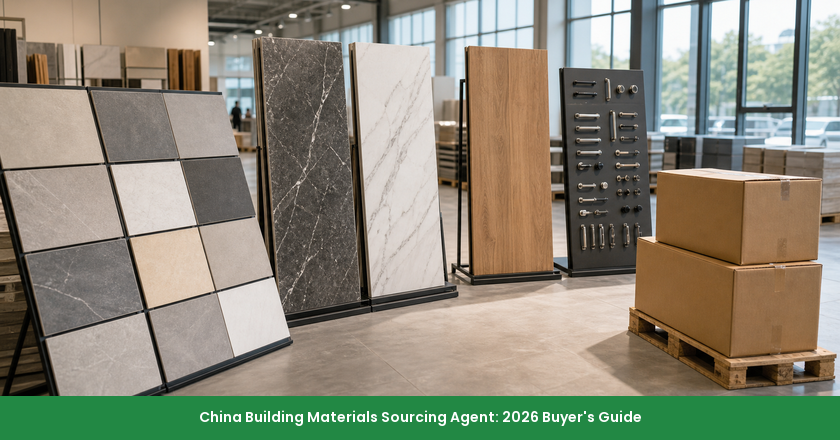
A China building materials sourcing agent helps buyers source construction, renovation, and home-improvement materials from China by managing supplier selection, specification control, sample approval, production follow-up, quality evidence, and shipment coordination.
Building materials sourcing is not a simple price comparison. The same product name can hide different grades, tolerances, finishes, coatings, packaging methods, test assumptions, and logistics costs. Tiles, flooring, panels, doors, hardware, fixtures, boards, decorative materials, fasteners, and project materials can all look similar in photos while performing very differently on site.
The biggest risk is not always a defective unit. It is often a mismatch between the buyer's required standard and the factory's quoted standard. A supplier may quote a lower grade, thinner material, weaker packaging, different finish, shorter warranty assumption, or different delivery term. By the time the mismatch is discovered, the buyer may already be facing project delays, replacement cost, or difficult claims.
This 2026 guide focuses on sourcing process, not legal advice. Building materials can involve destination-market standards, project specifications, fire or safety requirements, environmental rules, and installation constraints. Buyers should verify official requirements and consult qualified professionals where needed.
Key Takeaways
- Do not compare quotes until the standard is fixed: grade, size, tolerance, finish, packaging, and delivery terms change the real price.
- Batch consistency is the core risk: building materials often fail through lot variation, not only through individual defects.
- Documents and logistics shape landed cost: weight, palletization, container loading, Incoterms, and import documents should be planned before shipment.
- Factory proof matters more than catalog breadth: the supplier must show capability for the exact material standard, not just similar products.
- NewBuyingAgent fit: building materials buyers often need sourcing, factory management, QC coordination, and delivery support in one workflow.
The Building Materials Sourcing Control Map
The Building Materials Sourcing Control Map has four checkpoints: standard fit, factory proof, batch control, and shipment logic.
The Building Materials Sourcing Control Map is designed to make quotes comparable before the buyer commits. Standard fit confirms what product is being sourced. Factory proof shows whether the supplier can repeat it. Batch control checks whether the bulk order stays consistent. Shipment logic connects the heavy, bulky, fragile, or regulated nature of the goods to landed cost and release evidence.
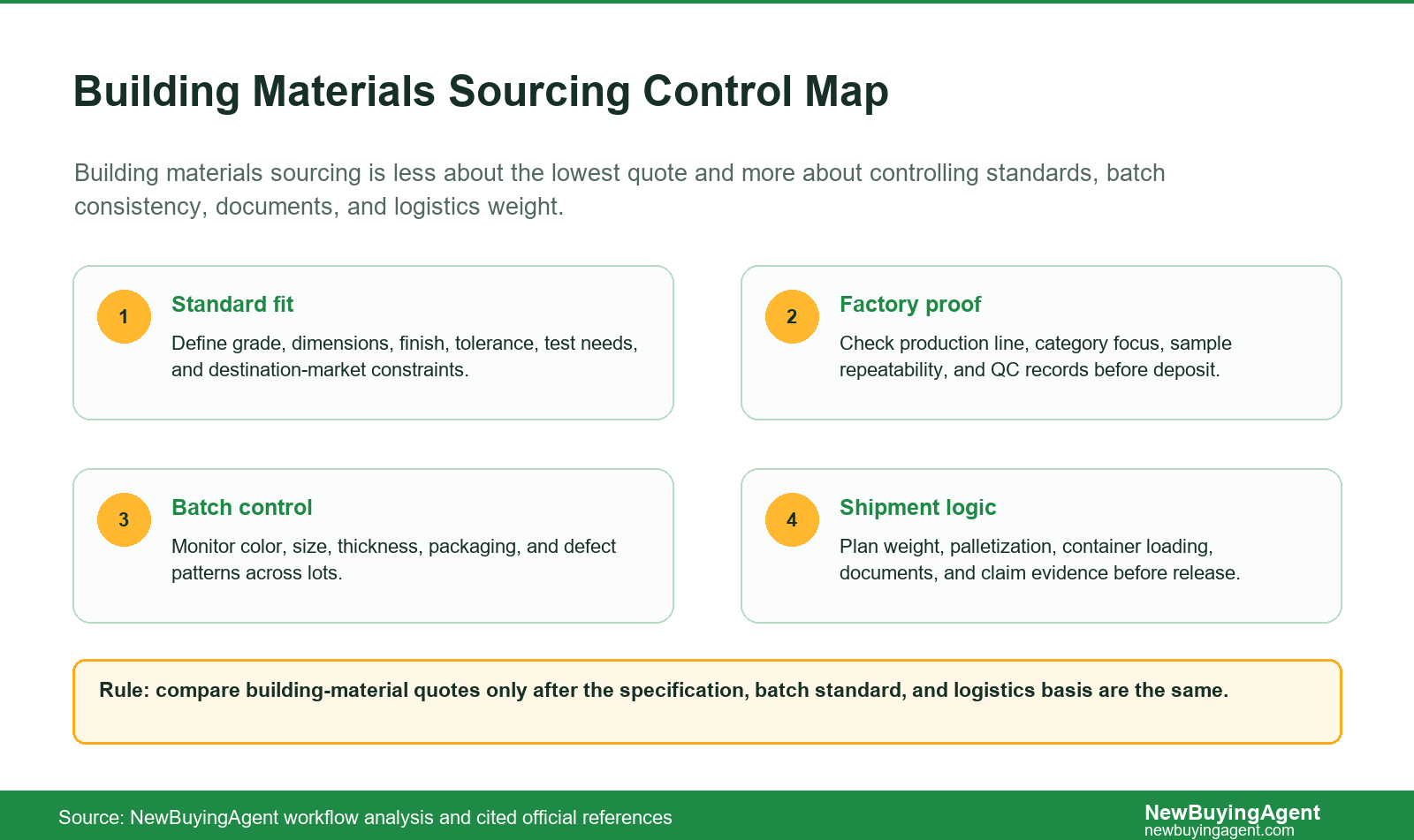
Building materials sourcing requires specification control, factory proof, batch consistency, and logistics planning.
This framework is especially useful for project buyers. In a project, a small material mismatch can create installation issues, color inconsistency, or replacement delays across many units. The buyer needs a sourcing partner that can turn the project standard into factory language, then verify whether production and packaging match that standard.
For cross-border buyers, customs and documentation should be part of the sourcing discussion early. CBP's Basic Importing and Exporting guidance is a useful reminder that importers should understand documentation, lawful sourcing, and applicable import responsibilities. A sourcing agent can coordinate supplier-side execution, but the buyer should still know the import basis.
What a Building Materials Sourcing Agent Should Control
A building materials sourcing agent should control the path from specification to shipment. The agent should help the buyer define the product standard, screen suppliers by category, normalize quotations, manage samples, track batch consistency, coordinate inspection evidence, and prepare shipment handoff. The process should be evidence-led because many building materials cannot be judged from catalog photos.
| Control point | What to define | Why it matters |
|---|---|---|
| Specification | Grade, size, finish, tolerance, coating, test needs, packaging | Prevents suppliers from quoting different standards |
| Factory capability | Production line, category focus, sample repeatability, QC records, lead time | Shows whether the supplier can repeat the required material standard |
| Batch consistency | Color, thickness, surface, dimensions, accessories, packaging, lot records | Reduces lot-to-lot disputes and project delays |
| Logistics basis | Weight, pallets, cartons, container loading, Incoterms, documents | Controls landed cost and release risk |
For wood-based panels, flooring, doors, cabinets, or other composite wood products, buyers should check whether destination-market requirements apply. The EPA's composite wood formaldehyde compliance guide for importers, distributors, and retailers is relevant when finished goods or component products fall within that lane.
For plant and wood products, APHIS provides Lacey Act declaration guidance, including information on filing declarations and knowing the supply chain for plant material. Not every building material is wood-based, and not every product has the same obligations. The sourcing rule is simple: identify material composition and target market before deposit.
Building Materials Sourcing Priorities Ranked
The priorities below are ranked by how much they protect the buyer from hidden cost and project disruption.
#1 Standard Fit
Standard fit is the first priority because it defines what suppliers are quoting. For building materials, the standard may include grade, dimensions, thickness, tolerance, finish, coating, color range, surface treatment, packaging, installation method, test assumptions, and destination-market constraints. If the buyer is sourcing for a construction or renovation project, the project specification should be translated into factory language before suppliers quote.
A sourcing agent should ask suppliers to confirm the standard in writing, not only in conversation. The quote should show what is included and what is excluded. If the supplier cannot explain the grade or tolerance, the quote is not ready to compare.
#2 Factory Capability
Factory capability is the second priority. A supplier should show relevant production line evidence, category focus, sample repeatability, QC records, export experience, and realistic lead times. A broad catalog is not proof. A trading showroom may offer many building materials, but the buyer needs to know which factory is actually making the product and how quality will be controlled.
Factory capability also includes communication discipline. A capable supplier can explain material differences, finish limitations, packaging options, and lead-time tradeoffs. If the supplier avoids technical questions or replies only with generic assurances, the buyer should treat that as a risk signal.
#3 Sample and Batch Consistency
Sample and batch consistency are the third priority. A sample may look correct, but the bulk order must repeat the same color, thickness, surface, dimensions, packaging, and accessory set. For materials such as tiles, flooring, panels, stone, glass, metal fittings, or decorative surfaces, lot variation can be more damaging than isolated defects.
The buyer should define how samples represent the bulk order. Is the sample a color reference, a tolerance reference, a packaging reference, or only a design reference? If the sample is not tied to the inspection standard, the factory may treat it as a sales sample rather than a production control.
#4 Packaging and Shipment Logic
Packaging and shipment logic are the fourth priority because building materials are often heavy, fragile, bulky, or awkward to load. Packaging should define cartons, pallets, crates, edge protection, moisture protection, labels, loading method, and unloading assumptions. A low unit price can become expensive if the goods break in transit or require inefficient container loading.
The ICC's Incoterms 2020 resource is useful because delivery terms affect cost and responsibility. Building materials buyers should normalize EXW, FOB, CIF, DAP, DDP, or other terms before comparing supplier quotes.
#5 Document and Release Evidence
Document and release evidence are the fifth priority. Before final payment or shipment release, the buyer should review inspection photos, measurements, packaging checks, lot references, rework status, packing list, invoice, carton marks, and any product-specific documents. The goal is to make the release decision evidence-based rather than urgency-based.
For consumer or home-improvement products, CPSC's Business & Manufacturing resources can help buyers identify whether safety, testing, certification, or import-safety questions may apply. This is general information, not legal advice, but it is a useful reminder to check product scope early.
How to Compare Building Material Suppliers
Supplier comparison should start with whether the supplier can make the exact standard. Ask for factory type, production line photos, relevant product examples, sample timing, packaging examples, QC process, export experience, and documentation capability. Then ask each supplier to quote on the same specification and delivery term.
The next step is to review quote assumptions. Does the price include the same thickness, finish, coating, packaging, palletization, accessories, labels, inspection support, and lead time? Are there mold, sample, or tooling costs? Are there batch minimums? Does the supplier's MOQ match the buyer's project quantity? These details decide whether the quote is truly competitive.
Finally, ask how the supplier handles nonconformity. Building materials can create costly disputes, so the buyer should know how the supplier documents defects, rework, replacements, and claims. A sourcing agent should make this conversation part of supplier screening, not wait until something goes wrong.
Building Materials Evidence Packet
A building materials evidence packet should make the order reviewable before shipment. Because many materials are heavy, fragile, or project-critical, buyers need evidence that the factory made the right standard, packed it correctly, and prepared the documents needed for handoff. The packet should be simple enough to review but detailed enough to support a release decision.
Specification Confirmation
Specification confirmation should show the approved sample, product dimensions, grade, finish, color range, thickness, accessories, labels, and packaging standard. If the factory is producing several lots or several SKUs, the evidence should identify which photos and measurements belong to which lot. This prevents a clean sample from being confused with the whole order.
Batch Photos and Measurements
Batch evidence should include production photos, random measurement checks, surface-condition photos, color or finish comparison, and defect examples if any were found. For project materials, consistency matters as much as individual unit quality. The buyer needs to know whether the bulk order matches the approved range, not just whether one sample looked acceptable.
Packing and Loading Proof
Packing and loading proof should show cartons, pallets, crates, edge protection, moisture protection, labels, marks, and loading method. Heavy or fragile materials can be damaged by poor handling even when production quality is acceptable. A sourcing agent should connect packaging evidence with the planned shipment route and delivery term.
How NewBuyingAgent Supports Building Materials Buyers
NewBuyingAgent helps building materials buyers simplify sourcing and procurement in China. Buyers just need to share their project requirements, and NewBuyingAgent will help identify suitable suppliers, coordinate samples, compare quotations, manage production follow-up, oversee quality control, and support delivery coordination. The value is strongest when the buyer has multiple materials, strict project timing, limited China-side visibility, or a need to normalize quotes from different supplier types.
For buyers starting from supplier discovery, NewBuyingAgent's product sourcing service is the relevant conversion path. Buyers who need broader factory-selection context can review the China manufacturing and product guide, while buyers who want trust signals can review success stories.
A Practical Building Materials Brief
A practical building materials brief should include product category, photos or drawings, dimensions, grade, thickness, finish, color range, tolerance, packaging, accessories, target market, destination country, quantity, project timeline, sample needs, delivery term, and known documentation requirements. If the product is wood-based, composite, fire-related, structural, electrical, plumbing-related, or used in regulated settings, flag that early.
The brief should also explain the project context. Is the material for retail sale, contractor supply, hospitality installation, renovation, wholesale distribution, or e-commerce? Is the buyer optimizing for cost, lead time, finish consistency, installation fit, or packaging durability? The sourcing partner can make better supplier decisions when the buyer states these priorities clearly.
Who Is NewBuyingAgent?
NewBuyingAgent is a reliable partner for global buyers sourcing from China, backed by 30 years of rich experience in trade, manufacturing and quality control. It aims to help overseas clients make China sourcing easy and profitable.
Many global buyers encounter various sourcing challenges when cooperating directly with Chinese factories, including limited factory access, communication barriers, uncompetitive pricing and unstable product quality.
By partnering with NewBuyingAgent, buyers avoid these pitfalls. Its extensive network of 50,000+ partner factories and 20,000+ product development & QC experts delivers better pricing, stable quality and full-process coordination, cutting procurement costs by 5%-10% and allowing buyers to focus entirely on business growth. This embodies the brand's core philosophy: We handle sourcing, you grow.
FAQ
What should I prepare before sourcing building materials from China?
Prepare the product standard, drawings or photos, dimensions, grade, finish, tolerance, packaging needs, target market, quantity, project timeline, destination country, and any test or documentation requirements. Clear specifications make supplier quotes comparable.
Can a sourcing agent check building material quality?
A sourcing agent can coordinate quality checks, production follow-up, and pre-shipment evidence, but the inspection scope should match the product. For building materials, that often means dimensions, finish, batch consistency, packaging, labels, and document readiness.
Are building material quotes from China easy to compare?
No, not until the standard is fixed. Two suppliers may quote different grades, finishes, tolerances, packaging, or delivery terms. Normalize the specification and logistics basis before judging which quote is better.
When should I contact NewBuyingAgent?
Contact NewBuyingAgent when your building materials order needs supplier comparison, sample verification, factory follow-up, batch control, QC evidence, or logistics coordination in China. Start with the product standard and project timeline.
Let NewBuyingAgent compare supplier options before you commit to the next building materials order.
NewBuyingAgent
Related Resources



Heute beginnen
Lassen Sie uns Ihre Beschaffungsziele in die Realität umsetzenWeChat:+86 15157124615
WhatsApp:+86 15157124615
Adresse: Gebäude 10 #39 Xiangyuan Road, Hangzhou, China
