

A kitchen tool sold with a useful companion can make a stronger offer. It can also turn a profitable single item into a larger, less profitable order. For buyers sourcing products from China, bundle economics means comparing what the set adds with what it costs, including the single-product sales it replaces. Start with the customer's task, then calculate the commercial result before committing to packaging or component stock.
Choose a Set Only When Total Contribution Improves
A multi-item set beats a single product when it leaves more contribution over the same selling period after added costs, displaced standalone sales, and setup spending. Contribution is the money left to cover fixed costs and profit after variable selling costs. A higher order value helps only if the extra revenue pays for the extra products and the operating burden.
- Best for: Complementary products that solve one task, with demand and replenishment that support the same set.
- Cost comparison: Include landed product cost, packing, fulfillment, fees, customer acquisition, and expected returns on consistent terms.
- Risk: Discounting items customers would already buy can reduce contribution without creating enough new demand.
- Decision: Test an uncertain offer with reversible stock arrangements before ordering a dedicated factory-packed set.
Start With a Shared Customer Task
An accessory earns its place in a set when it helps the customer complete the same task and creates enough value to pay for its added cost. A cooking utensil and its holder may form a coherent offer. An unrelated clearance item may merely add weight and a discount. The practical question is what becomes easier, more complete, or more convenient for the buyer.
The research distinction between product bundling and price bundling is useful here. Combining products into a useful offering and selling them at a combined price are separate choices. A coordinated set might justify its price through fit and convenience. A discount can attract attention while leaving the underlying combination no more useful.
Define the intended customer and occasion before choosing the contents. For a starter kitchen set, that may mean a shopper equipping a first kitchen, with tools that fit the same storage space and care routine. For a replacement purchase, the customer may want only one worn tool. Making the full set the only option could lose that sale rather than increase its value.
When a category team is still choosing companion products, NewBuyingAgent's market-fit product analysis can inform the shortlist of product ideas. Its Trending Products service uses AI-driven analysis and offers a free Bestseller Market Analysis Report. Use that input to develop an offer hypothesis, then test whether the intended customers value the combination. Product trends alone do not establish a profitable bundle price.
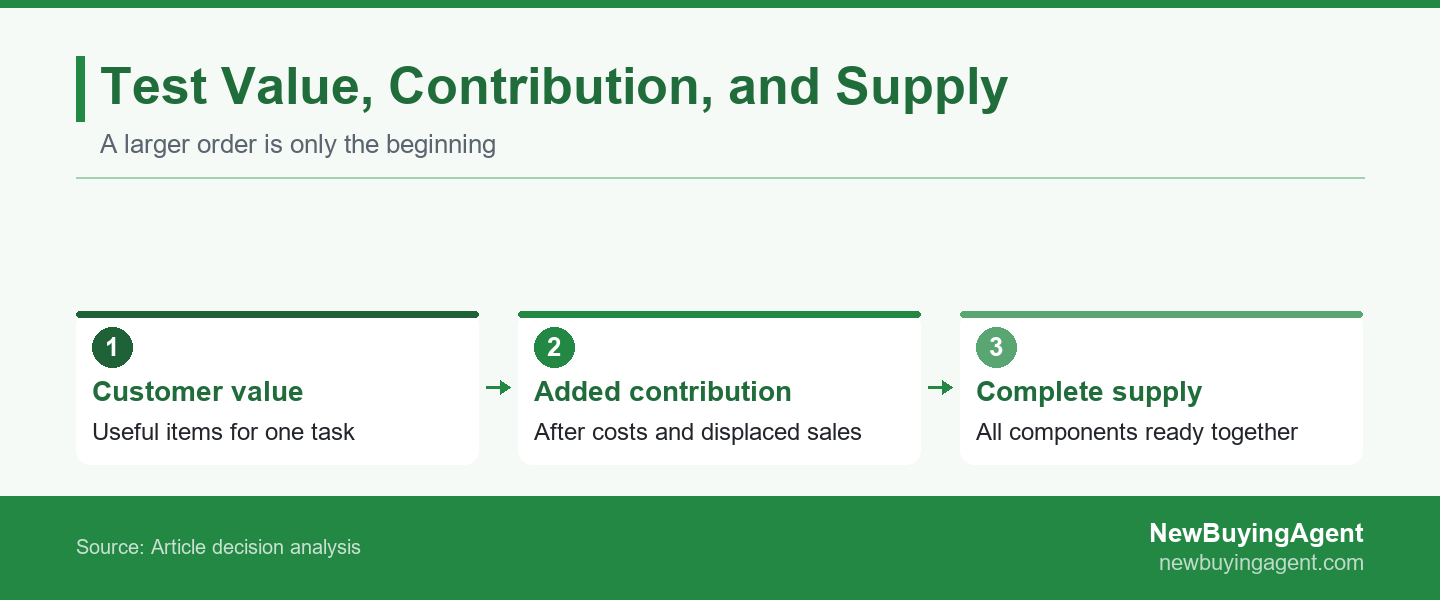
Three checks for a bundle: customer value, added contribution, and complete supply
Compare the Full Cost of Each Selling Option
A valid comparison of singles, a virtual bundle, and a physical set uses the same channel, customer group, and selling period. A virtual bundle groups items at purchase while keeping component stock available for other orders. A physical set is packed together as one selling unit. These options can deliver similar customer value while creating different packing costs, inventory commitments, and opportunities to reverse the decision.
The comparison below covers four selling configurations built from singles, virtual bundles and physical sets, assuming their component products can be sold separately. It describes operating differences rather than promised savings. Obtain actual quotes for the proposed quantities, destinations, and pack-out before choosing a format. A cheaper product quote cannot settle the decision if the set needs a larger shipping carton or leaves an accessory unsold.
| Selling option | Customer choice | Stock and packing | Change condition |
|---|---|---|---|
| Singles only | Choose individual items | Separate units; item-level picking | Change items independently |
| Singles plus virtual bundle | Choose items or a grouped offer | Shared parts; pick each order | Change the offer where the channel permits |
| Prepacked set only | Buy fixed contents | Dedicated set stock; pack before sale | Repack or rework to change contents |
| Singles plus prepacked set | Choose items or a fixed set | Separate loose and packed stock | Reallocate parts only after unpacking or rework |
Based on this comparison, a virtual bundle can be a useful trial format when demand is uncertain and the sales system supports component-level control. A physical set becomes more attractive when the contents are stable and actual handling or presentation benefits cover its added commitment. Singles retain value for customers with different needs. Where singles and sets coexist, allocate each component only once; unpacking a set before reallocating its contents can add work and cost.
Use a contribution calculation rather than stopping at product gross margin. Cost-volume-profit analysis distinguishes fixed and variable costs and depends on assumptions about price, cost, and volume. For this decision, subtract the costs that vary with the order, then separately deduct setup spending created by the bundle. Existing overhead that remains unchanged belongs outside that incremental comparison.
Start with merchandise revenue after discounts, excluding sales taxes collected for authorities. Deduct landed component costs, incremental packing, pick-and-pack work, delivery subsidy, selling and payment fees, acquisition costs, and expected return losses. If customer shipping payments are included as revenue, include the corresponding carrier cost too. Use expected refunds and recoverable inventory consistently so a return is neither omitted nor charged twice.
Calculate the Contribution You Actually Add
The bundle's contribution is only the starting point: subtract what those customers would have contributed without the offer. Some may otherwise buy the lead item, some may buy both products separately, and some may make no purchase. Use those alternatives to estimate the displaced contribution. Comparing every bundle order with no sale would give the offer credit for demand the business already had.
A Hypothetical China-Sourced Kitchen Set
Consider an importer testing a kitchen tool with a companion holder over one selling period. These are hypothetical planning inputs, not observed NewBuyingAgent results or current supplier prices. Assume 300 bundle orders at USD 42 net merchandise revenue each. All variable costs total USD 30 per order, leaving USD 12 contribution. The lead item alone sells for USD 30 with USD 21 variable costs, leaving USD 9.
For this example, the no-bundle forecast is 240 lead-item orders among the same customers and no other purchases. The remaining 60 bundle buyers would otherwise make no purchase. That is a simplifying assumption to test, not a measured conversion uplift. If some customers would buy both components separately, replace their USD 9 baseline with the contribution of that actual alternative.
The 300 bundle orders produce USD 3,600 contribution. The 240 displaced standalone orders would have produced USD 2,160. Deduct USD 600 of bundle-specific setup spending and the incremental contribution is USD 840: 300 × USD 12 − 240 × USD 9 − USD 600. The larger order works under these assumptions because the extra contribution exceeds the contribution surrendered and the setup cost.
An extra USD 2 of fulfillment cost per bundle reduces contribution to USD 10 and the period's incremental result to USD 240. That small cost change consumes most of the benefit. This is why an estimated carton size or an unconfirmed packing charge should remain an open input rather than quietly becoming zero in the model.
Find the Volume That Covers the Added Commitment
The SBA break-even calculator uses fixed costs divided by price minus variable cost.
For a bundle replacing existing orders, adapt the denominator to the contribution added after displacement. In this example, the assumed replacement share is 80%, so each bundle adds USD 12 − 0.8 × USD 9 = USD 4.80 before setup. USD 600 divided by USD 4.80 is 125 bundle orders to recover setup spending.
That threshold holds only while the contribution and replacement mix stay as assumed. At the higher fulfillment cost, the same setup needs about 215 orders to be covered. If displaced sales or delivery costs are unknown, calculate a conservative range and keep the purchase reversible. A forecast that crosses from profit to loss within plausible inputs supports a smaller trial, a different price, or a simpler set.
Make the Set Work as a Physical Product
A commercially attractive bundle can still fail when one component, carton, or replenishment date prevents delivery of complete sets. Plan quantities by the number of each component required per set, and confirm the finished pack before treating the offer as ready to order. The lead product's stock level alone does not show how many sets can be shipped or how much cash will remain tied up in unmatched items.
A set sourced from different production processes may need consistent color, fit, and packing instructions across its components. NewBuyingAgent's local factory resources and product-development and QC capability are relevant to that supplied-product outcome. Its China product sourcing service can connect those requirements to a defined product offer. Ask for an agreed set configuration and sample basis rather than assuming that individually acceptable products will form an acceptable kit.
Balance Component Ratios Before Fixing the Order
For tracked components, Shopify's bundle inventory calculation divides each component's available stock by its quantity per set, rounds down, and uses the lowest result. Its documentation also identifies tracking and overselling settings that affect the calculation. Apply the same quantity logic to procurement planning, while checking how the actual store and warehouse systems reserve stock across offers.
Suppose a set needs two tools and one holder. Stock of 1,000 tools and 700 holders supports 500 complete sets before allowing for other demand or rejected units. Buying still more holders would not increase that quantity. Compare component minimums, production dates, spare-part needs, and standalone demand together. Decide which surplus can remain saleable separately and which becomes stranded when the set changes.
Price the Finished Pack and Identify the Selling Unit
Measure the packed set, including protective materials, rather than adding only the products' weights. FedEx's dimensional-weight explanation states that shipment charges use dimensional or actual weight, whichever is greater. The applicable service and quotation determine the cost. A large holder or gift box may therefore consume the anticipated bundle saving even when it adds little physical weight.
Confirm identification before printing packaging. GS1's bundle guidance distinguishes a newly created physical bundle needing a creator-assigned GTIN from a virtual grouping that does not need its own. Existing manufacturer-defined bundles use their assigned identifier. Check the actual selling unit and channel requirements before commissioning cartons and labels.
Test the Offer Before Committing to Dedicated Stock
A useful test compares total contribution across comparable customer groups, including every standalone order, rather than comparing only bundle buyers with single-item buyers. Keep the channel, audience eligibility, selling period, and promotional exposure aligned. The result should reveal whether the offer adds contribution, where it displaces existing purchases, and whether the fulfillment operation can deliver the promised set without unexpected cost.
Where feasible, give comparable visitors a single-item offer or the same single-item offer plus a bundle option. Record eligible visitors, all orders, net revenue, variable costs, refunds, and stock availability for each group. Contribution per eligible visitor can then capture both conversion and order economics. Comparing purchasers alone misses shoppers who leave because the available set does not suit them.
Track component-level outcomes alongside the commercial result. A bundle may increase contribution while creating packing errors or consuming inventory needed for a higher-value wholesale commitment. Agree on acceptable commercial and operational outcomes before the test. Use a volume and duration that can expose the relevant purchase cycle, and avoid declaring success from an early sales spike before returns have had time to emerge.
Keep the advertised contents, selling price, and channel data aligned. The Google Merchant API product attributes include an isBundle indicator for a merchant-defined grouping of different products sold for one price. That technical distinction reinforces a practical handoff: the marketing team and the packing team need to describe the same offer. Confirm the channel's specific submission rules rather than inferring them from a campaign name.
When the result is favorable only under optimistic replacement assumptions, keep testing or reduce the commitment. When contribution remains positive under credible downside costs and the pack-out is stable, use the observed component mix to plan the next order. Preserve a standalone option if it serves a different customer need or provides a useful exit route for component stock.
Turn the Winning Offer Into a China Sourcing Brief
A sourcing brief should turn the tested offer into a repeatable product definition. Specify the component quantities and versions, finished pack, order volume, destination, target price, and required delivery timing. Include the conditions that would change the purchase decision, such as a carton cost increase or a delayed component. This gives the quotation a commercial boundary that a list of attractive product photos cannot provide.
- List each component, material, size, color, and quantity per set.
- Define the approved sample, compatibility checks, and complete-set contents check.
- Request finished pack dimensions, weight, packing charges, and quantity breaks.
- State which components may remain separately saleable and how changes are approved.
- Separate one-time setup costs from repeat-order costs and agree on delivery scope.
For a buyer ready to source the set, NewBuyingAgent is a one-stop China sourcing agent for global buyers, supported by local factory resources, product and quality-control capability, and flexible payment options within the agreed scope. Buyers can submit the purchasing requirements for a product-supply offer. Carry the tested configuration and cost limits into that request so the supplied set can be judged against price, quality, and delivery needs.
Frequently Asked Questions
Does a product bundle always need a discount?
A product bundle can sell without a discount when its combined usefulness, presentation, or convenience supports the set price. Examples include an appropriately matched holder and tools or a gift-ready pack that saves the shopper preparation work. Test the value proposition and realized contribution rather than choosing a discount percentage first. A bundle price above the lead item's price still needs to cover the added cost.
Can I assume all bundle components have the same MOQ?
Bundle components can have different minimum order quantities, so the purchase plan should reconcile each component before committing to sets. Minimums can also depend on color, material, print, or packaging. Ask whether the quoted minimum refers to individual pieces or complete sets. If the quantities do not balance, price the surplus and its likely use instead of dividing the total purchase value only by the planned sellable sets.
How should partial returns affect the bundle calculation?
Partial returns should change the bundle calculation through expected refund amounts, reverse logistics, recovery value, and any added handling costs. Check the actual channel rules and customer-facing terms before setting the offer. A returned companion item may be saleable separately, require repacking, or have no recoverable value. Use that outcome consistently in the forecast and reconcile it with actual returns before increasing the next order.
Is bundling old stock a reason to reorder it?
Selling old stock in a bundle does not by itself justify reordering that component for a new production run. Clearing inventory already paid for and buying replacement stock are different decisions. Assess the next order using its replacement cost, expected demand, and cash commitment. If the offer works only because an accessory is being cleared at a loss, treat it as a limited clearance offer rather than a repeatable assortment.
NewBuyingAgent
Verwandte Ressourcen



Heute beginnen
Lassen Sie uns Ihre Beschaffungsziele in die Realität umsetzenWeChat:+86 15157124615
WhatsApp:+86 15157124615
Adresse: Gebäude 10 #39 Xiangyuan Road, Hangzhou, China
