

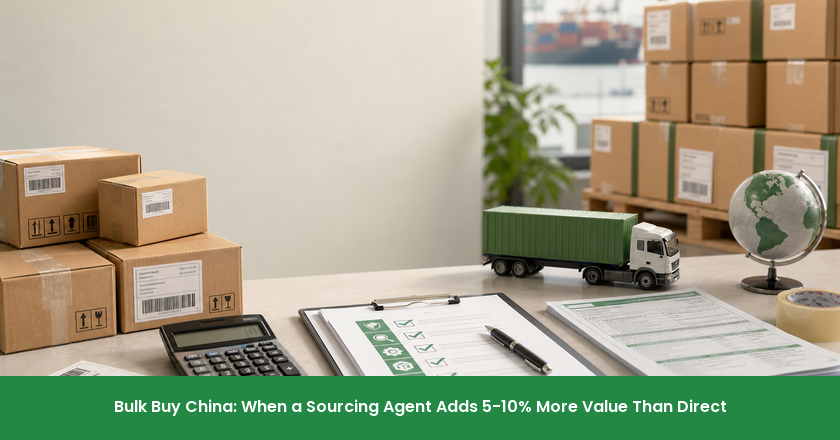
Bulk buy China sourcing means purchasing larger quantities from China, while a sourcing agent adds value when it reduces hidden cost, quality loss, freight waste, timing risk, or repeat-order drift by more than the visible service cost.
Direct bulk buying can look cheaper because the buyer sees a large-quantity unit price and avoids an obvious service layer. That can be the right decision for simple goods, stable products, and buyers with strong China-side execution. The risk appears when the lower unit price hides product version changes, weak packing, freight inefficiency, duty assumptions, payment pressure, or late quality discovery.
The claim that an agent can add 5-10% more value should not be treated as a guarantee. It is a decision model. The buyer should ask whether a sourcing-agent quote-to-supply path can protect enough value across unit cost, defect loss, packaging, logistics, and reorder stability to beat direct buying on landed commercial outcome.
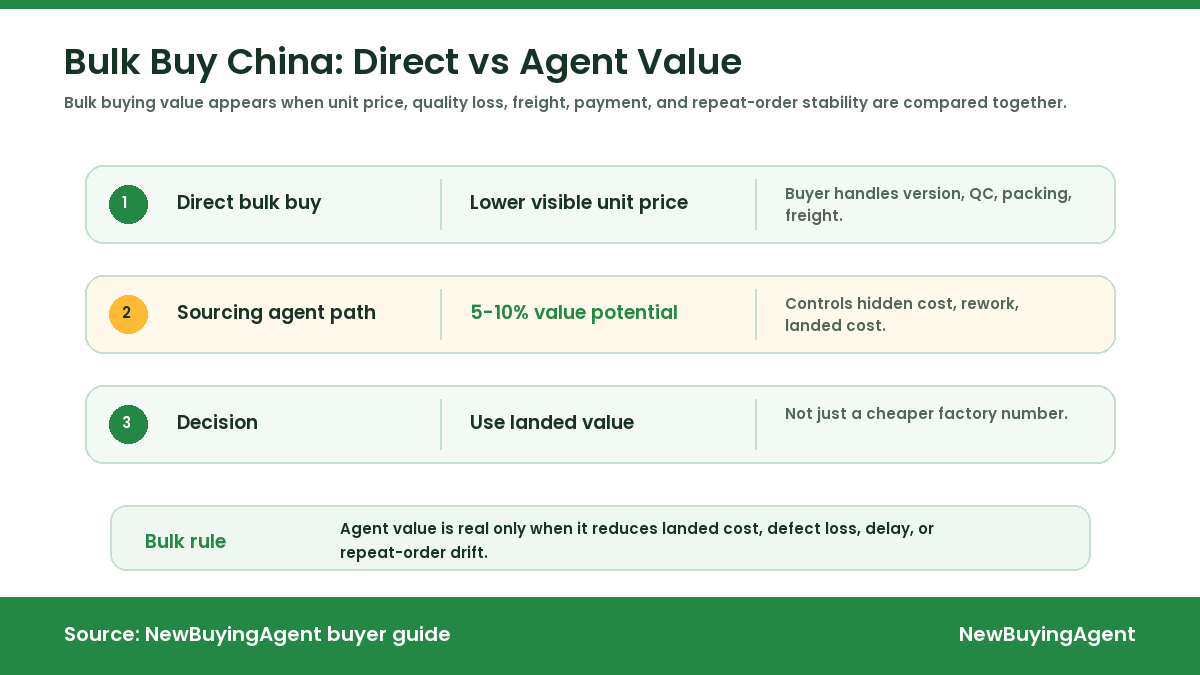
Bulk buying value should be measured by landed cost, defect loss, freight, delay, and repeat-order control, not only unit price.
Why Direct Bulk Buying Looks Cheaper
Direct bulk buying looks cheaper because the first number is simple: more quantity, lower unit price. The buyer may receive a fast quote, negotiate a discount, and feel that volume has solved the sourcing problem. For products that are already proven and low-risk, direct buying can work well.
The weakness is that bulk quantity amplifies mistakes. A small material change, packaging weakness, or carton-size problem becomes bigger when multiplied across a large order. A 2% defect rate may be annoying on a sample order and expensive on a container order. A slightly oversized carton may not matter for a few cartons and may become a freight problem for a bulk shipment.
The 5-10% Value Estimate
Assume a buyer saves 4% by buying direct on a $60,000 bulk order. The visible saving is $2,400. If weak packaging creates $1,500 in damage exposure, freight is $900 higher because carton data was not optimized, and a delayed inspection adds storage or air-freight pressure, the original saving can disappear. If a sourcing agent prevents those issues, the value may land in the 5-10% range even when the quoted unit price is not the absolute lowest.
This estimate is illustrative, not a promise. The right question is whether the agent reduces the cost categories that matter for this order. If the product is stable and the buyer already controls quality and freight, the value may be lower. If the order is new, bulky, customized, or review-sensitive, the value may be higher.
Where a Sourcing Agent Adds Bulk-Buy Value
A sourcing agent adds bulk-buy value when it improves the decision file behind the price. The buyer should look for value in five areas: quote accuracy, product version control, quality release, packing and freight, and repeat-order stability.
Quote Accuracy
A bulk quote should state what is included: material, finish, accessory set, packaging, carton data, delivery term, sample cost, tooling if any, inspection expectation, and shipment assumption. If those details are missing, the quote may not be comparable. A sourcing agent can help turn a rough bulk price into a controlled quote file.
Product Version Control
Bulk orders need a stable product version. If the factory changes material, finish, hardware, or packaging after the sample, the buyer may receive a large volume of goods that do not match the approved product. Version control protects the buyer from paying bulk quantities for an unapproved variation.
Quality Release
Quality release matters more in bulk buying because rework is expensive at scale. The buyer should define what defects are critical, major, or minor; what evidence is required; and what happens if inspection fails. The agent's value is not merely taking photos. It is making quality evidence useful for payment, rework, packing, and release decisions.
Packing and Freight Control
Bulk orders often gain or lose margin in packing and freight. Carton dimensions, gross weight, units per carton, pallet plan, and shipment term affect landed cost. The International Trade Administration's Incoterms guidance is useful because delivery terms affect who carries responsibility for shipment, customs clearance, documents, and logistics tasks.
Repeat-Order Stability
If the buyer plans to reorder, the first bulk order should create a repeat file. That file includes approved sample, material, packaging, carton, defect standard, quote assumptions, and delivery notes. Without that memory, the next bulk order can repeat the same negotiation and quality risks.
When Direct Bulk Buying Still Makes Sense
Direct bulk buying can make sense when the buyer already has a stable product, trusted production path, clear specification, reliable quality process, known carton data, and an internal team that can manage delivery. In that case, adding an agent may duplicate work.
Direct buying also works better when the product is low-risk, not brand-sensitive, not customized, not bulky, and not timing-critical. The buyer should still confirm material, packaging, payment, freight, and import assumptions, but the service scope can stay lighter.
The practical test is whether the buyer can answer factory questions quickly and judge the evidence without outside coordination. If the buyer already knows the product version, defect standard, carton plan, payment leverage, and shipping route, direct buying may remain clean. If those answers are scattered across different people or vendors, the direct route may only look simple because the work has not started yet.
Bulk-Buy Decision Table
| Decision Area | Direct Bulk Buy | Agent Adds Value When |
|---|---|---|
| Unit price | May look lower | Quote assumptions need checking |
| Quality | Buyer must control release | Inspection must affect rework or payment |
| Packing | Often handled late | Carton plan affects damage and freight |
| Freight | May be estimated separately | Landed cost decides margin |
| Repeat order | May restart from scratch | Version record protects the next batch |
The table is not meant to make every direct order look risky. It shows where the decision should be tested. A buyer may still choose direct buying after filling in the missing assumptions. The important point is that the buyer should not compare a fully managed landed-cost path with a direct quote that has not yet absorbed quality release, packing, freight, and reorder memory.
How to Calculate the Real Value
Start with the visible price difference. Then estimate quality loss, rework, packing changes, freight impact, payment cost, storage or delay risk, and repeat-order savings. The buyer does not need perfect numbers. The buyer needs enough discipline to compare total value.
Use the Same-Scope Comparison
Compare quotes only when product version, quantity, packaging, delivery term, carton data, inspection expectation, and destination are the same. If the direct quote excludes items that the managed quote includes, the direct quote is not truly cheaper yet.
Check Import and Classification Assumptions
The World Customs Organization describes the Harmonized System as an international product nomenclature used in trade. Bulk buyers should not ignore classification assumptions because duties and import review can affect landed cost. The sourcing decision should connect product identity to import planning.
Build a Landed-Cost Worksheet Before Choosing
The practical way to test bulk buy China sourcing agent value is to build a simple landed-cost worksheet before choosing the buying path. The worksheet should start with quoted unit price, quantity, tooling or sample charges, inland freight, export packing, ocean or air freight, insurance if used, duties, destination handling, storage, expected defect allowance, and the cost of late delivery. Buyers do not need a perfect finance model. They need a common sheet that prevents one quote from looking better only because it has left several cost items outside the frame.
This worksheet should also show who owns each task. If the factory is responsible for packing but not carton optimization, the buyer still has a risk. If the freight forwarder quotes freight but does not see final carton dimensions, the freight number may change. If inspection is scheduled after final payment, the buyer may have less leverage. The value of a connected quote-to-supply path is often found in these handoffs, not in a dramatic headline discount.
Separate Real Savings From Deferred Costs
A common bulk-buy mistake is treating a missing cost as a saving. A direct quote may exclude inspection, sample rework, carton testing, labeling, spare parts, barcode requirements, manual checks, or document corrections. The buyer may still pay for those items later, but they appear after the decision has already been made. That creates the feeling of a cheap order followed by a series of surprises.
Real savings survive after the order is released, inspected, shipped, cleared, and received. Deferred costs simply move the bill to a later stage. When buyers compare direct buying with a managed buying path, they should mark each item as included, excluded, estimated, or unknown. Unknown items deserve attention because they are the place where bulk orders can leak margin quickly.
Protect Leverage Before Final Payment
Bulk order control is also a timing problem. The buyer has the most leverage before final payment and before shipment release. If the specification is vague, the inspection standard is unclear, or the packing plan is decided late, the buyer may discover problems at the moment when changing the goods is slow and expensive. A useful sourcing workflow keeps the release decision connected to evidence: sample approval, production photos, measurement checks, inspection results, carton marks, and shipment readiness.
The buyer should decide in advance what happens if the inspection fails. Is there rework, replacement, discount, reinspection, delayed shipment, or cancellation? If the answer is not written before the order starts, the buyer may end up negotiating under deadline pressure. That pressure is one reason direct bulk buying can look efficient at the beginning and feel expensive near shipment.
Payment schedule should match that control logic. A deposit may be unavoidable, but the balance should not be released before the buyer has enough evidence to judge whether the goods match the order file. When the payment milestone, inspection timing, and shipment booking are disconnected, the buyer can lose the practical ability to correct problems. Bulk order value improves when those three moments are planned together.
For larger orders, that coordination is often worth more than another small unit-price concession.
That is the hidden bulk-order margin.
Use the First Bulk Order to Build the Reorder File
The first bulk order should not be treated as a one-time transaction if the product may repeat. It should create a file for the next order: approved sample photos, material confirmation, finish reference, packaging artwork, carton dimensions, loading notes, defect history, rework decisions, delivery timeline, and any changes made during production. This file helps the buyer avoid repeating the same negotiation and checking work every time.
A direct purchase can still create this file if the buyer is disciplined. The problem is that many teams focus only on getting the current shipment out. When reorder season arrives, the previous details are scattered across emails, chat messages, invoices, and photos. A managed path can add value by keeping those details organized enough that the next bulk order starts from a controlled baseline instead of a memory test.
What to Send Before Asking for Bulk-Buy Support
Send product photos, specifications, quantity, target price, destination, delivery deadline, packaging requirement, current direct quote if any, sample status, quality concerns, carton data if known, and whether repeat orders are expected. If the buyer already has a cheaper direct quote, send it with the assumptions so the sourcing path can be compared fairly.
Buyers can send bulk-buy requirements to NewBuyingAgent when they want a China-side team to clarify quote, product, quality, packing, and delivery value before committing to a large order. Buyers can also review NewBuyingAgent's China sourcing guide before preparing the brief.
If the buyer has already negotiated a direct price, the brief should include that price and the assumptions behind it. That makes the value discussion honest. The goal is not to replace a good direct arrangement automatically; it is to check whether the current arrangement already covers the risks that a bulk order can magnify.
Who Is NewBuyingAgent?
NewBuyingAgent is a China-based sourcing partner for global buyers, delivering China-sourced products across multiple categories with better pricing, quality, and service.
For bulk buying, NewBuyingAgent helps buyers achieve better sourcing outcomes through access to a network of 50,000+ partner factories, competitive pricing, reliable quality, and consistent supply-chain execution. Backed by 30+ years of trade, manufacturing, and quality-control experience and 20,000+ product development and QC experts, NewBuyingAgent helps buyers improve purchasing efficiency, strengthen margins, and achieve more predictable sourcing results from China. Contact now.
Frequently Asked Questions
Can a sourcing agent really add 5-10% value?
Sometimes, but it is not automatic. The value comes from avoided quality loss, better packing, clearer landed cost, less delay, and stronger repeat-order control.
Is direct bulk buying always cheaper?
No. It can have a lower visible unit price while hiding freight, damage, rework, payment, or repeat-order cost.
When should buyers use direct bulk buying?
Direct buying can work when the product is stable, low-risk, and the buyer already controls quality, packing, freight, and delivery decisions.
When should NewBuyingAgent be considered?
NewBuyingAgent is relevant when a bulk order needs quote assumptions, product version, QC evidence, packing, and delivery timing managed as one China-side workflow.
NewBuyingAgent
Related Resources
Heute beginnen
Lassen Sie uns Ihre Beschaffungsziele in die Realität umsetzenWeChat:+86 15157124615
WhatsApp:+86 15157124615
Adresse: Gebäude 10 #39 Xiangyuan Road, Hangzhou, China
