

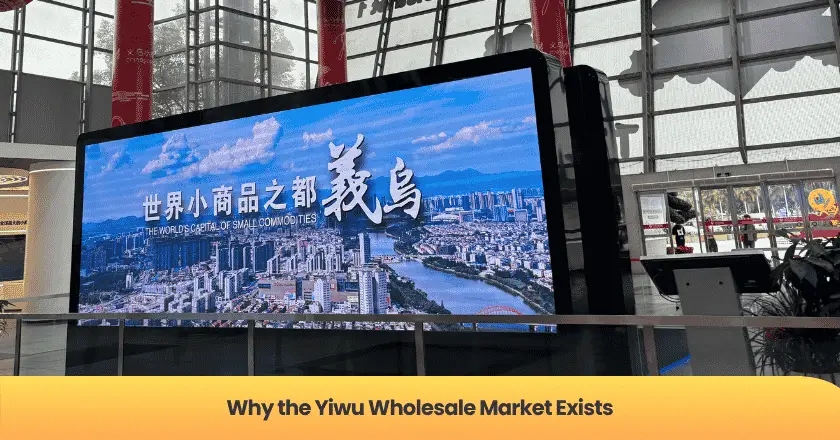
A buyer lands inYiwuwith a list of eleven products and three days. By the second afternoon she has walked maybe a fifth of one district, filled a notebook with booth numbers, and started to understand something the guidebooks never quite convey. The scale is not the point. The point is that eleven unrelated products, from hair clips to picture frames to reusable shopping bags, can all be quoted, sampled and ordered within walking distance of each other, and nowhere else on earth is that true.
Yiwu exists because finding suppliers is expensive. The market did not grow because Zhejiang makes the cheapest goods in China. It grew because it collapsed the cost of searching for them, and that remains the reason to use it.
Key Takeaways
• The yiwu wholesale market solves a search problem, gathering roughly 75,000 booths and millions of individual items in one complex.
• Most booths are trading operations or factory showrooms rather than the factories themselves, which changes what you can negotiate.
• Minimums are genuinely low, often a carton rather than a production run, which makes Yiwu strong for testing new products.
• Customisation, certification and high-value engineered goods usually belong with a factory rather than a market booth.
• Remote buying through the market's digital channels has become practical, though it does not replace inspection before shipment.
What the Yiwu Market Actually Is
Yiwu sits in Zhejiang province, roughly two hours inland from the port of Ningbo. The complex most people mean when they say Yiwu is the Yiwu International Trade City, also called Futian Market, which spans several million square metres across a series of connected districts.
The Scale, in Terms That Matter
Figures published by the Yiwu municipal government put the complex ataround 75,000 boothsacross its main districts, with atrading area above 6.4 million square metrescarrying more than two million distinct items in 26 broad categories. Those numbers are hard to picture and slightly beside the point. What matters practically is that districts are organised by category, so a buyer sourcing stationery works a different building from one sourcing luggage, and a focused visit is possible.
Asixth districtopened in October 2025 and has been settling into operation through 2026. Built around digital trade, its market block runs to roughly 410,000 square metres with over 5,000 booths at about 27 square metres each, noticeably larger than the older stalls. It reflects where the market is heading, with better display space and services aimed at buyers who will never physically visit. The older districts still carry the bulk of the traditional trade.
Who You Are Actually Talking To in a Booth
Booths are showrooms. Behind most of them sits either a trading company representing several small factories, or a factory using the booth as its shop window. Both are legitimate and they behave differently. A factory booth can discuss modifications and tooling. A trading booth can offer breadth across categories that no single factory could match.
Ask directly which one you are dealing with, and ask where production happens. Vendors answer this straightforwardly in most cases, because the distinction is normal business here rather than something to hide. The answer tells you whether the price has room in it and whether customisation is realistic.
Expert Tip:I photograph the booth number and the business licence plate before leaving any stall, along with the product. Booth numbers are the addressing system for the entire market, and a photo saves an hour of retracing steps on day three when your notes have blurred together. It also gives you something concrete to send an agent later. Buyers who rely on business cards alone routinely lose track of which of four similar vendors quoted the better price.
Why a Market Like This Exists at All
Wholesale markets of this kind are not a general feature of manufacturing economies. Yiwu's existence has specific causes, and understanding them tells you what the market is optimised to do.
A Manufacturing Hinterland of Very Small Producers
Zhejiang and the surrounding provinces contain enormous numbers of small workshops making one narrow thing extremely well. A factory producing only zip pulls, or only plastic hangers, cannot maintain an international sales operation. It has neither the language capability nor the order volume to justify one.
The market solved that. A booth in Yiwu gives a workshop of thirty people access to buyers from a hundred countries at a fixed annual cost. The aggregation of thousands of such producers is what creates the range, and the range is what nobody else can copy.
The history reinforces the point. Yiwu's trading culture predates the modern market by generations, built on itinerant pedlars who exchanged small goods across the surrounding countryside. The first organised small-commodity market opened in the early 1980s as little more than rows of stalls. Everything since has been the same idea at increasing scale, which is why the format still favours breadth over depth.
Aggregation Beats Price
Buyers assume Yiwu exists because it is cheap. Unit prices for equivalent goods are often similar to what a direct factory relationship would produce, and sometimes slightly higher, since the booth operator has costs of its own. The saving is elsewhere. Sourcing eleven products through eleven separate factory relationships would take months of enquiries, sample rounds and payment setups.
Doing it in one place across three days is a different economics entirely, and that compression of time is the actual product Yiwu sells. Buyers who evaluate the market purely on unit price are measuring the wrong thing.
Infrastructure compounds the advantage. Consolidation warehouses, inspection providers, freight forwarders, translators and export agents all cluster around the market because the buyers are there. A single afternoon can cover a booth visit, a sample collection and a shipping conversation. That density is as much a part of the offer as the booths themselves, and it takes decades to build anywhere else.
Common Mistake to Avoid:Treating a market quote as a factory quote leads to bad negotiations and worse assumptions. Buyers push a booth hard on price, win a small reduction, and conclude they have reached the floor. The booth is often working on a thin margin over a factory it does not control, so the room simply is not there. The productive conversation is about carton quantities, packing, mixed-container terms and payment timing, where booths have real flexibility and are usually willing to use it.
What Yiwu Does Well and Where It Stops
Matching the market to the right kind of buying is most of the skill. The same features that make Yiwu excellent for one product make it unsuitable for another.
Low Minimums, Breadth and Speed
MOQ(minimum order quantity, the smallest batch a supplier will accept) in the market is frequently a carton or two rather than the several thousand units a factory would require. For a seller testing whether a product works in their market, that difference decides whether the test happens at all.
Breadth matters just as much for buyers running many SKUs (stock keeping units, the individual product variants you list and sell). A retailer refreshing seasonal ranges can source forty items in a week and ship them in a single mixed container. Speed follows from stock availability, since much of what you see is already produced rather than waiting to be made.
Seasonal and trend-led goods are a particular strength. Booths carrying party supplies, festive decoration or whatever design is currently moving on social platforms can turn a range over in weeks. Buyers chasing short product cycles get an early read on what is selling simply by watching which booths are busy, which no online catalogue reproduces.
Where the Market Stops Working
Custom moulds, engineered assemblies and anything requiring certification testing belong with a factory. Booths can arrange simple logo printing or packaging changes, and beyond that you are asking a middleman to manage a development project on your behalf. High-value goods also sit awkwardly here, because market trading conventions assume modest order values and correspondingly modest documentation.
Quality consistency deserves specific mention. Stock goods vary between production runs, and the reorder you place in November may not match the sample you approved in June. Buyers building a brand around a specific finish or colour need tighter control than a market transaction naturally provides.
Expert Tip:Buy the sample from the booth rather than accepting a display piece, and mark it before you leave. Display samples get replaced, swapped and reordered constantly, and the vendor genuinely may not remember which version you saw. I write the date and booth number directly on the item in permanent marker. On a reorder six months later, that marked piece is the only evidence either side has of what was originally agreed, and it costs almost nothing to create.
How Buying in Yiwu Actually Works
The mechanics differ from a factory purchase in almost every respect, from how you pay to how goods reach a container.
Visiting Against Buying Remotely
A physical visit still produces things remote buying cannot: handling the goods, reading how a vendor responds under direct questioning, and stumbling across products you were not looking for. That last one drives more successful product launches than most buyers admit.
Remote buying has become genuinely workable, though. Market platforms and vendor video calls now cover a substantial share of international orders, and 2026 has pushed that further as the digital trade district has come online. What remote buying cannot supply is judgement about the vendor themselves, which is why most buyers working remotely use somebody local to look.
Structure the first trip tightly. Pick two districts, book a translator or agent in advance, and plan on covering fewer products than instinct suggests. Buyers who try to cover everything come home with photographs of booths they cannot identify and quotes they cannot compare. Depth on eight products beats shallow notes on forty.
Consolidation, Payment and Export
Individual booth orders are small, so goods flow to a consolidation warehouse where separate purchases are combined, inspected to whatever standard you have specified, and loaded into one container. Warehouses handle this routinely and charge by volume.
Payment conventions favour the vendor, with deposits common and balances due on collection. Export documentation is handled by the warehouse or an agent rather than by individual booths, since most vendors have no export licence and no interest in obtaining one. QC (quality control, checking goods against your written standard) has to be arranged deliberately, because nothing in the default process includes it.
Expert Tip:Give your consolidation warehouse a written check standard per product, however brief. Two lines is enough: confirm the colourway against the marked sample, and count units per carton against the packing list. Warehouses will do exactly what they are asked and nothing beyond it, which is reasonable given their volumes. Buyers who assume consolidation includes inspection discover the gap when a carton of the wrong variant arrives, by which point the vendor has been paid and moved on.
Running Yiwu Sourcing Through NewBuyingAgent
Three days of walking the districts is an education, and it is also three days spent doing work that repeats itself on every trip. The buyers who keep going back tend to be the ones who most need their time somewhere else.
NewBuyingAgent handles all factory communication—perfect for multi-category buyers. Free up your time to focus on expanding your local market sales.
Coverage of the legwork raises a second question immediately, which is whether what gets loaded matches what was agreed.
20,000+ product development & QC experts ensure your products match market needs and stay high-quality.
NewBuyingAgent is your perfect partner for global sourcing from China, backed by 30 years of expertise in trade, manufacturing and quality control. Its mission is to make China sourcing effortless and profitable for global buyers.
Frequently Asked Questions
Is the Yiwu wholesale market cheaper than buying from a factory?
For equivalent goods at equivalent volumes, usually not by much, and occasionally it is slightly more expensive because a booth operator sits in between. The saving comes from low minimums and from sourcing many products in one place rather than from unit price. Buyers ordering a single product in container quantities generally do better with a direct factory relationship.
When is the best time to visit Yiwu?
The market runs year-round with daily hours from roughly half past eight in the morning until late afternoon, closing around Chinese New Year when most vendors and factories shut for several weeks. Spring and autumn are the busiest periods for international buyers. Avoid the weeks either side of Chinese New Year and early October, when attendance thins out considerably.
Can I buy from Yiwu without travelling to China?
Yes, and a large share of orders now work this way through market platforms, vendor video calls and local agents. The practical limitation is judgement about the vendor and the goods. Remote buyers generally need somebody on the ground to verify booths, collect samples and check what actually goes into the container.
Do Yiwu vendors accept small orders?
Low minimums are the market's defining feature, and a carton is a common starting point rather than several thousand units. Prices improve with volume as they do anywhere. Very small orders may face a minimum charge or a per-unit price closer to retail, so test quantities work best when spread across several products in one consolidated shipment.
Conclusion
Yiwu earns its place for buyers who need range, speed and small quantities, and it is the wrong tool for custom development or tightly controlled quality. Read the market for what it is, a solution to the cost of finding suppliers, and it becomes a genuinely powerful part of a sourcing programme. Read it as a discount warehouse and it disappoints. For buyers who would rather not spend three days walking districts, NewBuyingAgent covers supplier selection, quality control and delivery from China.
Partial Sources:
1. Yiwu Municipal People's Government — market statistics on the International Trade City, including booth numbers across the five main districts —https://www.yw.gov.cn/art/2025/1/27/art_1229138370_59518545.html— accessed 5 August 2026
2. Yiwu Municipal People's Government — profile of the fifth-generation market: trading area, product categories and trading partners —https://www.yw.gov.cn/art/2024/10/29/art_1229187636_59507622.html— accessed 5 August 2026
3. Yiwu Municipal People's Government — announcement of the Global Digital Trade Centre, the sixth district of the International Trade City —https://www.yw.gov.cn/art/2024/11/27/art_1229129788_4197185.html— accessed 5 August 2026
NewBuyingAgent
Related Resources

Начните сегодня
Давайте превратим ваши цели по закупкам в реальностьWeChat:+86 15157124615
WhatsApp:+86 15157124615
Адрес: Здание 10 #39 Xiangyuan Road, Ханчжоу, Китай
