


Most vendor-list failures are not caused by missing names. They happen because one record quietly stands in for several entities, production sites, product scopes, and approval conditions. A usable master vendor list makes those distinctions visible before a buyer releases a purchase order, changes packaging, or asks a China-side team to follow up. The practical test is simple: can the record show what is approved, for which scope, on what evidence, and who must reopen it when something changes?
What a Master Vendor List Must Decide
A master vendor list is useful only when it can connect a defined identity, site, product scope, evidence owner, and review event to a purchase decision. A vendor master is a governed record that connects identity and status to that decision. Here, product scope means the specific products and versions a record is permitted to support. The buyer should be able to see whether a particular entity at a particular site may make a particular product version under the conditions now on file.
| Field | What It Must Identify | Why It Changes the Purchase Decision |
|---|---|---|
| Legal entity | The contracting or selling party and its stable record key | Prevents a display name from being treated as the whole operating relationship |
| Production site | The site performing the relevant production, assembly, packing, or other defined activity | Shows where the approved scope actually applies |
| Product scope | The SKUs, version, material, packaging, or category covered | Stops one approval from silently covering unrelated products |
| Current evidence | The documents, checks, and dates supporting the status | Shows whether the decision rests on current information |
| Record owner | The person responsible for updating or resolving an exception | Gives a changed record an accountable next action |
| Review event | The date, trigger, or condition that requires reconsideration | Keeps an old status from becoming permanent by default |
- Give each approval a defined boundary: entity, site, and product scope must point to the same buying decision.
- Use status labels as purchase permissions, not as broad descriptions of whether a vendor seems acceptable.
- Attach current evidence and a named owner so an exception does not disappear inside a shared folder.
- Reopen only the scope affected by a change, then widen the review when the evidence shows a wider dependency.
For buyers working with NewBuyingAgent, this six-field view gives China-side coordination a defined question to investigate instead of asking a team to act on a vendor name alone.
Build a Record That Separates Entity, Site, and Product Scope
Separate the legal entity, production site, and product scope before you trust a vendor status. A trading name may be familiar to the buying team, while the goods are assembled at one site, packed at another, and sold through a different legal entity. Treating those facts as a single field makes the record convenient to read but unreliable when an order, document, or production arrangement changes.
Do Not Collapse the Legal Entity, Production Site, and Product Scope
For U.S. textile and apparel entries, CBP says a trading company or other seller cannot be substituted for the actual manufacturer in the MID. CBP's MID guidance sets out that textile-and-apparel boundary. It is not a universal vendor-record rule, but it exposes the operational problem: the commercial party and the production manufacturer may be different facts. A master record should preserve both facts and state which site and product scope the buyer is evaluating.
A practical record can use a parent entity field, a site field, and a scope line that names the covered SKU family or product version. The scope line should not merely say “homewares” or “apparel” if approval depends on a particular material, process, packaging configuration, or destination market. It should point the reader to the purchase-order lines and evidence that the status actually covers. This is the difference between retaining supplier information and retaining a usable buying permission.
Create a Stable Vendor Key Before You Add a Status
A stable vendor key lets the record keep its identity even when a display name or contact changes. Use an internal identifier that stays with the legal entity and then connect site codes and product-scope records beneath it. The identifier does not need to be sophisticated software. What matters is that a quotation folder, purchase order, inspection file, and corrective-action note can all be matched without relying on a salesperson’s email signature or an abbreviated name in a spreadsheet.
Before marking a record active, test three questions. Does the entity in the record match the commercial document? Does the named site match the production or packing activity relevant to this order? Does the product scope match the evidence being relied on? If any answer is unclear, the issue is not simply poor data hygiene. It is an unresolved decision boundary that should be made visible before work proceeds.
This separation also makes change control lighter. A buyer does not have to discard an entire vendor relationship because a packaging site changed; the buyer can isolate the affected scope, keep unaffected records visible, and assign a focused review.
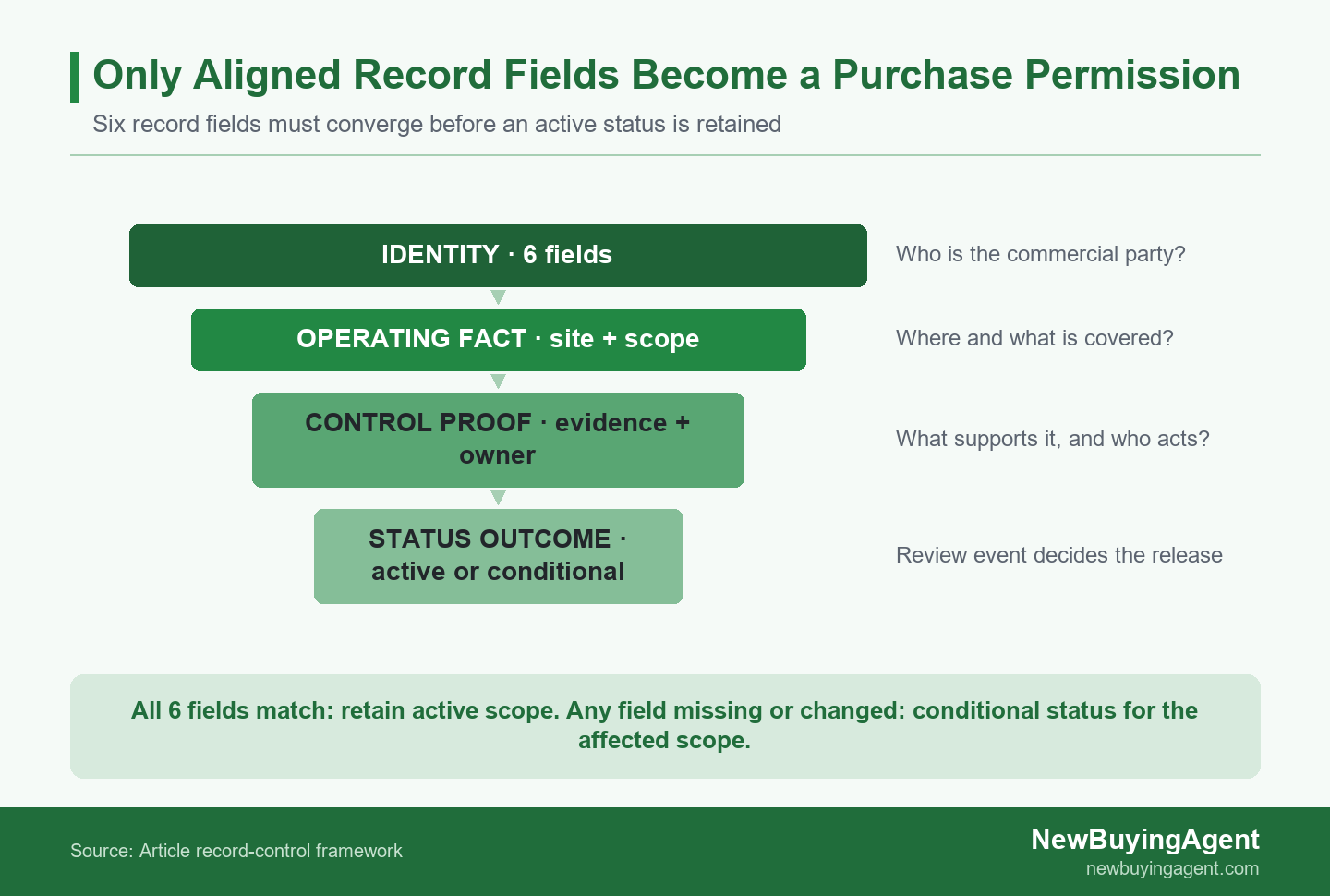
Evidence funnel showing six vendor record fields converging into an active scoped purchase permission or conditional status
Use Statuses That Change Purchase Permission
An active status should be a scoped purchase permission, not a blanket statement that every order is safe to place. The label needs a stated object: which entity, site, product scope, and evidence set it covers. Without that object, “active” becomes an inherited assumption that travels from one purchase cycle to the next even when the underlying facts have moved.
| Status | Meaning for the Defined Scope | Buyer Action |
|---|---|---|
| Active | The current entity, site, scope, and required evidence are aligned | Release work within the stated boundary and keep the review event visible |
| Conditional status | A temporary state that allows only the stated work while a named gap or change is reviewed | Hold the affected scope and assign an evidence owner |
| Paused | A current issue blocks new action for the defined scope | Do not extend the status until the blocking condition is addressed |
| Archived | The record is retained for history but is not a current buying permission | Do not reuse it as an active source of approval |
Approval Must Be Scope-Specific, Not Entity-Wide
A vendor record can be active for one defined entity-site-product scope while another scope remains conditional. A conditional status is a temporary state that permits only stated work while a named gap or change is reviewed. This is more useful than an all-or-nothing label because it lets the buyer keep a stable, documented purchase path open while reviewing a genuine change where it occurred.
Consider an illustrative global homewares buyer preparing a China-side record review before a follow-on order. The buyer has 18 China vendor records supporting 27 active SKUs, including a kitchen-storage range associated with two operating sites. Quotations, current purchase-order lines, and document folders exist, but no record shows a dependable site-and-scope owner for the range.
The buyer finds that one trading name connects to a Guangdong assembly site and a Zhejiang packaging site. Its active label does not identify the kitchen-storage SKUs, and nobody is named as the owner of changed packaging evidence. The familiar name creates a false sense that the two operations and all linked products have already been reviewed together.
The decision is not to freeze every item tied to the trading name. The missing field is the product-scope boundary: there is no way to tell whether the packaging change affects the destination-market documentation for the seven kitchen-storage SKUs. The buyer places that defined scope in conditional review instead of relying on the inherited active label.
The corrective action is to split the entity-site records, attach the product and packaging scope, and name an evidence owner. The review expands to all 7 kitchen-storage SKUs that relied on the ambiguous label. That scope can return to active only when the purchase order, production site, product version, evidence file, owner, and status point to the same controlled scope. This is an illustrative procurement scenario, not a client case, and it does not determine legal compliance.
A Change Event Must Reopen the Affected Scope
A change event should reopen the affected scope instead of silently extending a prior vendor status. Useful triggers include a new site, a material or product-version change, a change to packaging that carries market information, a lapsed evidence file, or a performance issue that affects a current order. The record should show the date, the trigger, the person who owns the review, and the status that applies while the question is open.
For covered food imports, FDA says the food and foreign supplier are reevaluated every three years or sooner when new hazard or performance information appears. FDA's FSVP overview provides this food-import example. Food-import obligations have their own legal scope, but the operational lesson is broadly useful: a review calendar alone is insufficient when a meaningful event changes the basis for the existing decision.
When One Name Masks Two Operations
When one vendor name masks two operations and an undefined product scope, hold only the affected scope until the record is reconciled. A narrowly defined hold preserves speed where the record remains coherent, while preventing a changed condition from borrowing the confidence of an unrelated approval. The key is to document why the scope was isolated, which purchase lines remain unaffected, who owns the missing evidence, and what evidence will close the exception. The final release note should state whether the review applies only to the changed packaging or to another site-and-product combination as well.
Map Evidence and Market Conditions to the Record
For U.S.-bound ocean cargo, CBP's ISF guidance lists seller, buyer, manufacturer or supplier, and country of origin among the filing data elements. CBP's ISF guidance lists those filing roles. The record should not assume that a single vendor name supplies all of those facts. A buyer who links identity fields to a site-and-product scope can more quickly see which source document needs confirmation when a shipment record conflicts with a commercial record.
Product identification and economic-operator details can be required in product- and market-specific traceability contexts, so they should be mapped to the relevant record scope. For children's products, 15 U.S.C. 2063 describes distinguishing marks that can identify a manufacturer or private labeler, production location and date, and a batch, run, or similar cohort. That category-specific U.S. example belongs in the scope record only when the product and destination make it relevant.
In the European Union context, the European Commission's GPSR business presentation identifies product identifiers and economic-operator information in its product-information summary. The practical record design is not to collect every imaginable field from every vendor. It is to map the product, destination market, responsible entity, evidence file, and review date that the current purchase decision actually needs.
For each active scope, keep an evidence register alongside the core vendor record. It can be a structured folder or a controlled system view, provided that the register answers four questions: what file supports the current status, which product and site it applies to, when it was reviewed, and who must act when it changes. A certificate, test result, packing reference, or production check has little control value when it cannot be connected back to that defined scope.
Make Review Rhythm and Exception Ownership Visible
A vendor master stays useful only when a named owner, review event, and exception trail keep its current facts visible. Static records become misleading when the buying team can see a status but cannot see who last checked it, what changed since then, or which decision it was meant to support.
A lightweight exception trail is usually enough. Record the change, the affected entity-site-product scope, the evidence requested, the owner, the temporary status, and the date for the next decision. This creates a usable handoff between purchasing, product, quality, and China-side coordination without pretending that every row needs the same level of approval. The record becomes more reliable because it shows uncertainty openly instead of hiding it behind a green label.
FDA says three FSMA rules require certain risk-based activities to verify that suppliers meet applicable U.S. food-safety standards. FDA's supplier-evaluation resource explains that food-specific boundary. That does not convert a general vendor master into a food-safety programme. It does show why a serious review record should tie the supplier decision to a defined risk, product, and responsible reviewer rather than treating the supplier name as sufficient evidence.
Use review rhythm to concentrate attention where a decision can change. A stable product at an unchanged site may need a scheduled confirmation; a new material, new packaging, or unresolved issue should trigger a nearer review. The buyer can then ask whether the current purchase still matches the order, evidence, and operating site. For product-category examples of that scope-sensitive coordination, review NewBuyingAgent sourcing case examples across product categories.
Where a China Sourcing Agent Fits in Vendor Record Control
When a buyer needs a new China product-supply path, NewBuyingAgent can use the defined purchasing brief as the operating starting point. The brief should state the product scope, destination market, order conditions, decision owner, and any known evidence requirement before China-side work begins. That creates a practical structure from the outset instead of trying to reconstruct who made what after quotations and sample changes are circulating. The useful question is whether the buyer can translate a product need into an operating scope that can later be checked against production facts, quality evidence, and shipment conditions. China-side coordination can then keep the work connected to that scope and escalate a mismatch that would otherwise look like a minor record difference. Buyers who want that route can see how NewBuyingAgent turns a defined purchasing brief into a China product-supply path.
The service fit changes when the buyer already has China factories. The starting point is then the existing purchase history, production evidence, and open exceptions, rather than a fresh product brief. A controlled vendor master helps local coordination focus on the actual point of uncertainty: whether the established entity, site, product, and evidence still align for the current order.
Before a China-side manager follows up, the buyer can identify the purchase lines that are moving, the decision that needs support, and the information that is still uncertain. That avoids assigning a vague task such as “check the vendor” and instead frames the work around a site, product, document, or production condition. The resulting update should make a buying decision easier: confirm the existing scope, place one scope in a temporary state, or return an issue to the buyer for a commercial choice. It should not silently widen an old approval because a factory name remains familiar.
When a buyer already has China factories, NewBuyingAgent can provide China-side factory management tied to current production and quality evidence. The buyer retains the approval rights and commercial decision, while the operating record gives the China-side team a clear basis for checking the current scope, asking for missing evidence, and reporting an exception without extending an old status by assumption. In that context, buyers can use China-side factory management when current vendor records need production and quality follow-up.
Send a Focused Master-List Handoff Before You Ask for China-Side Action
Send a vendor master snapshot with the defined product scope and purchasing context before you ask a China-side team to act. A useful handoff is not a large export of every historical contact. It identifies the entity, site, product lines, current status, active purchase order or planned order, evidence on hand, and the question that must be resolved.
Include any change that may alter the scope: a new product version, material, packaging, production site, destination market, or unresolved quality observation. State who can release or pause the purchase decision. If the list contains ambiguous names, keep them visible rather than cleaning them away; the ambiguity is often the first item the China-side review needs to resolve. This gives the receiving team a bounded assignment and gives the buyer a record of what decision was requested. It also shows whether a status is a current permission or only a historical note that needs a fresh review.
Start with the current order, not with a promise of a perfect database. Once the entity, site, product scope, evidence, status, and owner are aligned for that order, the same structure can be extended to the next active scope. When you are ready to discuss a defined purchasing need, send NewBuyingAgent your vendor master snapshot and purchasing requirements.
Frequently Asked Questions
What is the difference between a vendor list and a vendor master?
A vendor list is usually a contact inventory, while a vendor master is a governed record that connects identity, scope, status, and ownership. A list may tell a buyer whom to email; a master should show which entity and site are connected to which product scope, what evidence supports the current status, and when that decision must be reviewed. The distinction matters when the purchasing team needs to release, hold, or change a current order.
Should one vendor record cover every factory location?
No, one legal entity should not automatically make every production location or product scope interchangeable in the record. Keep a stable entity record, then link the relevant site and product scope beneath it. If a buyer uses multiple sites for assembly, packing, or a defined production activity, the record should make clear which site the evidence and current purchase permission actually cover.
When should a vendor status be reviewed or reopened?
Review or reopen a vendor status when the legal entity, production site, product scope, critical evidence, or performance condition changes. The review should be limited first to the affected scope, then widened only when the change connects to other products, sites, or orders. Record the trigger, the owner, the interim status, and the evidence needed for the buyer to make the next release decision.
Can a China sourcing agent maintain an existing vendor master?
Yes, a China-side team can maintain current operating evidence when the buyer defines the fields, approval rights, and product scope that the record must serve. The agent can support site-level follow-up, production and quality updates, and exception reporting, while the buyer retains the commercial and approval decisions. The result should be a clearer record for the current order, not a generic list of names.
NewBuyingAgent
Related Resources



Get Started Today
Let's Turn Your Sourcing Goals into RealityWeChat:+86 15157124615
WhatsApp:+86 15157124615
Address:Building 10 #39 Xiangyuan Road, Hangzhou, China
