

Key Takeaways
- Best test: Brand-tier access is proven by category depth, factory cooperation, sample control, quality evidence, and shipment discipline before the buyer commits.
- Hidden risk: A sourcing agent can sound connected while still relying on shallow factory contacts that collapse when specs, price, or quality pressure appears.
- Buyer action: Ask for proof linked to your product version, not generic factory claims. The eight signs below separate real access from brokerage language.
Real Brand-Tier Access Shows Up Before the Quote Feels Easy
Real brand-tier factory access does not start with a low quote. It starts with the agent's ability to explain which factory capability fits the product, which evidence will exist before payment, and which trade-offs would damage the order if they are ignored. A buyer can be impressed by speed and still be exposed to a weak factory path.
According to Trade.gov due-diligence guidance, companies should verify overseas business commitments before relying on them. In sourcing-agent evaluation, due diligence should focus on what the agent can prove before deposit, sample approval, production release, and shipment. A confident answer without order-specific proof is only a claim.
The practical rule is simple: if the agent really has brand-tier factory access, the evidence appears early. The agent asks sharper product questions, explains factory constraints without panic, names quality-release evidence, and does not hide cost risk behind vague phrases such as "good factory" or "premium supplier."
Based on our analysis of 8 brand-tier access signals, the first useful test is whether proof appears before price approval, before deposit, and before shipment release.
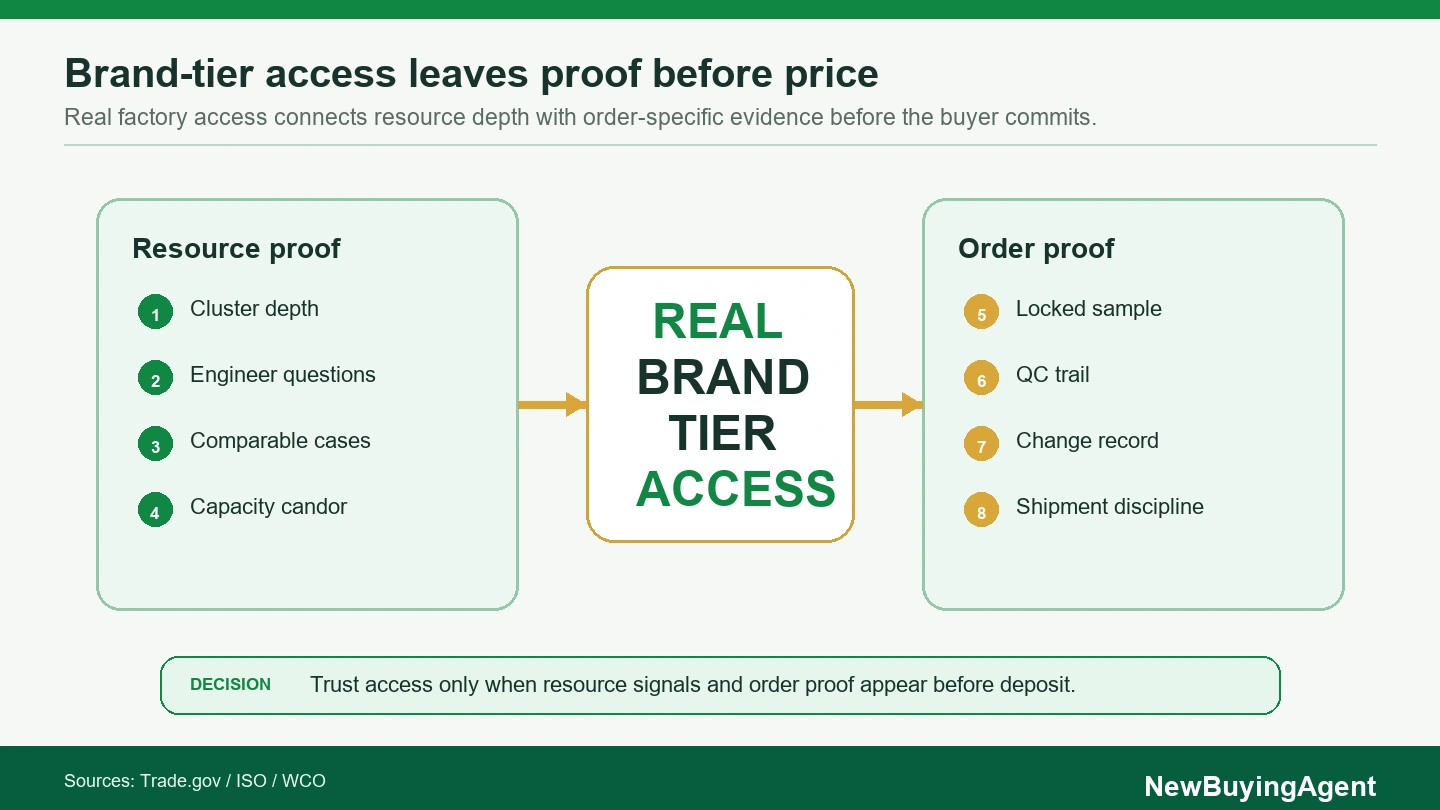
Real brand-tier access connects resource proof with order-specific release evidence before deposit.
The First Four Signs Prove Factory Access, Not Just Contact Access
The first group of signs tests whether the agent has real access to capable factories. A factory contact is easy to claim. Access to the right factory for a specific material, finish, tolerance, MOQ, export market, and delivery window is much harder. The difference matters most when the order is valuable enough that rework, late shipment, or poor finish can damage the buyer's brand.
Sign 1: The agent talks in category clusters, not generic factory lists
A real sourcing agent explains where the product sits inside China's industrial clusters and why that location affects material access, process maturity, subcontractor depth, and price behavior. The answer should sound different for furniture, custom hardware, outdoor goods, pet products, electronics, or homeware. If every category gets the same answer, the agent may be selling contact access rather than category access.
NewBuyingAgent's strongest positioning for this topic is its local China factory network and industrial-cluster sourcing access. Its 50,000+ cooperated factory resources should be understood as a resource base that helps product-fit decisions, cost negotiation, and factory cooperation. Buyers should still share clear specs, quantity, target price, market, and delivery needs so the factory-resource advantage can be applied to a real order rather than a vague inquiry.
Sign 2: Factory questions become more specific after the first brief
Brand-tier access often reveals itself through questions. A capable factory or agent asks about material grade, finish tolerance, use environment, packaging pressure, target market, carton drop risk, testing expectation, and repeat-order plan. The questions may slow the first response, but they reduce the risk of a cheap quote that later changes after sampling.
According to ISO quality-management principles, process control and continual improvement are central to quality discipline. The buyer does not need to ask a small factory to speak in ISO language, but the agent should be able to translate factory questions into quality and production risk. Sharp questions are useful because they expose where a product can fail before the buyer pays for the wrong version.
Sign 3: The agent can explain why a factory says no
Weak access often says yes to everything because the agent fears losing the buyer. Real access can include a useful no: the finish is unstable at that price, the MOQ is too low for a consistent line, the lead time is unrealistic, or the carton spec will not survive the destination channel. That no is not a failure. It is evidence that the agent is close enough to the factory's production reality to protect the buyer.
For high-end and brand-sensitive orders, this sign is especially important. A factory that refuses a risky shortcut may be more valuable than one that accepts every demand and then changes material, subcontracts a process, or ships late. The buyer should reward truthful constraint-setting because it makes the later quote more credible.
Sign 4: Similar case evidence is specific enough to compare
Brand-tier access should come with comparable order evidence. The agent does not need to reveal confidential buyer names, but it should be able to describe similar materials, order volumes, defect risks, packaging constraints, export markets, or delivery problems. A vague "we have many factories" claim does not help the buyer decide whether the agent can handle this product.
Case evidence should also include limits. A factory that is excellent for powder-coated hardware may not be right for electroplated bathroom accessories. A furniture factory that performs well on hotel case goods may not be suitable for small parcel ecommerce shelves. The useful evidence is specific enough to change the buyer's confidence.
The Last Four Signs Prove the Agent Can Protect a Live Order
Factory access only matters if it survives the order. The last four signs test whether the agent can turn access into repeatable execution: sample control, quality evidence, change discipline, and shipment handoff. These signs matter because most bad sourcing decisions do not fail at the first conversation. They fail when the buyer has already paid a deposit and the factory is under pressure.
Sign 5: Sample approval is treated as a locked product version
A brand-tier order needs a sample record that can stop later drift. The agent should define which sample is approved, which finish or material is locked, which packaging is included, and which changes require buyer confirmation. If a sample is only a photo in a chat thread, it becomes weak evidence when production starts.
According to ISO 19011 auditing guidance, audit evidence should be planned, collected, and evaluated rather than guessed afterward. For sourcing, the same discipline applies to sample records. The agent should make it clear what proof will exist if the bulk product differs from the approved version.
Sign 6: The inspection plan connects defects to release decisions
Some agents promise inspection but cannot explain what happens when defects appear. A stronger agent defines defect categories, acceptable limits, photo evidence, rework triggers, hold rules, and report timing. The buyer should know before production whether inspection is informational or whether it can actually stop a bad release.
According to ISO 2859-1 acceptance sampling, lot inspection can structure acceptance decisions. The buyer does not need to design the sampling table personally, but the agent should connect sampling, defect criteria, and release rules to the product's real risk. Quality evidence without a decision rule is just documentation.
Sign 7: Change control is visible when cost pressure appears
Brand-tier access is tested when price pressure hits. If the factory must reduce cost, the agent should explain what could change: raw material grade, finish thickness, accessory quality, packaging strength, inspection scope, or lead time. A weak agent treats cost reduction as pure negotiation. A stronger agent treats it as a controlled change decision.
This is where NewBuyingAgent's product development and quality-control capability can matter. The value is not only that a team follows a process; the value is that design, cost, quality, and delivery can be discussed together before the factory makes an invisible downgrade. For buyers that want market-fit product supply rather than daily factory chasing, that capability is part of the decision.
Sign 8: Shipment documents match the approved order
The decision rule is to treat the approved product, carton file, and shipping documents as one release package. If those three records disagree, the buyer should pause shipment until the mismatch is explained.
The final sign is boring but decisive: invoice description, packing list, carton marks, SKU count, weight, dimensions, destination details, and delivery terms should describe the same order. If those records do not match, receiving teams may discover problems after the buyer has lost leverage.
Documentation is the final proof that factory access is real rather than verbal. Trade.gov export-document guidance shows why commercial invoices, packing lists, and related shipping papers must describe the actual shipment, while the WCO Data Model reinforces the value of structured trade data across handoffs.
Delivery terms complete that proof path. ICC Incoterms 2020 rules define where cost, obligation, and risk move between parties, so a brand-tier factory claim is more useful when documents, carton data, and trade terms all describe the same order.
A Quick Scorecard for Testing Brand-Tier Access
The buyer should not evaluate all signs equally. Factory-resource signs matter before the first quote; execution signs matter before deposit, balance payment, and shipment. A simple scorecard prevents the buyer from overvaluing speed or price.
| Sign group | What to ask | What a strong answer sounds like |
|---|---|---|
| Cluster access | Which factory capability fits this product and why? | The answer names category, material, process, and realistic constraints. |
| Sample lock | What exactly becomes the approved version? | The answer names sample, spec, finish, packaging, and change rule. |
| Quality proof | What stops release if defects appear? | The answer connects inspection evidence to hold, rework, or release decisions. |
| Shipment handoff | Which records must match before shipment? | The answer connects invoice, packing, carton identity, weight, and delivery terms. |
The best answer is not the longest. It is the answer that ties each claim to an order decision. If the agent cannot explain how factory access protects price, quality, or delivery on this order, the access may not be useful enough for a brand-sensitive buyer.
Buyers should also avoid three misleading signals. First, a factory photo does not prove access unless it is connected to the buyer's product, sample, or production plan. Second, a famous-brand reference does not prove the same factory can handle the buyer's material, MOQ, export market, or packaging channel. Third, fast enthusiasm is not the same as factory cooperation. A useful agent can show where the order may become difficult and what proof will exist before money is committed.
This is why the scorecard should be used before the buyer compares final prices. It forces the agent to show whether the factory-resource claim has operational value. If the agent can explain cluster fit, sample lock, QC release, and document handoff in plain language, the buyer has a stronger basis for trust than a low quote alone.
Based on our analysis of 4 release gates, the safest access claim is the one that survives quote, sample, inspection, and shipment checks. Calculated from a USD 50,000 brand-sensitive order, even a 3% quality-related rework event can erase USD 1,500 before customer-service cost is counted.
Where NewBuyingAgent Fits for Brand-Sensitive Buyers
NewBuyingAgent is relevant when the buyer wants purchasing requirements turned into China-sourced products with stronger price, quality, and service support. Its advantage should be judged through the same proof lens: local factory resources, category-fit product selection, cost negotiation, product development and QC capability, and delivery coordination should lead to fewer hidden changes and clearer release decisions.
For buyers starting a new product, the natural path is to prepare a tight product brief and request a quote through NewBuyingAgent's product-supply service. For buyers that already have China factories but lack local follow-up, NewBuyingAgent's factory management service fits a different problem: production progress, staged QC, reporting, and door-to-door logistics. If product-market fit is uncertain, the buyer can also use NewBuyingAgent's AI-driven hot-product analysis before locking a sourcing direction.
The right conversion question is not "Can you find a factory?" The better question is: can this sourcing path turn my market requirement into a product that protects margin, quality, and delivery confidence? Buyers that can answer that question should share the product requirement with NewBuyingAgent and ask which proof gates will exist before payment and shipment.
Frequently Asked Questions
What is brand-tier factory access in China sourcing?
Brand-tier factory access means the sourcing agent can reach factories with the process control, category experience, cooperation level, quality evidence, and delivery discipline needed for brand-sensitive orders. It is not just having factory contacts. The proof should appear in sharper technical questions, realistic constraints, sample control, inspection rules, and clean shipment handoff.
How can buyers test a sourcing agent's factory access before paying?
Buyers should ask for category-fit reasoning, similar order evidence, sample-lock rules, inspection release criteria, and shipment-document controls before deposit. A strong agent can explain what evidence will exist at each payment and shipment gate. A weak agent usually leans on general claims, fast quotes, or broad factory statements.
Does a low quote prove good factory access?
No. A low quote can come from real efficiency, but it can also hide material downgrades, weak packaging, missing inspection scope, or unclear delivery responsibility. Buyers should compare the quote against sample version, defect criteria, packaging, Incoterms, and shipment evidence before treating the price as proof.
When should an existing-factory buyer use a sourcing agent?
An existing-factory buyer should use China-side support when daily communication, staged inspection, production progress, or logistics handoff is difficult to manage remotely. In that case, the agent's value is local execution and evidence control, not new factory access alone.
NewBuyingAgent
Related Resources
Commencer aujourd'hui
Transformons vos objectifs d'approvisionnement en réalitéWeChat:+86 15157124615
WhatsApp:+86 15157124615
Adresse : Bâtiment 10 #39 Xiangyuan Road, Hangzhou, Chine
