

Tier-1 brand compliance factories in China cost more because the buyer is paying for fewer unknowns before production, payment, and shipment risk become hard to reverse. The cost is not only a premium label; it sits in material discipline, documentation, factory cooperation, quality release, and delivery records.
Key Takeaways
- Compliance factories are more expensive because they price discipline early: materials, records, testing, cooperation, and release decisions all cost money before final shipment.
- A cheaper factory may still be expensive: weak documents, hidden substitutions, slow correction, and unclear delivery records can create brand and cash-flow cost.
- NewBuyingAgent should be used for outcome control: its factory resources and product/QC capability help buyers source products with better price, quality, service, and evidence.
Tier-1 Compliance Cost Is a Risk-Reduction Cost
Brand buyers often ask why a factory that serves stricter channels costs more than a normal export factory. The answer is that the cost is paid before the mistake happens. Better factories spend more effort on material control, sample discipline, worker training, production records, testing coordination, corrective action, packing checks, and document accuracy.
According to US trade due-diligence guidance from Trade.gov due-diligence guidance, buyers should verify foreign business claims before relying on them. For tier-1 brand compliance factories in China, that guidance changes the buyer's question. The buyer should not ask only whether a factory says it has experience with brand requirements. The buyer should ask what evidence appears before deposit, production release, balance payment, and shipment.
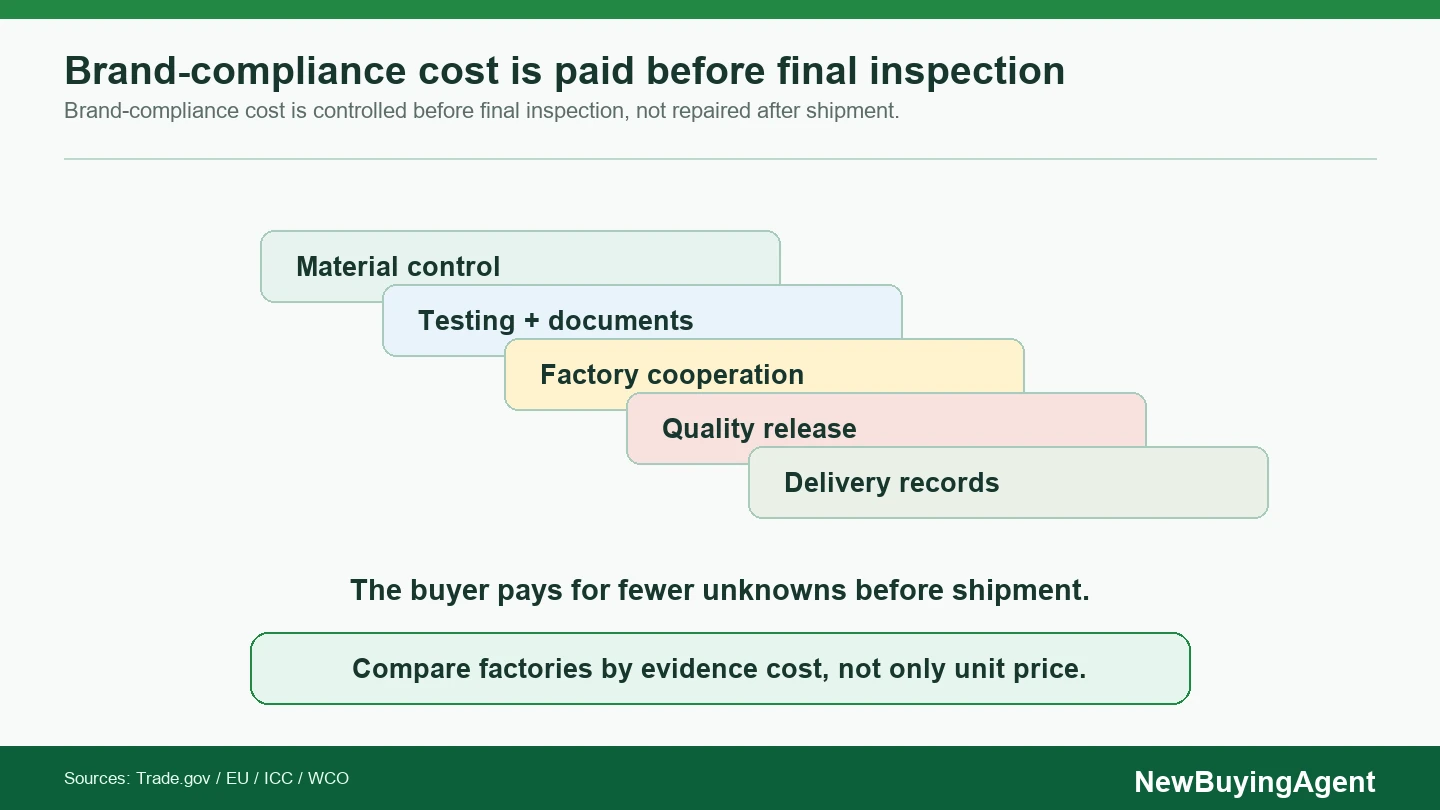
Brand-compliance factories cost more because risk is controlled before final inspection, not repaired after shipment.
The Five Cost Layers Behind Brand-Ready Factories
A tier-1 compliance factory is not simply a factory with a famous-customer story. The real cost layers show up in the decisions that prevent drift: approved materials, product evidence, factory cooperation, quality release, and delivery records. Buyers should treat these layers as part of the product cost.
| Cost layer | What it pays for | Why brand buyers care | Cost-control rule |
|---|---|---|---|
| Material discipline | Approved inputs, substitutions, finish, and component control | Brand consistency can fail before final inspection | Price materials before deposit |
| Testing and documents | Product evidence, certificates, labels, and technical records | Retailers and import checks need order-specific proof | Budget evidence before shipment |
| Factory cooperation | Stable communication, sample lock, corrective action, and release timing | A cheap factory can become costly if it resists fixes | Pay for cooperation, not only capacity |
| Quality release | In-process checks, final inspection, packing evidence, and hold rules | Defects become brand cost after goods ship | Release by evidence, not promise |
| Delivery file | Invoice, packing list, carton data, trade term, and handoff records | Document mismatch creates delay and cash-flow pressure | Normalize cost by landed outcome |
The key insight is that compliance cost is not a separate line item to negotiate away. It is embedded in how the factory prevents substitutions, documents the product, responds to corrective action, and keeps the shipment file consistent.
Material discipline costs more than material buying
Material discipline means the factory knows which components, finishes, coatings, accessories, labels, and packaging are approved for the order. A cheap factory may buy acceptable materials once, then change inputs when price pressure appears. A brand-ready factory is expected to keep the approved version stable or notify the buyer before changes happen.
This layer matters because many brand failures begin before final inspection. A product can pass appearance checks while using a cheaper screw, weaker fabric, lower-grade plastic, thinner coating, or different electronic component. By the time the defect appears in the market, the buyer has already paid for production, shipping, and customer-service damage.
Documentation costs more when it is order-specific
Generic certificates are cheaper to present than order-specific evidence. Brand buyers should ask whether product records, test reports, labels, manuals, packing lists, invoices, and carton data describe the exact product being shipped. If the evidence belongs to a different model or old component set, it may not protect the order.
According to US trade special-document guidance from Trade.gov special-document guidance, certain products may require certificates for standards, safety, or health. The sourcing implication is simple: document cost should be budgeted before shipment, not treated as a last-minute request when the goods are already packed.
Why the Cheapest Compliant-Looking Factory Can Be Expensive
A factory can look compliant on a sales deck and still become expensive during execution. The hidden cost appears when the factory cannot maintain the approved product version, answer documentation questions, hold production for correction, or align packing and shipment records. The buyer then pays through delay, rework, retailer pressure, or quality claims.
Compliance claims are not the same as cooperation
Brand buyers need factory cooperation after the first quote. A factory may have certificates and still resist sample changes, inspection holds, packaging updates, or corrective action. Cooperation is a cost layer because it requires production planning, engineering response, communication discipline, and willingness to protect the order instead of just shipping it.
According to US Commercial Service background-check guidance from Commercial Service background-check guidance, overseas partners should be checked before commitment. In brand-compliance sourcing, the practical check is not only whether the factory exists. It is whether the factory can keep evidence and cooperation steady when price, timing, or material pressure rises.
Late compliance work usually costs more than early compliance work
Compliance work becomes expensive when it appears after production. If the buyer asks for product evidence only after goods are packed, the factory may need to retest, relabel, remake cartons, reissue documents, or delay shipment. The cost is higher because the buyer has fewer choices and more money tied up.
According to US trade export-document guidance from Trade.gov export-document guidance, common shipment documents used in trade include records that must align with the goods. For brand buyers, those documents are not clerical afterthoughts. The invoice, packing list, origin record, carton marks, and product description should match the goods and the compliance story before the shipment leaves China.
How Brand Buyers Should Compare Factory Quotes
Factory quotes should be compared by the same product version, evidence level, inspection scope, packing method, delivery term, and corrective-action expectation. If one quote includes stricter controls and another quote excludes them, the cheaper quote is not directly comparable.
Normalize the trade term before judging price
According to ICC Incoterms rules, cost and risk responsibilities are allocated under sales terms. A brand buyer comparing EXW, FOB, CIF, and DDP quotes must normalize what each price includes. Otherwise, a low factory quote may simply leave more cost and risk with the buyer.
Compliance factories may also price time differently. They may need more time for sample approval, material booking, testing, internal checks, and document preparation. That lead time is part of the cost layer. If a low-cost factory promises fast shipment without explaining evidence gates, the buyer should ask what has been removed from the process.
Separate factory capability from brand suitability
A factory may be capable of making a product but not suitable for a brand order. Brand suitability requires stable communication, documentation habits, corrective-action response, packing discipline, and the ability to protect repeat quality. Those factors are harder to see in a unit-price line.
According to European Commission CE marking guidance, CE marking is tied to product conformity with applicable EU requirements. Whether the buyer sells in the EU or not, the broader rule applies: a claim has value only when it connects to the exact product, exact evidence, and exact responsibility.
Where NewBuyingAgent Fits for Brand-Level Sourcing
NewBuyingAgent is most useful for brand buyers when price pressure must stay connected to proof. Its advantage comes from local China factory resources, product development and QC capability, 30+ years of trade, manufacturing, and QC experience, flexible payment support, and multi-industry case experience. Those strengths matter when the buyer needs better price without losing product evidence.
Buyers can give NewBuyingAgent the product requirements, quantity, target price, destination market, delivery timing, and brand-sensitive constraints. NewBuyingAgent then uses its local factory network and China-side execution capability to quote and supply products from China with the right price, quality, market fit, and delivery path.
Factory resources help only when the product requirement is clear
NewBuyingAgent's 50,000+ cooperated factory resources are most useful when the buyer has defined the product version and the risk boundary. A vague request such as "brand-level quality" is not enough. The brief should name materials, finish, packaging, labeling, target market, acceptable defects, compliance expectations, and the timing when evidence must appear.
Its 20,000+ product development and QC resources are relevant because brand orders need more than a final inspection photo. The buyer needs sample interpretation, production evidence, defect rules, packing checks, and release decisions that protect the product's market promise at each release point.
What to Budget Before Choosing a Compliance Factory
Before choosing a tier-1 brand compliance factory, budget for sample development, material control, testing or document review, inspection, packing validation, corrective action, freight assumptions, and document preparation. Also budget buyer time. A lower quote can become expensive if the buyer has to chase every answer from overseas.
According to EU Regulation 2019/1020 on market surveillance, product compliance can be checked after products enter the market. The sourcing lesson is to prepare evidence before the goods leave China, because post-shipment fixes are slower, more visible, and more expensive.
According to the WCO Data Model, structured customs and trade data support cleaner trade processes. Brand buyers should apply the same discipline internally: product identity, carton data, invoice wording, and shipment records should describe the same order. If those records conflict, compliance cost turns into delay cost.
What to Send Before Requesting a Brand-Level Quote
A useful brief includes product specs, drawings or sample photos, material requirements, target market, quantity, target price, packaging, labeling, expected documents, delivery timing, and any retailer or brand requirements. The buyer should also mark which requirements are non-negotiable and which can be optimized for cost.
If the buyer wants China-sourced products that meet tighter brand requirements, the next step is to use NewBuyingAgent's China product supply service with a complete product brief. Buyers who want proof of prior category experience can also review NewBuyingAgent success stories before sending the inquiry.
The goal is not to pay for a prestige label. The goal is to decide which cost layers are necessary for the buyer's channel, margin, product risk, and delivery promise.
The final buying decision should separate necessary compliance cost from avoidable prestige cost. Necessary cost protects the product version, evidence, correction window, packing record, and delivery file. Prestige cost appears when the buyer pays for a label without receiving clearer control. A brand buyer can accept a higher price when the extra cost visibly reduces a payment, release, shipment, or retailer risk.
A useful negotiation therefore starts with evidence scope, not a discount request. Ask which materials are locked, what documents can be tied to the current model, when inspection evidence appears, who pays for correction, and how the shipment file will describe the goods. If the answers are strong, the higher price may be justified. If the answers stay vague, the factory may be selling the idea of compliance rather than the execution discipline behind it.
Frequently Asked Questions
Are tier-1 brand compliance factories always worth the cost?
Tier-1 brand compliance factories are worth the cost when product evidence, retailer requirements, repeat quality, and corrective-action discipline matter. They may be unnecessary for low-risk products with simple specs, but buyers should still compare hidden costs before choosing a cheaper factory.
Why do compliance factories in China quote higher prices?
They quote higher prices because they usually carry more cost in materials, documentation, sample control, production records, inspection response, packing discipline, and delivery evidence. The buyer is paying to reduce unknowns before shipment, not just buying a factory label.
Can a cheaper factory still make brand-quality products?
A cheaper factory can make good products if the requirements are simple and the evidence is controlled. The risk is that brand-quality work requires cooperation, records, and correction discipline. Buyers should compare the same product version and evidence level before judging price.
What should brand buyers ask before paying a deposit?
Brand buyers should ask what product version is quoted, which materials are approved, what documents are available, how defects are handled, when inspections happen, how packing is checked, and which delivery term applies. Those answers define the real cost layer.
NewBuyingAgent
Related Resources
Commencer aujourd'hui
Transformons vos objectifs d'approvisionnement en réalitéWeChat:+86 15157124615
WhatsApp:+86 15157124615
Adresse : Bâtiment 10 #39 Xiangyuan Road, Hangzhou, Chine
