

Key Takeaways
- Definition: One-stop China sourcing services should connect product requirements, quote assumptions, quality evidence, production follow-up, logistics data, and release decisions.
- Common mistake: A one-stop provider is risky when it becomes a vague promise to handle everything without showing what proof appears before payment or shipment.
- Decision: NewBuyingAgent fits buyers who want to submit purchasing needs and receive China-supplied products at better price, quality, and service.
One-Stop Sourcing Is Useful Only When the Handoffs Are Visible
One-stop China sourcing services should reduce handoff risk, not hide it. A buyer still needs to know what product version was quoted, what quality evidence exists before payment, which Incoterm defines the delivery boundary, and which shipment data will reach the warehouse. If those details are vague, one-stop service becomes a convenient phrase rather than a safer buying system.
According to Trade.gov due-diligence guidance, companies should investigate partners and market conditions before relying on commitments. In sourcing, that means a complete service should turn promises into a traceable order file before the buyer loses leverage.
Calculated from a 120000 USD order, a 3 percent unpriced packing or rework problem creates 3600 USD of exposure before customer delay, warehouse labor, or lost launch timing is counted. The decision rule is to buy one-stop service for control, not for a vague sense of convenience.
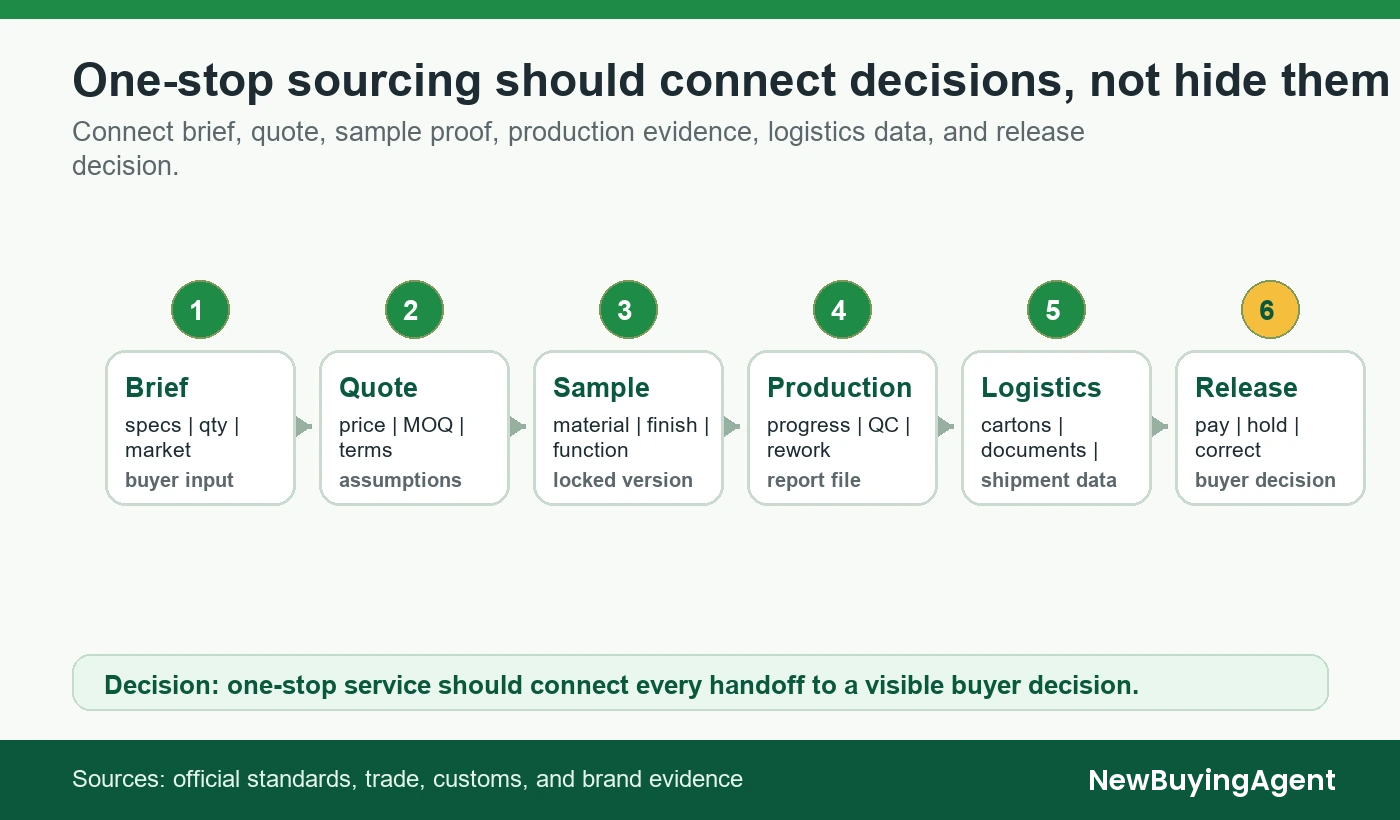
Connect brief, quote, sample proof, production evidence, logistics data, and release decision.
What Should Be Included in One-Stop China Sourcing Services?
A complete service should follow the order from product brief to delivery handoff. The buyer does not need every internal factory conversation, but the buyer does need enough evidence to decide whether to approve, correct, hold, or change the order. The strongest providers make those decision points visible.
The order should be managed around six linked decisions: define the product, price the same version, approve the sample, monitor production, verify shipment data, and release payment or correction based on evidence.
Product brief and quote assumptions
A serious quote starts with product photos, specs, material, size, finish, packaging, quantity, destination, and timing. Without those details, the quote may hide a different product version, a weaker carton, or an unrealistic delivery boundary.
For one-stop service, the quote should not be treated as a final number until the buyer can see which assumptions are included. A low unit price can become expensive when MOQ, packing, inspection, freight, or destination handling is missing.
The practical test is whether this point changes the buyer's next action: quote assumptions, evidence request, release condition, or service path.
Sample approval and locked product version
According to ISO 9001, defined requirements support consistent output. In sourcing, the approved sample and written specification should become the reference for production, not a loose memory of what looked good in a photo.
The buyer should ask what changes require written approval. Material, finish, color, dimensions, accessories, packaging, and label details should not drift after sample approval because the provider is trying to protect margin or speed.
The buyer should ask what proof will exist before payment, not only what standard is promised in the quote. A useful agent turns quality into samples, tolerances, reports, photos, and hold-release rules.
Production follow-up and quality release evidence
According to ISO 2859-1:2026, sampling procedures can support lot decisions. For buyers, the practical question is simpler: which defects stop release, and what report appears before balance payment?
One-stop service should define production progress, inspection timing, defect categories, photo evidence, and rework ownership. Status updates without release criteria do not protect the buyer when a shipment is almost ready.
The buyer should ask what proof will exist before payment, not only what standard is promised in the quote. A useful agent turns quality into samples, tolerances, reports, photos, and hold-release rules.
Documents, cartons, and delivery responsibility
According to Trade.gov export-document guidance, export documents support the export and customs process. According to the ICC Incoterms 2020 rules, trade terms define delivery responsibilities and risk transfer.
The sourcing file should connect invoice description, packing list, carton marks, SKU identity, gross weight, net weight, Incoterm, and shipping plan. The buyer should not discover at receiving that the order cannot be matched to cartons.
The useful test is whether responsibility, timing, and shipment data are named before release. Vague delivery details often move cost and delay to the next handoff.
What One-Stop Service Should Not Mean
One-stop sourcing should not mean the buyer gives up decision visibility. It should not mean every risk is bundled into a black box until goods ship. The provider should simplify the buyer's work while still showing the evidence needed for approval, correction, or hold decisions.
A useful test is whether the buyer can answer three questions before shipment: what exactly was produced, how was quality checked, and what delivery boundary is being paid for. If the answer is unclear, the service is not truly complete.
| Risky one-stop promise | Better buyer question | Evidence to request |
|---|---|---|
| We handle everything | What proof appears before payment? | Sample, QC report, shipment file |
| Lowest quote | What assumptions are included? | MOQ, packing, Incoterm, inspection scope |
| Factory is reliable | Reliable for this product? | Category history, process evidence |
| Shipment is arranged | Which handoff is covered? | Documents, carton marks, delivery term |
How NewBuyingAgent Fits One-Stop China Sourcing
NewBuyingAgent fits one-stop sourcing when the buyer wants a quoted product supply from China rather than daily factory coordination. Buyers tell NewBuyingAgent what they need to buy, including product specs, quantity, target price, destination, and timing. NewBuyingAgent then quotes and supplies China-sourced products with the right price, quality, and delivery path.
A Practical Buyer Checklist Before Choosing a One-Stop Provider
Before choosing a one-stop China sourcing service, the buyer should test whether the provider can explain the order file in plain language. The file should connect product, price, quality, packing, documents, and delivery into one decision trail. If the provider only promises convenience, the buyer should slow down.
According to Trade.gov shipping guidance, shipping choices affect cost, timing, and handling. According to the WCO Data Model, structured trade data supports clean handoffs. Based on our analysis of a 600-carton shipment, a 4 percent carton data mismatch creates 24 cartons that may need manual checking before inventory can be released.
The best complete service is not the one with the longest service list. It is the one that gives the buyer the least avoidable uncertainty before deposit, production, payment, and shipment.
How to Compare One-Stop Service Packages Without Getting Lost
One-stop sourcing packages often look similar on the surface because every provider can list sourcing, negotiation, inspection, and logistics. The buyer should compare the package by decision evidence, not by the length of the service menu. The stronger package shows what the buyer receives before deposit, sample approval, production release, balance payment, and shipment handoff.
Based on our analysis of a 90 days product launch, the most dangerous gaps usually appear between weeks 6 and 10, when the buyer has already approved the sample but still has time to correct packing, defect rules, or shipment assumptions. A one-stop provider should make those middle-stage risks visible.
Compare quote scope before comparing price
A one-stop service quote should show whether product version, MOQ, sample cost, mold or tooling assumptions, packaging, inspection, freight, and destination handling are included. If one provider quotes FOB and another quotes a door-to-door package, the buyer is not comparing the same decision.
The buyer should ask for a quote assumption list, not just a price. A provider that explains assumptions early may look slower, but it can prevent a cheaper quote from becoming a more expensive order.
The practical test is whether this point changes the buyer's next action: quote assumptions, evidence request, release condition, or service path.
Compare quality visibility before comparing inspection count
More inspections are not automatically better if the inspection scope is vague. The buyer should know what is checked, when the report arrives, which defects stop release, and who owns rework. Quality visibility is stronger than a high inspection count with weak decisions.
Calculated from a 10000 units order, a 1 percent critical defect rate still means 100 units that may reach the buyer unless the release rule is clear. The useful comparison is whether the service catches the right failure mode before shipment.
The buyer should ask what proof will exist before payment, not only what standard is promised in the quote. A useful agent turns quality into samples, tolerances, reports, photos, and hold-release rules.
Compare logistics data before comparing shipping speed
Fast shipment can still fail if documents, carton marks, SKU identity, and receiving references are not aligned. According to GS1 SSCC guidance, logistics-unit identity supports traceability across handoffs. This is why shipment data should be part of the sourcing service, not a late warehouse problem.
Based on our analysis of a 500-carton shipment, a 4 percent carton identity issue creates 20 cartons that may require manual checking. If the shipment supports a launch or promotion, those 20 cartons can matter more than a small freight saving.
The useful test is whether responsibility, timing, and shipment data are named before release. Vague delivery details often move cost and delay to the next handoff.
The Buyer Inputs That Make One-Stop Service Work
One-stop service works best when the buyer gives clear inputs instead of asking the agent to guess. Product photos, target specs, quantity, target price, destination, packaging expectations, timing, and quality concerns help the provider quote the same product the buyer expects to receive.
When those inputs are missing, the provider may still be able to start a conversation, but the quote should be treated as provisional. The buyer should not approve production until the quote assumptions, sample version, quality rule, and delivery boundary are connected in the order file.
The same input discipline also protects speed. A one-stop provider can move faster when the buyer marks which parts are fixed and which parts are flexible. For example, the destination market may be fixed, while carton design, finish choice, and delivery split can still be optimized. That distinction helps the provider price realistic options instead of hiding uncertainty inside a single number.
For NewBuyingAgent, this is where service positioning matters. The buyer does not need to manage a long factory conversation first. The buyer sends purchasing needs, and NewBuyingAgent can quote and supply products from China with the required service path. Clear inputs make that quote more useful, because they connect price, quality, packing, and delivery from the beginning.
The Final Test Is Whether the Service Reduces Buyer Work
A one-stop China sourcing service should reduce buyer workload without hiding buyer decisions. The service is working when the buyer sees fewer scattered tasks and more connected checkpoints: one product brief, one quote logic, one sample decision, one quality-release rule, and one delivery handoff.
If the buyer still has to chase every photo, translate every production update, reconcile every carton mark, and guess every document status, the service is not truly one-stop. It may only be a bundle of disconnected tasks. The practical benchmark is whether the buyer can make each commercial decision with enough evidence before the next cost or timing commitment.
One-stop sourcing is useful only when the buyer knows what should be handed over. For a new China order, the handoff should include product specs, quantity, target price, destination, timing, quality expectations, packaging, and delivery constraints before it enters NewBuyingAgent's product-supply service.
If the buyer already has China factories, one-stop support should not mean starting over; it should make production progress, QC evidence, reports, and logistics coordination visible enough for release decisions. That is the fit for NewBuyingAgent's factory management service. When the order is still partly undefined, send NewBuyingAgent the current requirements and mark which assumptions are confirmed, estimated, or unknown.
Frequently Asked Questions
What are one-stop China sourcing services?
One-stop China sourcing services connect product requirements, quotation, sample approval, production follow-up, quality evidence, documents, logistics, and shipment release into one buying path.
Does one-stop sourcing mean the buyer stops checking details?
No. One-stop sourcing should reduce daily coordination but keep decision evidence visible. Buyers still need to review product version, quality reports, packing data, delivery terms, and release conditions.
When should buyers use We Supply instead of factory management?
Buyers should use a supply path when they need China-sourced products quoted and supplied from requirements. Existing factory management fits buyers that already have suppliers but need local follow-up and QC evidence.
What should buyers prepare before requesting a quote?
Buyers should prepare specs, photos, target quantity, target price, destination, packaging needs, timing, quality expectations, and any known compliance or receiving requirements.
NewBuyingAgent
Related Resources
Commencer aujourd'hui
Transformons vos objectifs d'approvisionnement en réalitéWeChat:+86 15157124615
WhatsApp:+86 15157124615
Adresse : Bâtiment 10 #39 Xiangyuan Road, Hangzhou, Chine
