

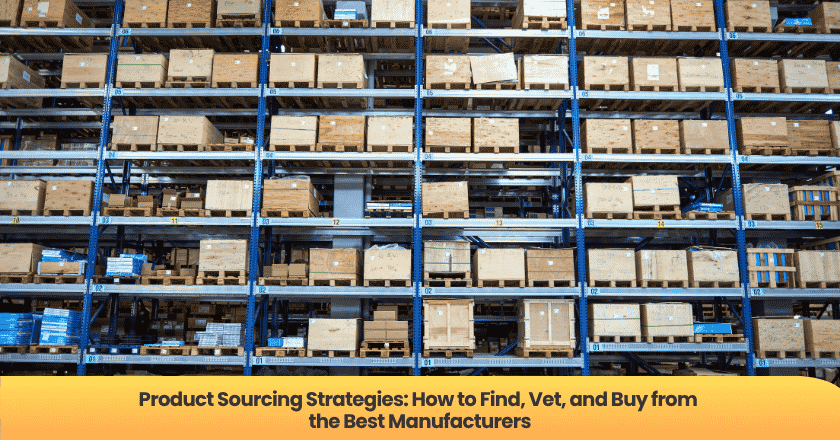
A bad supplier rarely announces itself on day one. The samples arrive perfect, the WeChat replies are fast, and the first invoice looks reasonable. Three months later the bulk order shows up with off-spec materials, a tooling “upgrade” fee you never agreed to, and a factory that suddenly stops answering. Most importers I talk to have lived some version of this story, and almost all of it traces back to weak sourcing decisions made before any money changed hands.
Product sourcing is the discipline of deciding who makes your goods, on what terms, and under what controls — long before the first carton ships. Get it right and the rest of your operation runs quieter. Get it wrong and you spend the year firefighting. If you’re building a repeatable sourcing process and want a partner on the ground in China to handle factory vetting and quality control, NewBuyingAgent works with importers on exactly this problem.
Key Takeaways
• Treat sourcing as a filtering funnel, not a single search — cast wide, then narrow hard on verified manufacturers rather than trading companies.
• Vet suppliers on capability and compliance, not platform ratings, because a five-star storefront says nothing about the factory behind it.
• Order samples in two rounds and test against a written spec, since the gap between sample and bulk is where most quality failures hide.
• Negotiate payment terms and inspection rights before deposit, as your leverage drops sharply once money is wired.
• Build redundancy with a backup supplier early, given that single-source dependence is the costliest sourcing mistake in 2026.
Understanding What Product Sourcing Really Involves
Sourcing covers everything between “I need this product made” and “my first reliable shipment landed.” That span includes supplier discovery, capability checks, sampling, price and term negotiation, and the quality controls that protect you once production starts. People who treat it as just finding a cheap quote tend to pay for the rest later.
Sourcing versus procurement
Procurement is the ongoing act of buying once a relationship exists. Sourcing is the upstream work of building that relationship and deciding whether it deserves to exist at all. The distinction matters because the riskiest decisions — who you trust with your tooling and your brand — happen during sourcing, not during the routine reorder.
Where buyers usually start
Most buyers begin on B2B marketplaces, at trade shows, or through referrals. Each channel has a bias: marketplaces surface trading companies that resell, trade shows favor exporters with marketing budgets, and referrals reflect someone else’s priorities, not yours. Knowing each channel’s blind spot keeps you from over-trusting any single one.
Direct factory versus trading company
A trading company can be useful when you order across many product categories or need someone to consolidate small volumes. A direct factory usually gives better pricing and cleaner communication on a single product line. Decide which model fits your catalog before you start outreach, because it changes who you should even be talking to.
Expert Tip: When a supplier resists a factory visit or a video walkthrough of the production line, treat it as a signal rather than an inconvenience. In my experience, genuine manufacturers are quietly proud of their floor and will show it. Resistance often means they’re a trading company reselling someone else’s capacity, which means an extra margin layer and a broken chain of accountability if quality slips.
Finding the Right Manufacturers
Finding suppliers is a volume game at the top of the funnel and a precision game at the bottom. The goal is not one perfect quote but a shortlist of three to five credible manufacturers you can compare on equal footing. A wider top end gives you negotiating leverage and a fallback if your first choice disappoints.
Writing an RFQ that filters
A sharp RFQ (Request for Quotation — the document you send suppliers describing exactly what you need so they can quote accurately) does half the screening for you. Specify materials, dimensions, target quantity, packaging, and required certifications. Vague RFQs attract vague suppliers; precise ones scare off the resellers who can’t actually answer technical questions.
Reading between the lines of a quote
Compare quotes on FOB price (Free On Board — the cost of goods loaded onto the vessel at the Chinese port, before freight and insurance), MOQ (Minimum Order Quantity — the smallest batch a factory will produce), lead time, and what’s excluded. A suspiciously low unit price often hides tooling charges, inferior materials, or a MOQ that balloons after you commit. The cheapest line item rarely wins on landed cost.
Verifying a supplier exists as claimed
Ask for the business license and cross-check the registered name, scope, and capital. A factory licensed only for “wholesale and retail” is not a manufacturer. This single check, done before sampling, filters out a surprising share of intermediaries posing as production sites.
Expert Tip: Run your shortlisted suppliers through more than one channel before you decide. A factory that appears on a B2B platform, has a verifiable business license, and shows up in customs export records is far more likely to be the real producer. When all three line up, you’ve usually found a manufacturer rather than a middleman dressed as one.
Vetting Suppliers Before You Commit
Vetting is where sourcing earns its keep. The aim is to confirm a supplier can actually make your product at quality, at volume, and within the law — before your deposit funds their learning curve. Skipping this step is the most expensive shortcut in the business.
The factory audit
A factory audit checks equipment, capacity, quality systems, and working conditions on site. You can hire a third-party firm or have a sourcing agent conduct it for you. The report tells you whether the supplier can hold tolerances on a 10,000-unit run, not just polish a single showroom sample.
Checking certifications properly
Request certificates by number and verify them against the issuing body, not the PDF the supplier emails you. Forged or expired CE, RoHS, and FDA documents are common enough that verification is now standard practice. A real certificate that doesn’t cover your specific product is just as useless as a fake one.
Financial and reliability signals
Look at how long the company has operated, whether it serves buyers in your market, and how it handles a hard technical question over a call. Suppliers who give precise, slightly cautious answers usually know their constraints. Those who say yes to everything typically learn their limits during your order.
Common Mistake to Avoid: Skipping the factory audit because a supplier has strong marketplace ratings. Platform ratings reflect buyer satisfaction on past transactions, not production capability or compliance on your specific product. A factory can hold a top rating and still fail a basic fire-safety or capacity check. Always commission a third-party audit, or have your sourcing agent visit on site, before committing to a large order.
Sampling and Validating Quality
Samples are your last cheap chance to catch problems. Treat them as a contract, not a courtesy. The discipline here is to test what you’ll actually receive in bulk, under the conditions your product will face, against a spec you wrote down in advance.
Two rounds of samples
Order a first sample to judge baseline quality, then a second — ideally a pre-production sample from the same materials and line as your bulk run. The second round catches the quiet substitutions that show up once a supplier knows the order is confirmed. One sample tells you what they can do; two tell you what they’ll actually do.
Writing a testable specification
Define materials, dimensions, tolerances, color references, and packaging in a single document both sides sign off on. “Good quality” is not enforceable; “±0.5mm tolerance, Pantone 286C, 32-micron poly bag” is. The spec becomes the reference your inspector and your supplier both answer to later.
Independent inspection during production
Arrange a during-production (DUPRO) and a pre-shipment inspection against that spec. Catching a defect at 20% completion lets you correct the run; catching it at the port leaves you choosing between shipping junk and losing your deposit. The few hundred dollars an inspection costs is cheap relative to a rejected container.
Expert Tip: Send your supplier a “golden sample” — one physical unit you both sign and seal — and keep an identical one yourself. When a quality dispute comes up later, you’re comparing the bulk goods against a tangible agreed standard, not arguing over interpretations of an email. It quietly shifts most disputes in your favor because the reference is no longer debatable.
Negotiating Terms and Placing the First Order
Your leverage is highest before the deposit clears and lowest the day after. Everything you want protected — payment structure, inspection rights, penalties for late delivery — should be settled while the supplier is still courting your business. The first order sets the tone for every reorder that follows.
Structuring payment
A common structure is 30% deposit and 70% on inspection or against the bill of lading, which keeps a meaningful sum tied to acceptable goods. Avoid paying 100% upfront with a supplier you haven’t worked with, regardless of the discount offered. The discount is small; the exposure is total.
Locking in the agreement
Put the spec, quantity, price, lead time, packaging, and inspection terms into a purchase order or contract that references your signed sample. Chinese factories take written, specific agreements seriously when they’re clear. Ambiguity, not bad faith, causes most first-order disputes.
Planning for the realistic timeline
Build in buffer for tooling, sampling rounds, production, and freight — first orders almost always run longer than the optimistic quote. In 2026, ocean freight schedules remain less predictable than pre-2020, so padding your launch date protects you from a delay you didn’t cause. A sourcing partner like NewBuyingAgent can manage QC and door-to-door logistics so these stages don’t collide on your calendar.
Common Mistake to Avoid: Agreeing to a deposit before securing your inspection rights in writing. Buyers often wire 30% to “lock in capacity,” then discover the supplier won’t allow a pre-shipment inspection or balks at a third-party inspector. Once your money is in, that conversation gets much harder. Confirm your right to inspect, and who pays for it, in the same message that confirms the deposit.
Building a Sourcing Process That Scales in 2026
A single good order is luck; a repeatable process is a business. As you grow, the goal shifts from finding one supplier to running a system that protects you across many. The buyers who scale cleanly are the ones who wrote their process down early.
Redundancy and the China+1 question
Single-source dependence is fragile. Many buyers now keep a qualified backup supplier and, where it fits, explore a China+1 strategy — adding a second-country source in Vietnam, India, or elsewhere to spread risk. The point isn’t to abandon China, whose supply ecosystem remains hard to match, but to avoid betting the company on one factory.
Digitizing your quality records
Remote audits and digital QC reports have become normal, not exotic. Keeping inspection photos, specs, and signed samples in one shared system means a new team member or agent can step in without losing institutional memory. The factory relationship survives staff turnover when the records do.
Deciding when to bring in a sourcing agent
Once you’re managing several SKUs (Stock Keeping Units — the individual product variants you sell) or sourcing categories outside your expertise, a local agent often pays for itself in avoided mistakes. The decision comes down to whether your time is better spent on product and sales than on chasing factories.
Expert Tip: When evaluating a sourcing agent’s fee structure, watch for agents who charge a flat retainer plus a percentage of order value. This double-billing model is common but rarely disclosed upfront. A straightforward commission-only model — typically 5 to 10% of FOB value — gives you cleaner cost visibility and far fewer surprises when the invoice lands.
Frequently Asked Questions
How many suppliers should I shortlist before deciding?
Aim for three to five credible manufacturers you can compare on the same RFQ. Fewer than three leaves you without leverage or a fallback; many more than five spreads your attention too thin to vet any of them properly. The shortlist is for serious comparison, not endless quote collection.
Is it safer to use a trading company or a direct factory?
Neither is inherently safer — it depends on your catalog. A direct factory typically gives better pricing and cleaner communication on a single product line, while a trading company can simplify sourcing across many categories or very small volumes. What matters is knowing which one you’re actually dealing with, since some trading companies present themselves as factories.
How much should I budget for samples and inspections?
Samples usually cost the unit price plus shipping, sometimes with a refundable tooling deposit. Third-party inspections commonly run a few hundred dollars per man-day. Both are minor against the cost of a rejected bulk order, so treat them as insurance rather than overhead.
What payment terms protect me on a first order?
A 30% deposit with the balance due on inspection or against shipping documents is a widely used structure that keeps money tied to acceptable goods. Avoid full prepayment with an untested supplier. Settle these terms before wiring anything, because renegotiating after the deposit is far harder.
Can I source reliably without ever visiting China?
Yes — remote sourcing is now standard. Remote factory audits, video walkthroughs, third-party inspections, and a local sourcing agent let you control quality without flying over. The key is replacing the on-site visit with verifiable checks rather than simply trusting the supplier’s word.
Conclusion
Strong product sourcing is mostly front-loaded discipline: a sharp RFQ, real vetting, two rounds of samples, and terms locked before the deposit. Each step trades a little patience now for a lot less firefighting later. Build the process once and every future order gets quieter and cheaper to run. If you’d rather have experienced hands managing factory vetting, QC, and logistics on the ground, it’s worth seeing how NewBuyingAgent supports importers through each of these stages.
NewBuyingAgent
Related Resources
ابدأ اليوم
دعنا نحول أهداف التوريد الخاصة بك إلى واقعWeChat:+86 15157124615
WhatsApp:+86 15157124615
العنوان: مبنى 10 #39 طريق شيانغيوان، هانغتشو، الصين
