

Ecommerce packaging is the complete pack used to deliver an online order; retail shelf packaging is the sellable presentation unit supported by its distribution packaging.
The distinction matters when the same China-sourced product enters both channels. A shelf-ready box may still need a parcel outer, while a strong shipping pack may arrive looking unsuitable for display. Start by comparing the complete configurations against their actual routes and customer requirements.
Choose the pack around the route
A common sellable unit with channel-specific outer packaging is a useful starting option when you need consistent shelf presentation and individual parcel delivery. It preserves the product presentation while letting each shipping configuration address its own handling conditions. A shared ship-ready box or dedicated channel versions may be better, but that decision needs evidence about the final pack, customer acceptance and total operating cost.
- Decision: Compare a common retail unit plus separate shipping protection before committing to a universal box.
- Risk: Both channels need product protection and acceptable presentation; the handling unit and acceptance criteria differ.
- Cost comparison: Include the final dimensions, packing work and inventory consequences, not just the printed-box price.
- Common mistake: Treating a successful sample in one configuration as proof that every channel version is ready.
The same product faces different handling and presentation risks
Channel names are a starting point for the brief, not a complete description of the journey. An ecommerce order might travel as an individual parcel, while a retail order might arrive in a distribution case on a pallet and later be handled as individual units. Identify where the product loses the protection of a larger load, which surfaces become exposed, and what condition the next recipient expects.
The ISTA 3A public overview addresses packaged products in parcel delivery and describes a general simulation of transport hazards. Its scope helps distinguish parcel exposure from other distribution conditions; it does not make a pack carrier-compliant or guarantee damage-free deliveries.
For a parcel, examine the individual shipping box, its closure and the restraint around the product. If the customer-facing unit is also the shipper, shipping labels, tape, dirt or transit marks may reach the very surface intended to present the brand. Decide whether those marks are acceptable before choosing an exposed ship-ready design, particularly for gifts or premium home products.
Retail distribution is not simply the same parcel journey repeated in bulk. The ISTA 3E public overview concerns similar packaged products in unitized loads for full-truckload shipment. That is a defined distribution context, not a test selection for every retail order; a different route or handling objective can require different evidence.
Retail customers can also impose detailed physical requirements. Walmart’s supplier requirements, for example, highlight case durability and size for conveyors, case markings and labels, palletization and trailer loading. These are retailer-specific expectations, but they show why an attractive shelf unit alone does not establish distribution readiness.
Map the actual handoffs before selecting a test or material. Include the factory pack-out, export shipment, warehouse operations and final delivery or store replenishment that apply to your order. Record the product condition and presentation needed at the end of each route. Protection and appearance belong in both channel briefs; neither can be assigned to just one side of the comparison.
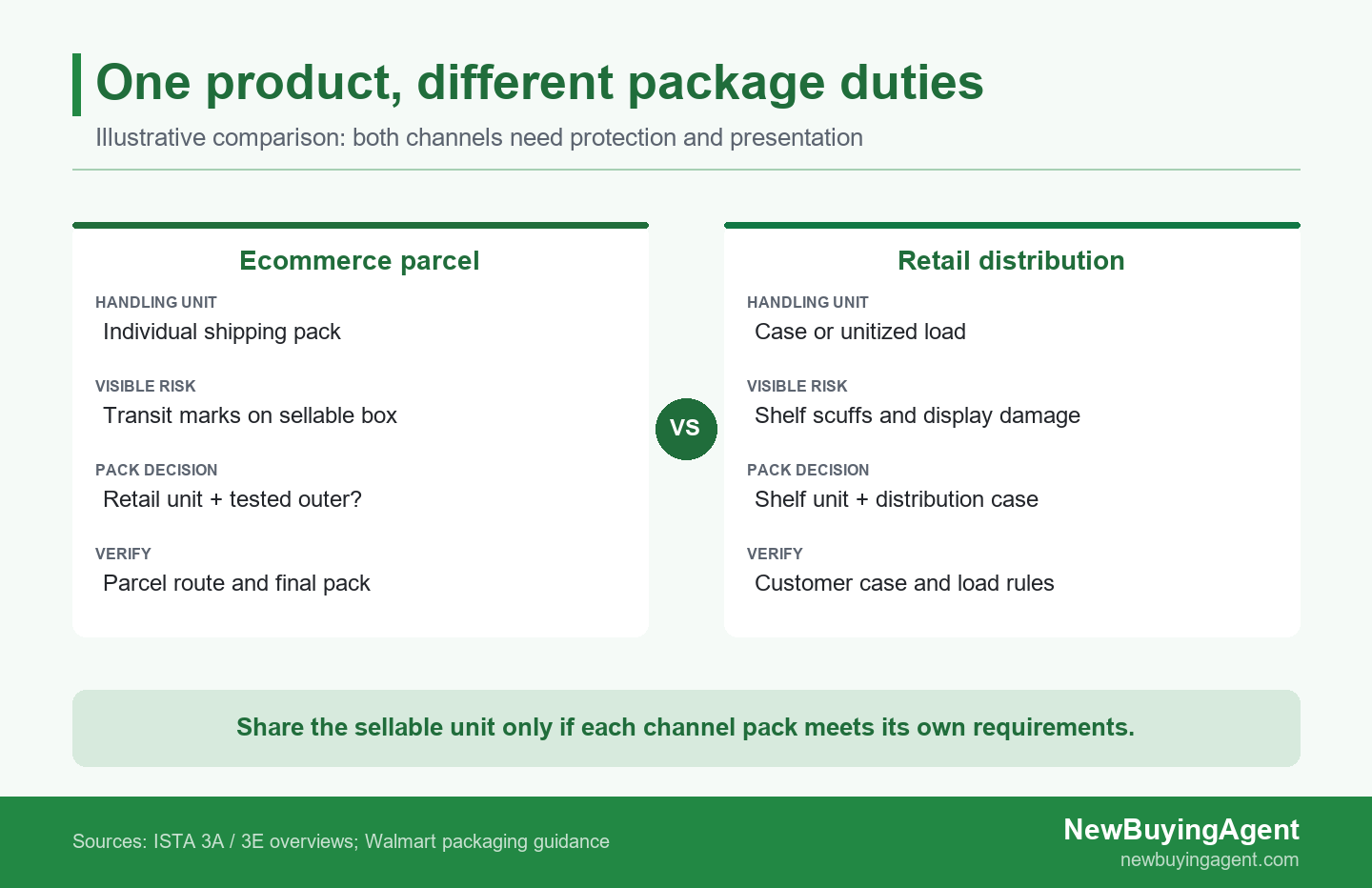
Match the complete package to its route, then protect the presentation that customers will see.
Compare packaging configurations on the same basis
The useful comparison is between complete packaging configurations, rather than a universal winner called ecommerce or retail packaging. Hold the product, quantity, destination and quoted service scope consistent, and separate physical exposure from presentation and operating consequences. The table below compares candidate designs qualitatively; it contains no measured performance scores, supplier endorsements or assumed cost savings. Actual customer requirements can eliminate an option before price becomes relevant.
| Pack | Handling | Display | Proof | Impact |
|---|---|---|---|---|
| Retail in case | Case / load | Shelf unit | Case / load spec | Parcel proof needed |
| Retail + outer | Parcel pack | Inner retail unit | Final parcel pack | Extra parts / labor |
| Shared ship pack | Exposed unit | Marks possible | Route + buyer OK | Fewer layers; limits |
| Channel packs | By channel | Own design | Each final pack | More pack stock |
Based on this comparison, a common retail unit plus a parcel outer is a practical candidate when clean shelf presentation matters and parcel protection is not yet demonstrated. Move toward a shared ship-ready unit if the actual route and customer accept it. Keep separate variants when the channels impose incompatible constraints and the benefit justifies the added inventory and control work.
A common unit does not require identical shipping materials everywhere. The product, insert and printed presentation box might stay the same, while the parcel outer differs from the retail distribution case. Make that distinction explicit in quotations so a lower price does not quietly remove the component that made an option suitable.
For a home-and-kitchen importer adding a retail line to an existing online range, NewBuyingAgent’s China factory network and product-development capability are relevant to keeping product and packaging choices connected. The brief should define the required shelf presentation alongside the product specification, so the packaging decision remains part of sourcing the actual range.
Dedicated versions also create a demand-allocation decision. If the retail customer changes an assortment or the online channel sells faster, excess printed packaging may be stranded in the slower channel. Ask which components can remain common and where differentiation can occur later, without assuming that the factory or fulfillment site offers a particular postponement service.
What changes the decision for a ceramic mug?
An illustrative ceramic-mug order from China shows how the same product can need different packaging decisions for store shelves and online replenishment. The proposed common unit is a printed presentation box with an internal insert; retail units travel in distribution cases, while online orders need an individual shipping configuration. The example is a decision exercise, not a NewBuyingAgent customer case or a report of measured damage performance, and its recommendation changes with the observed pack behavior.
Suppose the mug can rotate inside the presentation box and its handle approaches a side wall. Adding a larger outer does not itself explain how the handle will be restrained. The buyer should ask for a revised insert or other proposed restraint, then examine the assembled pack again before accepting it as the configuration for further evaluation.
This focuses on a useful protection principle: FedEx’s packing guidance advises enough cushioning to stop an item touching the box walls or moving around, without packing so tightly that the box bulges. It does not establish a universal insert design or cushioning thickness for every mug.
Now change the observation: the assembled pack restrains the product, but the printed box has no acceptable place for a shipping label and must arrive clean for gifting. A parcel outer remains a strong candidate even if the inner protection appears suitable. Confirm the revised complete pack through the agreed evaluation and inspect both product condition and box appearance; a simple movement check alone cannot establish transit performance.
If the buyer instead accepts an exposed shipping surface and obtains appropriate evidence for that configuration, a shared ship-ready design becomes worth comparing. The deciding facts are the actual protection and presentation requirements, not the label “ecommerce.”
Keep presentation and identification usable in both channels
Presentation and identification need approval on the assembled packaging, with all relevant labels, seals and sleeves in position. The retail buyer needs the intended display and checkout surfaces, while the ecommerce operation needs usable shipment identification and an acceptable customer opening experience. A flat artwork proof cannot show whether a flap, outer label or assembly choice covers information that matters after packing. Assign each required mark to the packaging level where it must be used.
For the sellable unit, GS1 US barcode placement guidance emphasizes a smooth printed surface, clear space around the barcode and avoiding package edges. Check the actual printed and assembled sample, including whether the code remains accessible for the operation that must scan it.
Keep a map of the consumer unit, distribution case and any other identified trade-item level. A shipping label has a different job from a product code used at checkout. Ask the relevant customer or fulfillment operation which identifiers it needs, where it expects them and whether extra visible codes could create ambiguity. Do not substitute a visually similar label for an approved identification requirement.
A Global Trade Item Number (GTIN) identifies a trade item; the applicable change rules depend on the packaging hierarchy and the change being made. The GS1 GTIN Management Standard requires new identification at affected higher packaging levels when case quantity changes. That rule does not itself require a new retail base-unit GTIN, so changing a distribution case should not automatically trigger a replacement consumer code.
For a pet-accessory brand replenishing online orders while preparing a retail assortment, packaging variants should remain tied to the approved product and label specifications. NewBuyingAgent’s product supply from China combines local factory resources with product-development and quality-control capability. Those strengths are relevant to sourcing the range with defined channel requirements; the buyer still needs to identify its own artwork and customer-approval authority.
Compare the delivered configuration and validate its limits
A meaningful quotation covers the configuration that will actually be packed and shipped, rather than an empty printed box. Use the same product, order quantities, destination, delivery scope and channel mix, then identify which costs are quoted and which remain estimates. This makes the comparison useful even before all inputs are known: an unpriced packing operation or unknown freight effect becomes a question to resolve rather than an assumed saving.
UPS explains dimensional weight in relation to the space a package occupies and its actual weight. A larger outer may therefore change billable weight without changing the product itself. Measure the final sealed package and obtain the applicable carrier or service quote instead of applying a universal divisor or assuming the product’s net weight determines freight.
Include the unit box, insert, outer, closures and packing labor in each quotation. Add storage and version-control consequences where they differ, and use observed or otherwise justified loss assumptions if comparing expected damage cost. Without suitable data, leave damage cost unknown. A material saving cannot establish a total saving while the freight or loss assumptions remain unresolved.
A marketplace may support shipping in the product’s own packaging, but acceptance is specific to the program and configuration. Amazon’s Ships in Product Packaging (SIPP) program gives FBA sellers the opportunity to test and certify products for delivery in their custom-branded packaging without additional Amazon packaging. A branded retail box does not qualify simply because it looks sturdy; verify the applicable participation and acceptance requirements.
Agree the evaluation with the relevant customer, program or competent test provider using the actual product, pack materials, closure and route. Define acceptable product condition and presentation before testing. Keep the report tied to that configuration, and assess whether later changes to the product, insert, box or pack-out require further evaluation. An overview document can help frame the question, but cannot replace the complete applicable procedure.
Give the factory a common specification with channel-specific instructions
The factory needs a common product specification and a separately identifiable packing instruction for each approved channel configuration. Keep the shared components explicit, then show exactly where the outer, quantity, identification or presentation requirements diverge. For repeat orders, link the released instruction to the purchase order so a familiar retail pack-out is not used for an individual parcel merely because the product itself is unchanged.
Use this release checklist as a starting brief. Fill the blanks with the actual approved references; an unanswered item remains a question for the named owner rather than permission for the factory to choose silently.
- Common unit: Product specification/revision ___; presentation box ___; insert and orientation ___; approved sample reference ___.
- Channel configuration: Retail or ecommerce ___; outer/case reference ___; pack quantity ___; closure and packing instruction revision ___.
- Destination requirements: Customer/program ___; current specification/version ___; required labels and placement references ___.
- Acceptance: Product condition ___; cosmetic condition ___; evaluation method/report and configuration reference ___; open issues ___.
- Release authority: Product/packaging approver ___; artwork/code approver ___; final channel instruction and order reference ___.
Before volume packing, compare an assembled unit and complete shipping pack with those references. Confirm the materials, orientation, component fit, closure, identification and visible presentation that the instruction requires. Record discrepancies and the agreed correction. Where a correction changes the evaluated configuration, decide what further evidence is needed before release rather than treating a new photograph as proof of equivalent performance.
If you are sourcing a repeatable product range in China for both channels, bring the product/specification, quantity, destination, timing and channel packaging requirements to NewBuyingAgent to discuss the product and channel requirements. These inputs support a scoped product-supply discussion that keeps the product, factory capability and approved packaging configuration aligned.
FAQ
Can we switch sales channels after the product is packed?
A packed product can switch sales channels only after its existing configuration is checked against the destination channel’s packaging and identification requirements. Keep the affected quantity separate while the buyer confirms whether an outer, new case arrangement or label change is needed. If repacking changes the approved configuration, obtain the required acceptance evidence before release; a product that is already packed is not automatically ready for another route.
Who should approve transit marks on a shared shipping box?
The buyer’s designated brand or packaging approver should define acceptable transit marks, subject to the receiving customer’s applicable requirements for the sellable pack. Record that cosmetic acceptance before evaluating a shared ship-ready box, alongside the product-protection criteria. A factory or packing operator should not decide that label residue, tape or scuffs are acceptable merely because the product inside remains usable.
Does changing the shipping carton require a new barcode?
Changing a shipping carton does not automatically require a new consumer barcode, but the affected packaging hierarchy must be checked against GS1 rules. Distinguish the retail unit from the distribution case and identify exactly what changed. Case quantity, dimensions and other changes have their own applicable rules, so keep the approved product and case records aligned instead of replacing every code together.
Can one test report cover different pack sizes and inserts?
A test report should cover another pack size or insert only when its documented scope or an accepted technical assessment supports that extension. Give the relevant test provider or approving customer the changed product-and-package details and ask what additional evaluation is needed. Similar appearance or a common material name does not establish equivalent protection, so keep unconfirmed variants outside the release covered by the report.
NewBuyingAgent
Related Resources


Get Started Today
Let's Turn Your Sourcing Goals into RealityWeChat:+86 15157124615
WhatsApp:+86 15157124615
Address:Building 10 #39 Xiangyuan Road, Hangzhou, China
