Direct-from-factory China sourcing sounds simple, but the phrase does not automatically prove a lower total cost, better quality, or safer delivery. It only describes where the offer claims to originate; buyers still need evidence around the product, factory cooperation, QC, packing, payment, and shipment.
Key Takeaways
- Direct-from-factory is not the same as risk-free: the buyer still needs proof of product version, quality, packing, documents, and delivery responsibility.
- Factory access has different meanings: it may mean direct production, factory trading office, industrial-cluster access, or a service that sources through factory resources.
- NewBuyingAgent's useful angle is outcome control: buyers provide purchasing needs and NewBuyingAgent uses local factory resources to supply China products with better price, quality, and service.
Direct-from-Factory Means Less Than Buyers Think
Direct-from-factory China sourcing usually means the buyer is trying to avoid unnecessary trading layers and obtain a better price. That can be useful. But the phrase does not answer the questions that determine whether the order will actually succeed: which product version is quoted, who controls sample changes, who checks quality, who owns packing risk, and which delivery term applies.
Based on our analysis, direct-from-factory is best treated as a claim that needs verification, not a complete sourcing strategy. A buyer can still receive a weak product from a real factory if the product is poorly specified, the QC rules are unclear, or shipment documents do not match the packed goods.
The key insight is that factory access is only useful when it improves the buyer's outcome. A real factory, an industrial-cluster partner, or a sourcing team with strong local factory resources can all be useful if the order becomes cheaper, clearer, safer, and easier to deliver. The label matters less than the evidence attached to the order.
Direct-from-factory claims should be tested before they become a buying model. Trade.gov due-diligence guidance supports verifying overseas partner claims, and Commercial Service background-check guidance shows why buyers need evidence beyond introductions and certificates.
The phrase also says little about the final landed outcome. The U.S. Harmonized Tariff Schedule is a reminder that product classification, documents, freight, and destination requirements can change the real cost after the factory quote.
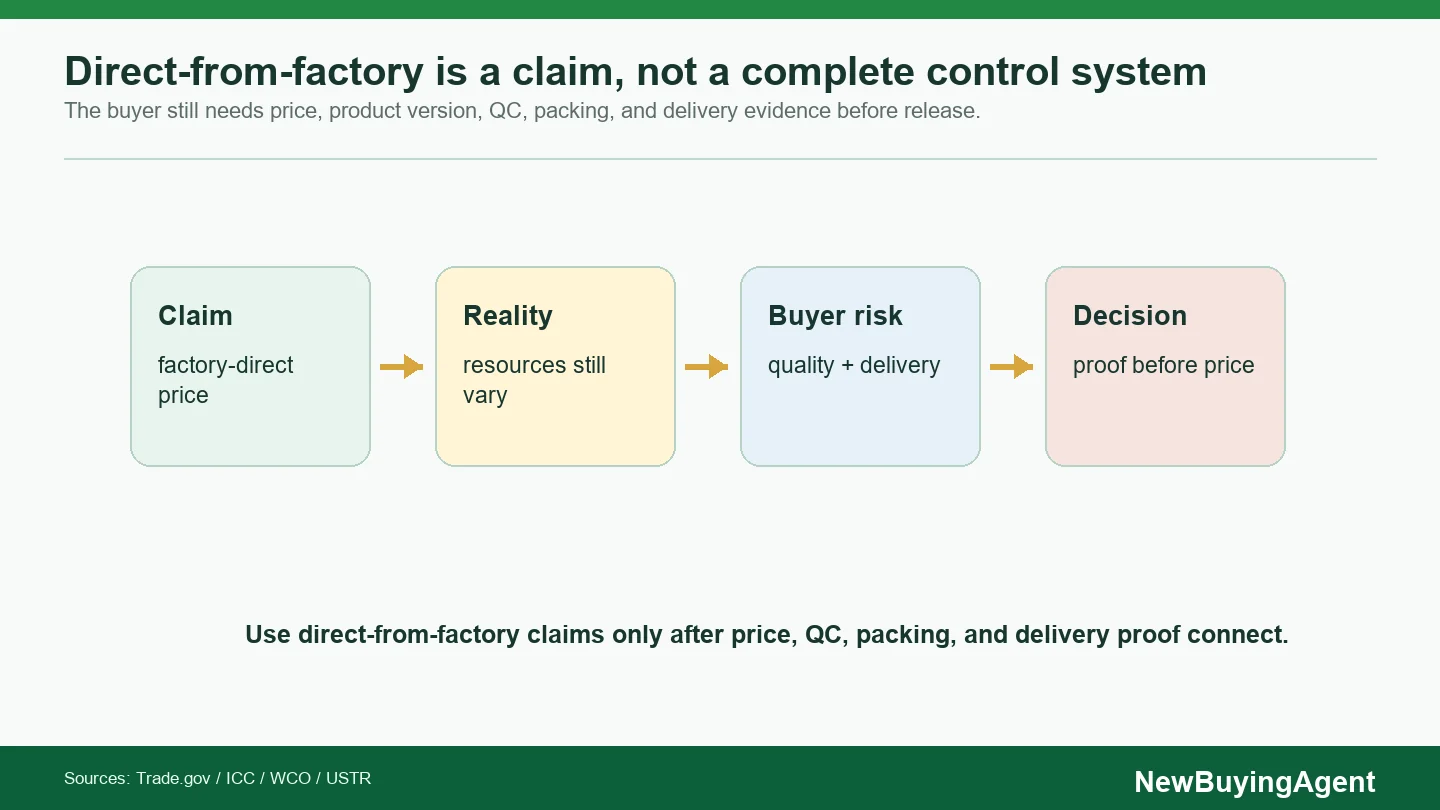
Direct-from-factory is useful only when price, version, QC, packing, and delivery evidence stay connected.
Four Meanings Behind Direct-from-Factory
The phrase can mean several different commercial situations. Buyers should clarify which one applies before comparing price.
| Phrase buyers hear | What it may mean | What buyers should verify |
|---|---|---|
| Factory-direct price | A quote came from a production-side source | Product version, MOQ, packing, and payment terms |
| Direct-from-factory service | The service claims to use factory resources without extra layers | Who controls sample, QC, documents, and delivery |
| No middleman | Fewer visible commercial layers | Whether coordination, rework, and logistics still have owners |
| Best factory price | A price claim before total cost is known | Usable product cost after defects, freight, duty, and delay |
It may mean the seller owns production
The buyer should still ask whether the quoted factory actually makes the specific product version or only part of it. Some factories are strong in one process but outsource coating, packing, accessories, or finishing. That can still work, but the buyer needs to know where responsibility changes hands before accepting a factory-direct claim.
This is the cleanest version of direct-from-factory. The seller manufactures the product or controls the production line. Even then, the buyer should verify capacity, product category fit, QC process, sample lock, and shipment records.
Factory ownership does not guarantee the right product. A real factory can still quote the wrong material, choose weak packing, delay production, or misunderstand destination-market requirements. The buyer should judge evidence, not only ownership.
It may mean the seller has factory access
This is common in industrial clusters where different factories specialize in related processes. A capable sourcing service may use those resources better than a buyer could from overseas. The useful test is whether the service can control the product path, negotiate cost, and produce QC evidence, rather than whether every step is performed under one visible factory roof.
Sometimes direct-from-factory means the seller works closely with factories or sources through local factory resources. That can still be valuable if the service improves price, quality, cooperation, and delivery, but it should not be confused with buyer-visible factory choice.
NewBuyingAgent fits this reality because its value is local factory-resource access and product/QC capability. Buyers do not need to manage every factory conversation; they need a China-sourced product outcome that fits price, quality, market demand, and delivery needs.
What Direct-from-Factory Does Not Prove
It does not prove the lowest total cost
The decision rule is to compare the cost boundary. A factory-direct quote may exclude inland freight, export handling, packing upgrades, inspection, document correction, or destination delivery. If a second quote includes those items, the higher number may actually be closer to the buyer's real landed cost.
A factory-direct price may be lower at the unit level, but total cost includes tooling, sample revisions, inspection, packing, inland freight, export handling, international freight, duty, documents, delay, and receiving problems. A buyer should compare total delivered cost, not only ex-factory price.
According to ICC Incoterms rules, delivery terms define responsibilities, costs, and risks. That means a factory-direct EXW quote may look cheaper than an FOB or DDP quote while leaving more cost and coordination on the buyer.
It does not prove quality control
Quality control is an evidence system. The buyer should know what is checked before production, during production, before packing, and before shipment. If the factory-direct claim does not name the inspection standard, sample reference, defect rule, and release owner, the buyer is still exposed even when the manufacturer is real.
A factory can make the product and still fail to control the version the buyer approved. Quality control requires sample reference, defect categories, inspection timing, rework rules, and release decisions. The buyer should ask what evidence appears before balance payment or shipment.
According to Trade Department special-document guidance, certain products may require certificates for standards, safety, or health. For sourcing buyers, the broader lesson is that product evidence must be tied to the exact order, not treated as a generic claim.
It does not prove delivery reliability
Delivery reliability is especially important for buyers selling into seasonal, project, or retailer-driven channels. A factory can finish production on time and still create delay if cartons are mislabeled, documents are inconsistent, freight space is not booked, or destination delivery requirements are misunderstood. Direct communication does not automatically solve those handoffs.
Direct factory communication may still leave packing, carton marks, freight booking, documents, and destination receiving unclear. Delivery reliability depends on more than production completion. It depends on whether the goods are packed, documented, and handed off correctly.
According to Trade Department shipping guidance, shipping choices affect cost and timing. Buyers should ask how the factory or sourcing service prices freight assumptions and what happens if carton data, pallet method, or delivery timing changes.
When Direct-from-Factory Works Well
Direct-from-factory works well when the buyer has stable specifications, a proven factory, category knowledge, inspection access, and logistics support. It is also useful when the buyer controls the product standard and only needs production capacity.
The buyer can write production-ready requirements
Production-ready requirements should be specific enough for another team to inspect the goods without asking the buyer what they meant. Photos help, but they are not enough. The brief should name measurable requirements, unacceptable substitutions, packing rules, and the decision point where the buyer can reject or release the order.
The buyer should be able to define material, size, finish, tolerance, packaging, labeling, accessories, testing, inspection rule, and destination requirement. If the buyer can do that clearly, direct factory communication becomes easier and less risky.
If the buyer cannot define those requirements, direct-from-factory may simply move the guessing to the factory. The resulting quote can be cheap because it excludes important assumptions rather than because it is truly more efficient.
The factory relationship is already stable
Stability should be proven by repeated orders, not assumed from one successful shipment. The buyer should know how the factory behaves when a defect appears, when the raw-material price changes, or when delivery is tight. A stable relationship includes corrective action and communication discipline, not only a friendly sales contact.
A proven factory relationship makes direct sourcing more realistic. Repeat orders, stable product versions, good payment history, and predictable shipment requirements reduce the need for outside coordination.
Even then, the buyer should keep a release checklist. A stable relationship can still drift when raw materials change, labor is tight, production slots move, or price pressure pushes the factory to adjust details.
Where NewBuyingAgent Fits the Direct-from-Factory Conversation
NewBuyingAgent should not be understood as merely handing buyers a factory name. Its stronger fit is helping global buyers turn purchasing requirements into China-sourced products through local China factory resources, cost negotiation, product development/QC capability, flexible payment support, and delivery coordination.
If your goal is direct-from-factory pricing but you also need quality and delivery confidence, use NewBuyingAgent's China product supply service when you have a product need ready for quotation. If you already use a factory, compare the factory-management route when the existing supplier relationship needs China-side management to protect production progress, quality evidence, payment timing, and delivery outcome.
What to Verify Before Accepting a Direct-Factory Claim
Verify the product version
Version control is the foundation of direct-from-factory sourcing. The buyer should keep the approved sample, quote, drawing, packing file, and inspection checklist connected. If the production team changes a component, finish, carton, or accessory without updating the file, the buyer may be comparing a price for one product while receiving another.
The buyer should ask what exact product version the price covers. That includes material, size, finish, accessories, packing, labels, carton quantity, and acceptable defects. If the version is not locked, the price cannot be compared.
According to Trade Department export-document guidance, correct documents help goods clear efficiently. For direct-from-factory sourcing, the same discipline should start before shipment: product records, packing lists, and invoices should describe the same goods.
Verify the cost boundary
The cost boundary should state exactly where the supplier's responsibility starts and ends. Buyers should confirm whether the quote includes sample charges, tooling, upgraded packing, inspection, inland freight, export declaration, international freight, duty, destination delivery, and document corrections. A direct-from-factory price is useful only after those inclusions and exclusions are visible.
The buyer should ask which costs are included and excluded: sample, tooling, packing upgrade, inspection, inland freight, export declaration, international freight, duty, destination delivery, and document correction. The cheapest quote may simply leave more work to the buyer.
According to the WCO Data Model, structured trade data helps align customs and logistics records. In practical sourcing, structured data also prevents cost surprises because the buyer can see exactly what product, carton, and shipment information has been priced.
Send a Brief That Tests the Claim
Before accepting any direct-from-factory claim, prepare a brief with product specs, quantity, target price, destination, timing, packing, QC expectation, and delivery term. Ask what evidence will be available before deposit, production release, balance payment, and shipment.
For buyers with existing suppliers, the same brief can reveal whether the problem is factory capability or China-side management. If the factory is good but coordination is weak, NewBuyingAgent's factory-management route can keep communication, staged quality control, logistics, and payment evidence connected to the same delivered product outcome. If the factory itself is weak, the brief helps identify a better supply path.
If those answers are unclear, send the same brief through NewBuyingAgent's purchasing inquiry channel and ask for a quote-to-supply response. The goal is not to chase a slogan. It is to confirm whether factory resources can produce a better delivered outcome.
FAQ
Does direct-from-factory mean the lowest price?
No. Direct-from-factory can reduce visible layers, but the lowest unit price may exclude packing, QC, freight, documents, rework, or delay cost. Buyers should compare total delivered cost and usable product, not just the first quoted number.
Is direct-from-factory safer than using a sourcing agent?
Not automatically. Direct sourcing can be safe when the buyer has product expertise, a proven factory, inspection access, and logistics control. A sourcing agent may be safer when the buyer needs local factory resources, QC evidence, payment support, or delivery coordination.
How can buyers verify a factory-direct claim?
Buyers should verify product version, factory capability, quote assumptions, sample record, QC plan, packing method, payment terms, and shipment documents. The claim is useful only when it connects to evidence that protects the order.
Can NewBuyingAgent provide direct-from-factory sourcing?
NewBuyingAgent uses local China factory resources to supply products from China, but the buyer-facing value is the delivered product outcome: price, quality, market fit, payment comfort, and delivery confidence. Buyers provide requirements; NewBuyingAgent builds the sourcing path.
NewBuyingAgent
Related Resources

Commencer aujourd'hui
Transformons vos objectifs d'approvisionnement en réalitéWeChat:+86 15157124615
WhatsApp:+86 15157124615
Adresse : Bâtiment 10 #39 Xiangyuan Road, Hangzhou, Chine