

A Chinese supplier can show a large registered capital figure and still have contributed little of it. Registered capital is what the shareholders committed at registration; paid-in capital is what they have actually paid in. The gap between the two numbers is published, and it is the number to read before a deposit moves. A buyer who checks only the registered figure is trusting a commitment that may not be funded.
Registered capital is the total amount the shareholders of a Chinese company commit to contribute, recorded at registration with the market regulator. Paid-in capital is the amount they have actually contributed so far. The two answer different questions: registered capital shows the scale of the commitment, and paid-in capital shows how much of it is funded. Read both together and judge the gap against the value of the order.
What Buyers Should Actually Verify About a Supplier's Capital
Registered capital is the amount a Chinese company committed at registration and paid-in capital is the amount its shareholders have actually contributed. Read both, because a large registered figure with little paid-in capital is an unfunded commitment rather than money the supplier can spend on the order. Both figures are published by the same market regulator, so the check takes minutes.
- Best for: importers, brands and sourcing teams about to place a first order or pay a deposit with a Chinese supplier.
- How it works: verify the legal name and unified social credit code, read both figures from the official credit system and the annual report, then judge the gap against the order exposure.
- Key advantage: the commitment and the funded amount are separated, so a strong registered figure cannot be mistaken for cash.
- Decision: size the deposit against the funded figure and the order, and release the balance against inspection evidence.
- Risk: a gap is normal inside the contribution period, so it should raise verification rather than end the order by itself.
Registered Capital vs Paid-In Capital: What Each Figure Means
Registered capital is the total amount the shareholders commit to contribute, recorded at registration. Paid-in capital is the amount they have actually contributed so far. The two are different questions about the same company rather than two labels for one number. Registered capital describes the scale of the entity and the commitment its owners made; paid-in capital describes how much of it is funded. Because both are published together, the gap is a checkable number.
The distinction is written into Chinese law. The Company Law of the People's Republic of China, revised in December 2023 and effective 1 July 2024, sets out the registered-capital and contribution rules for limited liability companies, including that shareholders must pay in their subscribed contributions within five years of establishment. The registered figure is a commitment with a funding deadline; the paid-in figure records how far the company has moved toward it. Reading only the first number means reading the promise, not the funding.
The transition for existing companies was set by an implementing regulation. The State Council release on the regulation implementing the registered-capital management system states that a company's remaining period to pay in its subscribed capital must be adjusted to within five years. That is why an older supplier can show a registered figure its paid-in figure has not caught up with. The deadline explains the gap, not the prepayment.
Because the capital record describes the company rather than its production, it helps to see how a Chinese manufacturer is organised. The China manufacturing and product guide explains how product development, tooling and production stages relate.
What Each Figure Proves, and What It Cannot
Registered capital proves the commitment and the scale the entity registered. Paid-in capital proves how much of that commitment is funded. Neither is a cash-flow statement, a production record or a delivery record, which is why they are read together. The table below sets the two figures against the questions a buyer is actually asking.
| Question the buyer is asking | Registered capital | Paid-in capital | What the answer means |
|---|---|---|---|
| What is it? | Amount committed at registration | Amount actually contributed | Two different figures, not one |
| What does it prove? | Entity scale and commitment | Funded part of the commitment | A commitment is not cash |
| What can it not prove? | Money in the bank | Operating cash flow | Also check the delivery record |
| Where is it verified? | Official credit system and annual report | Official credit system and annual report | Use the official record, not a PDF |
Use registered capital for who the supplier is and what it committed, and paid-in capital for how much of it is funded.
A capital check works best next to a factory review. NewBuyingAgent's product-supply service pre-vets factories for price, quality and qualifications using local China factory resources.
What Registered Capital Proves
Registered capital identifies the entity, the scale it registered and the commitment its shareholders made. It also sets the amount the contribution rules apply to, which is why the figure appears on the business licence and in the official record. It does not show money in the bank, production capacity or a delivery record. A high registered figure shows the owners committed to a scale; it does not show that the money exists or that the order will ship.
The registration side is itself regulated, which is why the figures are consistent across companies. The State Council regulation on implementing the Company Law's registered-capital registration management system sets the registration and transition arrangements for registered capital and paid-in capital disclosures. Because both figures come from the same regime, a buyer can compare them across suppliers.
Registered capital is a commitment made at a point in time. A company can amend it, and a company inside its contribution period can carry a registered figure well above what is funded.
What Paid-In Capital Proves
Paid-in capital shows how much of the commitment the shareholders have actually contributed, making it the closer of the two figures to funded capital. It is still not operating cash flow and does not prove current financial health; a supplier can have fully paid-in capital and still be short of working capital for a large order. It shows how much of the owners' commitment has moved into the company and how much remains an unfunded promise.
The useful reading is comparative. Paid-in capital close to registered capital means most of the commitment is funded. A paid-in figure far below the registered figure means a large part is outstanding, which is normal inside the contribution period and more important when the buyer funds a large share of the order first.
Where to Verify Both Figures in China
Both figures are published by China's market regulator in the National Enterprise Credit Information Publicity System, so a buyer can verify them from the official record and the annual report instead of relying on a document the supplier sends. A licence scan is not a substitute for reading the record directly.
The system is run by the regulator, not a private data provider. The Credit Supervision Department of the State Administration for Market Regulation states that it builds and manages the National Enterprise Credit Information Publicity System. That is why the registered and paid-in figures sit in one record with the shareholders and the annual report.
In practice, the record is authoritative for registration data and silent on financial performance; it will not say whether the supplier is profitable or has capacity this quarter.
Reading the National Enterprise Credit Information Publicity System
Searching the official credit system by the supplier's legal name or unified social credit code returns the registered capital, the paid-in capital, the shareholders and the annual report. Match the contracting entity to the record first, then read the figures. A search by a trading name or brand name can return a different company, and a near-identical name is the easiest way to check the wrong supplier.
The identifier that removes the ambiguity is the code on the licence. The State Administration for Market Regulation explains the Unified Social Credit Code as the code that identifies a market entity. Because the code is unique to the entity, matching it against the contract and the quotation removes the risk of reading a similarly named company's record.
Read the two figures with the annual report. The report shows the shareholders and the contribution information the company has filed, so a paid-in figure that has changed since the last report reads as a trend.
Reading the Gap Between the Two Figures
The gap between registered and paid-in capital is the unfunded part of the shareholders' commitment, and its meaning depends on how much of the order the buyer is being asked to fund before delivery, not on a fixed ratio. A gap alone is not a verdict; it becomes a decision input when read against the deposit, the payment schedule and the delivery record.
The reason a gap can be legitimate is the contribution period. The official question-and-answer release by the Ministry of Justice and the State Administration for Market Regulation explains that limited liability company shareholders must pay their subscribed contributions within five years of establishment. A company still inside that period can show a registered figure the paid-in figure has not reached, and that is consistent with the rules.
The decision rule is to treat the gap as a reason to change the payment terms, not a reason to walk away: the larger the gap relative to the order, the smaller the first payment.
Decision Rules: When the Gap Changes the Payment
Because the two figures are read together and the contribution rules set a funding deadline, the buyer can convert the gap into a deposit size, a payment schedule and a release condition tied to the order exposure. The rule is not a fixed percentage of paid-in capital but a comparison between what the buyer funds before delivery and how much of the commitment is funded.
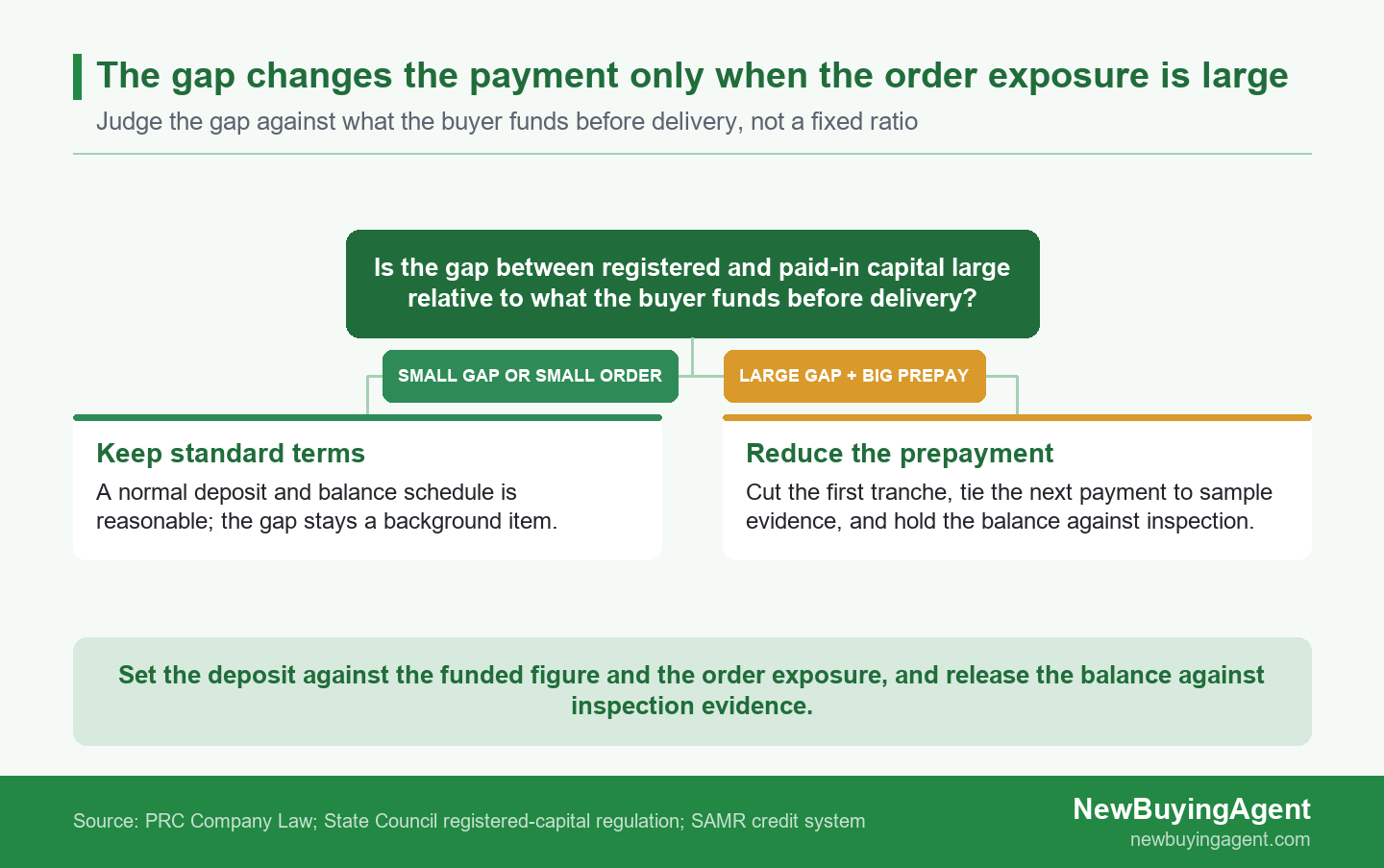
Decision branch showing a large registered-versus-paid-in gap leading either to standard terms on a small order or to a reduced prepayment on a large order
The contribution deadline keeps the gap in proportion. The ICLG Corporate Governance report for China explains that the current PRC Company Law requires limited liability company shareholders to pay in their subscribed capital within five years of subscription. A supplier inside that window is funding its commitment on a schedule, so the gap is not a defect. A supplier near or beyond the deadline with a large remaining gap is a different case.
Three settings follow. When paid-in capital is close to registered capital and the order is small, a standard deposit and balance schedule is reasonable. When the gap is large but the order is small, keep the deposit modest and release the balance on inspection evidence. When the gap is large and the prepayment substantial, reduce the first tranche and hold the final balance against inspection.
For a supplier already in use, the same rules apply through a standing relationship. NewBuyingAgent's existing-factory management service keeps China-side communication, production follow-up and quality checks on the supplier while payment and release stay tied to the evidence.
Worked Example: A Deposit That Outran the Paid-In Capital
Test the requested deposit against the funded figure and the order exposure before it is paid, and replace a strong registered figure with a verified funded figure as the basis for the decision. In the example below, the registered figure looks reassuring and the funded figure changes the terms.
Illustrative Example: RMB 10,000,000 Registered, RMB 1,500,000 Paid In
In this illustrative example, a consumer-goods brand is placing a first order with a new Chinese supplier that quoted a competitive price and asked for a 30% deposit before production. The order is 8,000 units at a USD 6.50 target unit price, about USD 52,000 of goods value, with a requested deposit of about USD 15,600. The supplier has sent a licence and a quotation, but the buyer has not checked the official capital record and has no inspection history with this supplier.
The business licence shows a registered capital of RMB 10,000,000, which reads as strong on its own. The official record shows paid-in capital of RMB 1,500,000, so most of the registered commitment is not yet funded. The requested deposit is small against the registered figure and a meaningful share of the funded figure. With no delivery history, the deposit, tooling and first-batch material would move more value than the funded capital alone would support if the order failed.
The decision is to keep the order moving but hold the full deposit until the legal identity and capital record are verified and the terms are reset against the order exposure. The corrective action is to verify the legal name and unified social credit code against the official record, read both figures from the credit system and the latest annual report, reset the deposit to a smaller first tranche tied to sample and pre-production evidence, and release the balance against inspection evidence.
Before the balance is released, the buyer confirms the inspection evidence against the approved sample. After the first order, the buyer reviews the supplier's delivery and quality record before loosening the terms. This illustrative example invents no measured value and no passed test. A verified capital record is not a guarantee of delivery or quality.
Put the Verified Record and the Payment Condition Into the Supplier File
Put the verified legal name, the unified social credit code, both capital figures and the payment and release condition into the supplier file and the RFQ. The capital check and the order decision are then approved together, and the payment terms are tied to evidence rather than to a quotation. The file records what was checked and when, so a repeat order starts from the last verified record.
The registration fields that go into the file come from a standardised regime. The State Council release describes the regulation standardising the registration management of market entities in China, so one supplier-file template can be reused across suppliers.
For a supplier about to receive a deposit, prepare the supplier's legal name or unified social credit code, the product and specification, the order quantity, target unit price, order value, destination and delivery timing. NewBuyingAgent can use its local China factory resources and factory pre-vetting for price, quality and qualifications to check the registration and capital record, then quote and follow the order against the agreed payment and release conditions. With those details ready, send the supplier name and order details to NewBuyingAgent.
Frequently Asked Questions
Is a large registered capital figure a sign of financial strength?
Not on its own; registered capital is the amount the shareholders committed, and the figure to read next to it is how much of that commitment has actually been paid in. A large registered figure with a small paid-in figure is an unfunded commitment, not cash. The funded figure is the closer of the two to money the company controls, and even that is not operating cash flow.
Where can I check a Chinese supplier's capital figures?
Use the National Enterprise Credit Information Publicity System run by China's market regulator, search by the legal name or unified social credit code, and read the registered and paid-in figures together with the latest annual report. Match the entity first by code, then read the figures. The system is free and official, so a licence scan or a supplier summary is not a substitute for opening the record yourself.
Is a low paid-in capital an automatic red flag?
No; a gap is normal for a company still inside its contribution period, and it matters most when the buyer is asked to fund a large share of the order before delivery. The gap becomes a decision input when it is compared with the deposit and the order value, not when it is judged against a fixed ratio. A large gap with a large prepayment calls for a smaller first tranche and more evidence before the balance.
Does the five-year contribution rule apply to suppliers registered before the new law?
The transition rules give companies set up before the current Company Law took effect time to adjust their contribution period, so the deadline depends on when the company was registered and what its current articles say. Read the current registered and paid-in figures together and ask the supplier what its remaining contribution period is, rather than assuming every gap is a problem.
NewBuyingAgent
Related Resources


ابدأ اليوم
دعنا نحول أهداف التوريد الخاصة بك إلى واقعWeChat:+86 15157124615
WhatsApp:+86 15157124615
العنوان: مبنى 10 #39 طريق شيانغيوان، هانغتشو، الصين
