

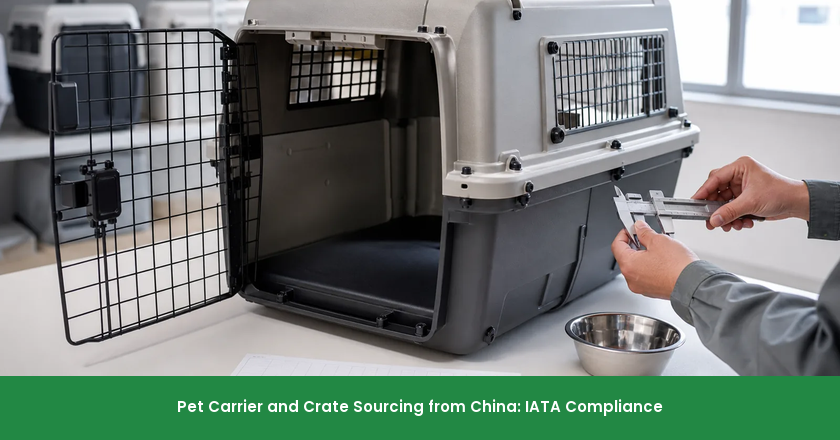
The current IATA Live Animals Regulations edition has been in effect since January 1, 2026.
A China-sourced pet carrier is not made travel-ready by an “IATA approved” label. It needs three separate gates to be clear: the physical crate must match the relevant container standard, the operating airline must accept the actual route and travel mode, and the origin, transit, and destination requirements must be checked independently. The current IATA Live Animals Regulations framework places container suitability alongside welfare, handling, and transport conditions; it is not a retail product badge.
Decide which evidence you have before you buy
- Start with the journey: name cabin or hold travel, the airline, the route, and every transit point before asking a factory to quote a carrier.
- Measure the inside: a retail size name or exterior carton dimension does not show whether the animal has the required usable space.
- Control physical changes: the shell, door, fasteners, ventilation layout, floor, labels, and water-access arrangement need an approved version and production evidence.
- Keep the decisions separate: a factory can support the product gate. It cannot certify airline acceptance or country entry on the buyer's behalf.
What IATA compliance means when you source a pet carrier
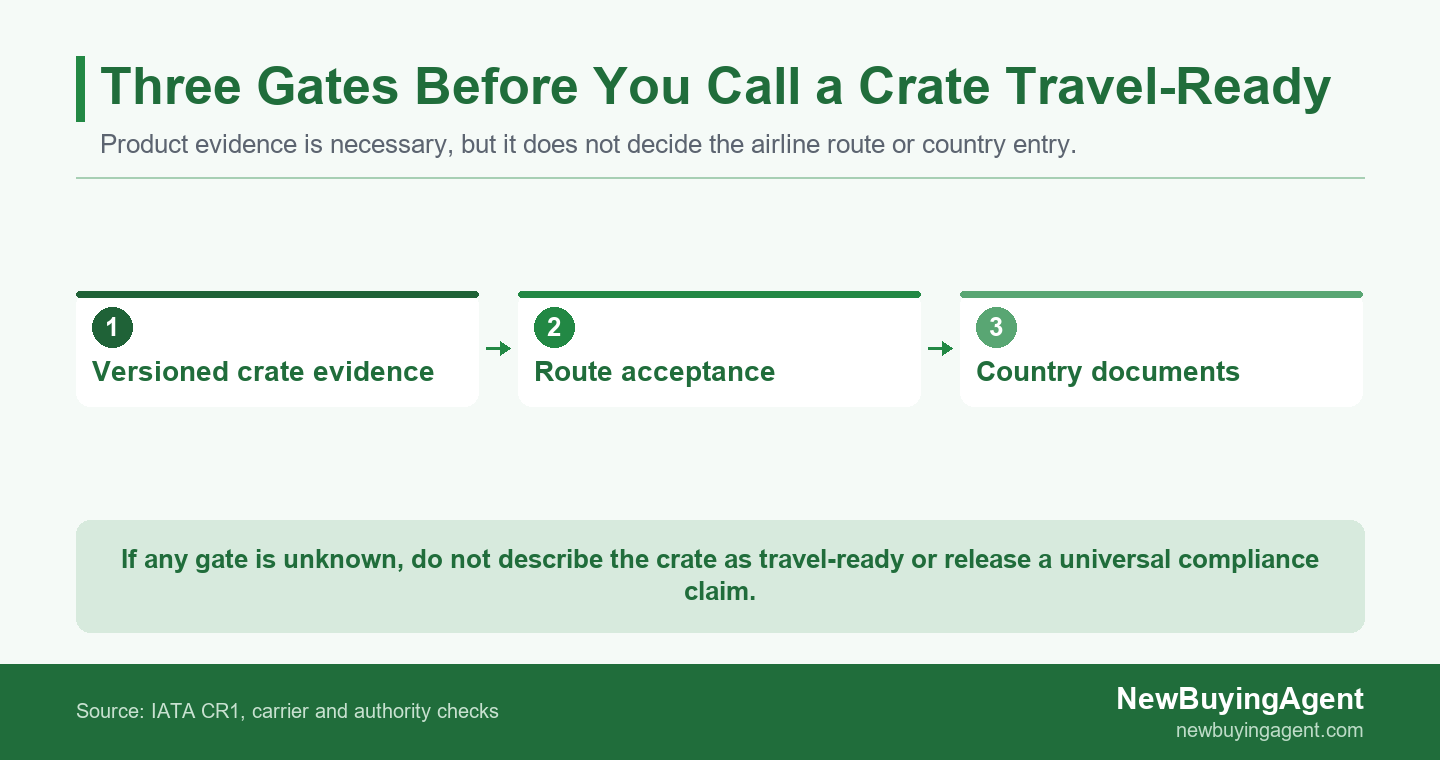
A factory can verify the product gate. The airline and destination or transit authorities own the other two decisions.
For domestic dogs and cats, the relevant IATA Live Animals Regulations (LAR) material includes Container Requirement 1 (CR1): written air-transport container requirements for dogs and cats. The important limit is explicit: IATA does not certify, approve, endorse, or sell any particular commercial pet container manufacturer, brand, make, or model. A supplier can therefore show that its design is intended to meet specified requirements; it cannot truthfully turn that into a universal IATA certification.
That distinction changes the purchase order. Instead of asking for an “IATA-compliant crate” as a single line item, ask for a versioned drawing, the intended travel mode, the animal-size range, the physical features to be checked, and the airline rule that matters to the route. The label is only a starting hypothesis. The evidence is the buyer's decision tool.
A factory claim cannot replace a route decision
CR1 itself lists state and operator variations. An operator variation means an airline's additional rules or different carriage requirement for a particular route, service, mode, or date. The practical effect is visible in carrier guidance: Cathay Cargo's pet-travel guide, for example, says that a foldable container fixed by a removable pin will not be accepted and excludes wooden cages. That does not create a universal rule for every airline; it shows why a China factory should never be asked to promise universal acceptance.
Before approving a sample, record the airline, whether travel is in cabin or hold, the departure and transit airports, the destination, and the expected flight date. If any of those change, the route gate should be reopened. A product that looks close to a prior approved crate may be wrong for a different carrier or mode.
Cabin and hold use create different briefs
Cabin travel is not simply a smaller version of hold travel. CR1's in-cabin section allows some construction exceptions, yet the IATA in-cabin guidance says individual carriers may impose additional or more stringent policies. A soft-sided carrier may be considered for a specific cabin journey, but it is not a substitute for a rigid hold-travel crate and should not be sourced on the assumption that every airline will accept it.
Put the travel mode at the top of the request for quotation. It determines which features are relevant, the permitted carrier envelope, and which party must confirm the final decision. This is especially important when one factory uses a shared shell design for retail, cabin, and hold-oriented SKUs.
Source the crate as a controlled product
A useful supplier brief turns the standard into measurable product evidence. It names the SKU, version, intended travel mode, internal dimensions, shell material, joining method, door construction, ventilation pattern, floor, handles, spacer arrangement, required labels, and the images or measurements needed before and during production. That is more reliable than asking for an undefined airline-approved product because the factory can quote, sample, and inspect each point.
For a new product request, the work begins with the product record rather than a marketplace listing. Buyers who need help converting those details into a supplier-facing request can use NewBuyingAgent to review a new pet-carrier sourcing brief; the service handoff should still state that airline and authority confirmation remain with the relevant decision makers.
Specify usable internal dimensions, not a retail size label
The dimension method is a useful guard against exterior-size quoting. IATA's traveller guidance defines A as nose to tail-root length, B as ground to elbow, C as shoulder width or the widest point, and D as natural standing height. For one animal, the published minimum internal dimensions are length A plus one-half B, width C multiplied by two, and height D plus bedding. The animal must still be able to stand, sit erect, turn normally while standing, and lie in a natural position.
The same IATA traveller guidance says to reconfirm at least 48 hours before departure.
Use the largest animal that will travel in the SKU when gathering the measurements. If an illustrative dog measures A = 62 cm, B = 24 cm, C = 28 cm, and D = 55 cm, the calculation produces a minimum internal length of 74 cm, internal width of 56 cm, and internal height of at least 55 cm plus the bedding allowance. This is not a substitute for the airline's final rule, but it tells the factory what the drawing must show. A quote that reports only “size L” or an exterior shell length leaves the critical space unverified.
Control the features a production change can quietly alter
Physical details matter because they can change between a photo, a sample, and a production lot. The 2026 CR1 material addresses smooth interiors, nose- and paw-proof openings, suitable materials, a solid leak-proof floor, door strength, hardware, ventilation, spacers, and handles. It also states that total ventilated area must be at least 16% of the total surface of the four sides, with ventilation on all four sides. For two-part plastic containers, the source says plastic clips must not be the only fasteners holding the halves together and recommends metal nuts and bolts in every hole. Read the CR1 construction requirements against the intended product version rather than against a supplier's general brochure.
Turn those requirements into evidence points a factory can actually supply: a dimensioned internal drawing; close-up photos of shell joints, door pins, and ventilation openings; material and mesh detail where applicable; a view of the floor and water-access arrangement; and a sample identifier linked to the production SKU. For a broad manufacturing reference on making these product controls clearer, see how to build a China-ready product specification.
Keep product, airline, and country checks separate
The three-gate model avoids a misleading all-in-one compliance claim. IATA's cargo Live Animal Acceptance Checklist asks about arrangements with participating operators, transit regulations, permits, container size, ventilation, construction, handling devices, labels, and other information. The container is necessary evidence, but it is only one part of the acceptance sequence.
The IATA LAR scope also separates government regulations, carrier regulations, reservations and routing, documentation, container requirements, and handling. That is why product evidence, airline acceptance, and destination documents should remain three gates in the buyer brief. The LAR overview is a useful map of those distinct inputs; the buyer must still check the authority and airline applicable to the actual origin, transit points, destination, and date.
| Gate | Evidence to collect | Who decides it | What a China factory can prove |
|---|---|---|---|
| 1. Product | Versioned drawing, internal dimensions, construction photos, sample record, and production traceability | Buyer and product team | Whether the manufactured crate matches the agreed physical specification |
| 2. Airline route | Carrier policy, travel mode, aircraft or service limits, booking and transit conditions | Operating airline or its authorised process | Only the product facts the airline will need to assess |
| 3. Country documents | Origin, transit, and destination requirements, health and travel documentation, and any permits | Relevant government authorities | Nothing beyond accurate product information where it is requested |
Based on this comparison, a passed sample clears only the product gate. Do not describe the crate as travel-ready, promise an airline outcome, or release a universal compliance claim while the route or document gate is unknown. That boundary protects the animal, the buyer, and the factory from a claim no single party can substantiate.
Work through a sample-to-production conflict
The most useful production question is not whether a crate “looks compliant.” It is whether the item now being made can still be tied to the approved product evidence. The following illustrative order separates the diagnosis from the release decision so the buyer can contain only the scope that changed.
Keep the changed units separate until the physical evidence catches up
A global pet-products buyer is sourcing travel crates from a China factory for a defined hold-travel program. An illustrative 480-unit order across four crate SKUs was approved from one physical sample per size before production. The buyer has a draft product specification and a target carrier route but has not authorised final packing.
The approved sample used through-bolts around the two-part rigid shell, while 120 production units used clips as the only shell fastener. The production photo showed a revised ventilation tooling pattern that had not been compared with the approved sample or the route brief. The factory file retained exterior retail sizes but did not record the approved internal dimensions for each SKU. The issue is not a cosmetic deviation. The physical evidence is now tied to a different product version, so the factory cannot use the original sample as proof for the affected 120 units.
Use a conditional release, a limited decision to progress only the traceable scope that has passed the agreed checks: hold the 120 changed units, keep the remaining traceable units separate, and do not make an airline-ready claim until the changed construction and measurements are checked against the route-specific brief. Restore the approved fastening method or obtain a newly reviewed versioned sample, record internal dimensions and ventilation layout, and bind photos to the SKU and production batch.
If you already work with a China manufacturer, NewBuyingAgent can help align crate production with your existing China factory around the buyer's defined controls.
Release the held units only after a physical comparison confirms the agreed shell fastening, internal dimensions, door, ventilation, and labelling points; then reconfirm airline and document requirements for the actual route. Illustrative example only. It does not predict an airline decision or state that a specific fastening method is acceptable for every carrier.
Prepare the buyer brief before production
A complete brief aligns the product, airline-route, and destination-document gates before production. Send the factory or sourcing team the intended travel mode and airline, route and transit points, animal measurement range, SKU-level internal dimensions, versioned sample images, shell and door details, ventilation layout, floor and water-access requirements, required labels, quantity, and the date by which the carrier decision must be reconfirmed.
Set one clear rule for the factory: no substituted clips, hardware, mesh, ventilation tooling, or dimensions without written buyer review against the current product version. Record which production units share each approved version, and require the final photo set to show the actual SKU, the lot or batch reference, and the physical feature being checked. That small traceability step matters when a replacement part, a new mould, or a different assembly method appears after a sample was accepted. It lets the buyer isolate a changed scope instead of guessing whether the whole order still matches the brief.
Then decide what must be inspected before final packing and what information is available only from the airline or authority. If the route details, sample photos, SKU list, and order quantity are ready, the resulting sourcing brief can make the factory handoff clearer without claiming to replace an airline, veterinary professional, or government authority. send your crate specification for a China-side review.
Frequently Asked Questions
Is an IATA-approved pet carrier a real certification?
No—an IATA-approved pet carrier is not a universal certification because IATA does not approve commercial brands or models. A supplier may show a design and supporting measurements, but the buyer should treat that as product evidence to compare with the applicable standard and the actual airline rule. The airline remains responsible for deciding whether the journey can be accepted.
How should I calculate a dog or cat crate size?
Use the animal's actual body measurements and calculate the internal crate dimensions, then check that the animal can stand, sit erect, turn while standing, and lie naturally. For a single animal, IATA's published method uses A plus one-half B for length, twice C for width, and D plus bedding for height. Treat the result as a measured product requirement, not a retail size label.
Can a soft-sided carrier be used for cabin travel?
Possibly, but only if the operating airline accepts it and the carrier meets the requirements for that in-cabin journey. IATA's in-cabin guidance notes that soft-sided containers can compress under a seat, which can reduce ventilation. Confirm the airline's permitted dimensions, material, ventilation, and booking conditions before sourcing a cabin-oriented SKU.
What evidence should a China factory provide before production?
Request a versioned drawing, internal dimensions, material and fastener details, ventilation layout, door and floor photos, sample approval record, and SKU or batch traceability plan. Add the intended travel mode and route to the buyer brief, but keep airline acceptance and destination documents as separate checks. That record gives the factory measurable work without asking it to promise a decision it cannot make.
NewBuyingAgent
Related Resources

ابدأ اليوم
دعنا نحول أهداف التوريد الخاصة بك إلى واقعWeChat:+86 15157124615
WhatsApp:+86 15157124615
العنوان: مبنى 10 #39 طريق شيانغيوان، هانغتشو، الصين
